Gen AI usage as superintendent – Reflections from Google – AASA ITC

For emphasis I am sharing a few use cases for Generative AI in this blog post

All content is actually my own and content from speakers (with their consent) via AI tools (glasses, iPad, phone, & other).

I took my “bespoke” notes – that were enhanced, reviewed, proofread and modified by various Gen AI tools and finally, with a prompt to Gemini, Using Canvas and 2.5Pro – see the prompt (unedited)

Is this a good blog post for my post? I’m Mike lubelfeld from mikelubelfeld.edublogs.org, Today, we are at GooglePlex in Mountain View, California. We are greeted by a Google For Education quote that reads, “Elevate education with simple, flexible, and secure tools.” The entire atmosphere is positive, composed, future-oriented, and innovative. I have visited GooglePlex before, and each experience has been as exceptional or more so than the previous one. From the imaginative furniture, billiards, micro and macro kitchens, G-Bikes, and the rich history to the electrifying energy of each learning session, the visit to Google is truly inspiring.

Then Gemini gave insights and feedback and a few suggestions for improvements – I then prompted Gemini to make the suggested edits … here is the Human inspired, Gen AI improved, blog post!

Okay, Mike, here is a revised version of your blog post draft incorporating the suggestions. I’ve focused on improving flow, clarifying the use of AI tools, adding structure with headings (using markdown), and slightly refining phrasing for conciseness and clarity.


Reflections from GooglePlex: AI, Innovation, and the Future of Education

(By Mike Lubelfeld, mikelubelfeld.edublogs.org)

Greetings from GooglePlex in Mountain View, California! Stepping onto the campus, we were immediately met with a powerful Google For Education quote: “Elevate education with simple, flexible, and secure tools.”This set the tone for an experience steeped in a positive, future-oriented, and innovative atmosphere. Having visited GooglePlex before, each visit seems to surpass the last – from the imaginative furniture and G-Bikes to the palpable energy in every learning session, it’s truly inspiring.

Our District’s Journey with Google Tools

Our school district has been leveraging Google’s tools for some time now, starting when Gemini was still known as “Bard.” As a Google For Education Advanced Workspace district, we actively employ a suite of tools including Gemini, Google’s NotebookLM, Vids, Veo, Deep Research, AI Studio, and more. Google is clearly concentrating heavily on generative AI, and the rapid advancements and daily improvements across their tool suite are remarkable.

This post, much like previous reflections, aims to share personal insights, journal entries, and “experience sharing” about the lessons learned and their broader implications.

Session 1: AI in Practice & What it Means for Education

Our day kicked off with an engaging session titled “AI in Practice & What it Means for Education.” We started with a light-hearted LLM exercise involving “sniglets.”

A sniglet is a word that isn’t in the dictionary but perhaps should be – often humorous and describing something nameless. We used Gemini (Gemini.Google.Com) with a prompt asking it to act as a superintendent and compose two humorous, education-related sniglets. (Sharing these creative outputs was a fun icebreaker!)

From there, we dove into the evolution of generative AI, tracing the path from traditional programming to neural networks and today’s large language models. A key moment highlighted was Google’s introduction of the Transformer (the “T” in GPT) back in 2017. Now, in 2024, we’re firmly in the era of multi-modality – integrating text, images, video, and audio. It was fascinating to hear how technology, like Osmo equipping computers with a sense of smell, is attempting to replicate human senses to better support us.

AI Adoption: Students vs. Teachers

We discussed the current landscape of AI adoption. A 2024 Digital Education Council report indicated that 86% of students are using AI tools. However, this usage contrasts sharply with teacher adoption rates. According to Education Week in October 2024, only 36% of teachers nationwide reported using AI tools. This gap highlights a critical area for professional development and support.

We also watched and discussed the impressive video “Airhead Made by Shy Kids,” created using OpenAI’s Sora video generation model, prompting thoughts on creative potential and ethical considerations.

Google’s Approach: AI Principles and Tools

Google emphasized its core AI principles: pursuing bold innovation while ensuring responsible development and deployment, fostering collaborative progress, and maintaining a sense of togetherness.

We explored SynthID, Google’s tool for watermarking AI-generated content, a crucial aspect of responsible deployment. The discussion centered on AI as a tool – like a hammer or calculator – and how we can create conditions where it effectively enhances learning and solves problems of practice, rather than simply being a novelty.

This led naturally to the importance of metacognition: understanding how we know what we know. In an age where knowledge is ubiquitous, developing the critical skills to discern, interpret, and effectively learn how to learn is paramount for our students.

Deep Dive: Harnessing NotebookLM

One tool we’ve explored extensively over the past few months is NotebookLM.Google.com. Building on insights from a previous post, we explored innovative ways to leverage this powerful resource.

As a practical demonstration, I used one of my own blog posts as a “source” within NotebookLM:

  • Source URL: https://mikelubelfeld.edublogs.org/2025/04/28/learnings-from-the-unfinished-unlearning-leader-112leads/

Using this source, NotebookLM helped generate an audio podcast summarizing the key takeaways.

Beyond NotebookLM, we also touched upon Deep Research and Gemini Canvas, which offer promising approaches for initiating research, coding, and fostering collaborative learning.

Peeking into the Future: Project Astra and AI Glasses

Looking ahead, Project Astra, a Google initiative exploring the future of AI assistants, was captivating. The potential integration with hardware like Google Glass, combined with multi-modality, hints at a revolutionary shift in human-computer interaction.

Real-World AI Application: Transcribing and Summarizing with Multiple Tools

Here’s a practical example of integrating AI tools during the event:

  1. Capture: I wore my Even Realities AI Smart Glasses during a session (with the presenter’s consent). I used the glasses’ Transcribe feature, which displayed the text on the lens in real-time and saved the full transcript via Bluetooth to an app on my phone.
  2. Initial Summary (Gemini): I copied the raw transcript from the Even Realities app and pasted it into Gemini (using the 2.5 Pro Experimental version) with a prompt to “summarize.”
  3. Refined Summary (ChatGPT): I then took Gemini’s summary and input it into OpenAI’s ChatGPT 4o-mini, prompting it to “make a concise summary of this summary of a meeting transcript suitable for inclusion in a blog post.”

Below is the AI-assisted, multi-step generated summary:

The discussion explores how generative AI is reshaping the workforce, drawing comparisons to past technological advancements such as the automobile and the personal computer, which disrupted certain jobs but also created new opportunities. Key points include:

  • AI and Jobs: AI may automate up to 30% of work hours, but like previous technologies, it is expected to create more jobs by shifting the types of roles available, particularly in areas requiring human skills.
  • Future-Ready Skills: Essential skills for future success include critical thinking, communication, creativity, adaptability, and social-emotional intelligence, referred to as “durable skills.” These are vital for navigating AI-driven changes.
  • Teaching Future Skills: Educators emphasize methods like project-based learning (PBL) and self-assessment to foster durable skills. Real-world PBL examples include adaptive technology creation and community collaboration projects.
  • Google’s Educational Initiatives:
    • Grow with Google: Offers career certificates and AI courses.
    • Be Internet Awesome: Teaches digital citizenship and AI literacy to younger students.
    • AI Quests: A gamified program helping middle schoolers build AI models for social good.
  • Partnership Ideas: Suggestions for Google included integrating digital citizenship in Google Classroom, addressing tech access gaps, and offering simulations for practicing durable skills.

This summary underscores the importance of adapting education to future workforce needs, where AI and human-centered skills intersect.

The Future of Education: Policy and Learning Science

Policy is evolving rapidly. As of our meeting (late April 2025), 26 US states have formal AI policies for education, while 24 do not. Google shared insights on creating impactful AI tutors, grounding their work in 5 Learning Science Principles:

  1. Inspire Active Learning
  2. Manage Cognitive Load
  3. Deepen Metacognition
  4. Stimulate Curiosity
  5. Adapt to Learner

Evaluating AI tools against these principles provides a meaningful framework, especially from an education perspective focused on privacy, data security, and responsible use.

We also got a glimpse of Project Mariner, an experimental “agentic” workflow automation tool designed to assist after research is completed. Imagine this workflow: a student submits a quiz, AI provides rubric-based feedback, an email goes to the parent, and an action plan is co-created with the student. This isn’t science fiction; it’s becoming reality.

Developing Skills: Google for Education Programs

Google highlighted resources available for educators and students:

  • General Resources: Edu.google.com
  • Professional Development: Training & Certifications
  • Digital Citizenship (Grades 2-6): Be Internet Awesome
  • Leadership Development: AASA & Google ELP Partnership (Ed Leadership Program)

Session 2: Fostering a Culture of Innovation

Konner Brewer, Google Product Manager and Stanford Lecturer, led a fantastic session on Google’s culture of innovation. A key takeaway was Project Aristotle, Google’s internal research which found that psychological safety is the single most important factor for high-performing, innovative teams.

Google’s values underpin this:

  • Respect the User: Understand their deep needs.
  • Respect the Opportunity: Act responsibly with resources.
  • Respect Each Other: Foster psychological safety.

The session drew heavily from the Stanford “d.school” design thinking elements:

  1. Need finding: Empathize (understand the verb – e.g., “I need to hydrate“) and Define (avoid locking into a solution too early – e.g., “I need a glass of water”).
  2. Leveraging: Ideate based on existing strengths and resources.
  3. Failing Fast: Prototype and Test small, learn quickly, and iterate.

Another AI Application: Audio Transcription and Summarization

For another insightful session, I used a different AI workflow:

  1. Capture: Recorded the audio using the Apple iOS Voice Memo app.
  2. Transcription: Used the Apple Intelligence feature within the Notes app to transcribe the audio recording.
  3. Initial Summary (Apple Intelligence): Used Apple Intelligence within Notes to summarize the lengthy transcript.
  4. Refined Summary (Gemini): Finding the Apple summary less concise than desired, I pasted the full transcript into Gemini 2.5 Pro Experimental for a more condensed summary.

Here is the Gemini-generated summary of the 50-minute session on innovation:

  • Psychological Safety is Key for Innovation: Google’s Project Aristotle found psychological safety (feeling safe to take risks/be vulnerable) is the most critical factor for effective teams, more vital than individual high performers. Innovation needs a blameless culture focused on learning from failures.
  • Google’s Innovation Principles: Respect the user (understand deep needs, like the Oreo story example), respect the opportunity (act responsibly), and respect each other (foster psychological safety/diverse voices).
  • Embrace Failure & Quantity: Innovation has a high failure rate (~95%). Google learned from failures (Loon, Glass). Generating many ideas (quantity yields quality) via methods like 20% time (Gmail’s origin), incubators, and external ventures is crucial.
  • Design Thinking Framework:
    • Need Finding: Start with the user need (verb), not a pre-defined solution (noun). Understand real challenges (student engagement, change resistance).
    • Leveraging: Utilize existing resources/skills (like Hermès moving from saddles to bags via leather skills).
    • Failing Fast: Test ideas quickly/small scale, learn, iterate (Google’s “dogfooding”).
  • Real-World School Examples (Glen, NJ Superintendent):
    • Mr. Rogers Project: Paired students needing experience with businesses needing social media help.
    • Swim Lessons/Lifeguarding: Identified unmet needs and built programs incrementally.
    • Farmer’s Market: Leveraged school space/student interest for entrepreneurial opportunities (“Pirate Pickles”).
  • Overall Message: Successful innovation in education requires deep need understanding, safe experimentation environments, leveraging resources, learning from failure, starting small, and community connection.

Wrapping Up: GooglePlex Tour and Reflective Thoughts

The day also included a walking tour of the GooglePlex global headquarters – always a highlight! The serene grounds, history, outdoor art, and intentional building design (even a dinosaur!) offer much to absorb.

This was an action-packed, high-energy, heavy-thinking day with a ton to unpack and process! I’m energized to bring back numerous ideas, affirmations, and opportunities for growth to our organization. A huge thank you to AASA and Google for this incredible experience.

Next up on the journey: our visit to Stanford… stay tuned for more!

Thanks for reading! What are your key takeaways or questions about AI and innovation in education right now? Share your thoughts in the comments below!


From AASA The Public Education Promise – Our Future is BRIGHT

AASA Initiative for All Children

Screenshot from Presentation

I just returned from the 2025 National Conference on Education from the AASA, the American Association of School List of the Public Education PromiseAdministrators. The title and theme was  Future Driven Leadership. They announced the Public Education Promise, see images below. There were hundreds of impactful presentations, exhibitors, thought leader sessions, panel discussions, presentations, opportunities for networking and socializing, and more. It’s an annual opportunity for superintendents to recharge their batteries and refuel their leadership toolkits! This year’s conference, my 15th, was powerful and impactful.

Each year upon return, I share resources with members of my leadership team, I write blog posts like this one, and I reflect on how to affirm practices which are working, change practices that are not working, and eliminate tried but failed practices. Each year I aim to do a better job as a leader than I did in the past year. Each month I endeavor to be more effective and impactful than I was in the last month. Each week I leverage skills acquired and knowledge gained to be a better version of myself. And each day I aim to be just a little bit better than I was yesterday.

Reflecting upon the magnitude of “public education” and all that’s “going on” – I often step back and look into the past (distant, mid-level, or recent) for perspectives on the present so that I may create and contribute to the creation of conditions for our collective future.

Currently, in March 2025, there are a lot of discussions about the future of the United States Department of Education as well as policies, laws, practices, and philosophies on behalf of our nation’s youth. As a life long public school educator (teacher, administrator, scholar, author, speaker, consultant, etc.), for decades, I have been a student of politics, economics, sociology, anthropology, social science research, ed-tech, and global relations.

Our future is as bright today as it ever has been.

fun AI Image

We are edu superheros

That’s right – our future is as bright today as it ever has been.

Last week thousands of leaders from all over the United States and Canada assembled at the National Conference on Education. Our Executive Director unveiled the latest future focused mission, the Public Education Promise, the American Dream in Action:

prioritize student centered learning

teach the new basics: real skills for real life

attract, hire, retain and reward the best employees

building highly engaged family and community partnerships

measure what matters

You see – whatever the political winds blow in our out, whatever changes may or may not be in your local context, our future is bright and we are united in purpose – across ideologies – to support our nation’s youth through public education.

We can absolutely address and improve upon each of the principles of this call for action. Together we can endeavor to measure what matters to demonstrate success, growth, learning, and excellence of our youth and our teachers. Together we can re-narrate our present and end the educator shortage. Together we can build and rebuild community partnerships and family/school relations.

We can seek guidance like that from the World Economic Forum’s Jobs report as we ensure we are teaching the needed basic skills for real life. We must always prioritize student focused learning!

Graphic of the CHANGE leadership framework from Lubelfeld/Polyak

CHANGE Leadership Framework from our new book

With the power of generative artificial intelligence (see multiple posts on this blog about this topic), to current and clear research/evidence that shows us how to lead through conflict, change, trauma, and strife, we CAN  and we WILL and we MUST advance the promise of public education.

If you are an educator and you are a bit overwhelmed, skeptical, tired, frustrated, or angry – I get it – we all get it!! But – please don’t fret and please don’t think “it’s never been this bad” or “we’re doomed” … we are not doomed. We can and we will recover to positive, productive, collaborative, and united approaches for our youth and via public education.


Inspirational Message

Improve, remain Unfinished and willing to unlearn and relearn

I leave you with a blog post I reprinted in 2014 about the “additional demands” put upon us in public education – as a people, as a society, as an association, let’s partner with our communities, our boards of education, our local and state lawmakers on behalf of children and society – let’s answer our executive director’s call for a renewal of the American Dream via the Public Education Promise!

For context and reflection, I share this post From my old blog – February 2014…

The Ever Increasing Burden on America’s Public Schools BY JAMIE ROBERT VOLLMER

The content in this blog post comes from Jamie Robert Vollmer

I saw Jamie at the Illinois Superintendent Conference last fall and I follow him on Twitter, and his messages, information, and publications are worth a closer look! As we prepare for some school Transformation in our district, I thought it relevant and timely to share Jamie’s brief history of US Education! Enjoy …

ML

The Ever Increasing Burden on America’s Public Schools

BY JAMIE ROBERT VOLLMER

America’s public schools can be traced back to the year 1640. The Massachusetts Puritans established schools to: 1) Teach basic reading, some writing and arithmetic skills, and 2) Cultivate values that serve a democratic society (some history and civics implied).

The founders of these schools assumed that families and churches bore the major responsibility for raising a child. Gradually, science and geography were added, but the curriculum was limited and remained focused for 260 years.

At the beginning of the twentieth century, however, politicians, academics, members of the clergy, and business leaders saw public schools as a logical site for the assimilation of immigrants and the social engineering of the citizens—and workers—of the new industrial age. They began to expand the curriculum and assign additional duties. That trend has accelerated ever since.

From 1900 to 1910, we shifted to our public schools responsibilities related to
• Nutrition
• Immunization
• Health (Activities in the health arena multiply every year.)

From 1910 to 1930, we added
• Physical education (including organized athletics)
• The Practical Arts/Domestic Science/Home economics (including sewing and cooking)
• Vocational education (including industrial and agricultural education)
• Mandated school transportation

In the 1940s, we added
• Business education (including typing, shorthand, and bookkeeping)
• Art and music
• Speech and drama
• Half-day kindergarten
• School lunch programs (We take this for granted today, but it was a huge step to shift to the schools the job of
feeding America’s children one third of their daily meals.)

In the 1950s, we added
• Expanded science and math education
• Safety education
• Driver’s education
• Expanded music and art education
• Stronger foreign language requirements
• Sex education (Topics continue to escalate.)

In the 1960s, we added
• Advanced Placement programs
• Head Start
• Title I
• Adult education
• Consumer education (purchasing resources, rights and responsibilities)
• Career education (occupational options, entry level skill requirements)
• Peace, leisure, and recreation education [Loved those sixties.]

In the 1970s, the breakup of the American family accelerated, and we added
• Drug and alcohol abuse education
• Parenting education (techniques and tools for healthy parenting)
• Behavior adjustment classes (including classroom and communication skills)
• Character education
• Special education (mandated by federal government)
• Title IX programs (greatly expanded athletic programs for girls)
• Environmental education
• Women’s studies
• African-American heritage education
• School breakfast programs (Now some schools feed America’s children two-thirds of their daily meals throughout
the school year and all summer. Sadly, these are the only decent meals some children receive.)

In the 1980s, the floodgates opened, and we added
• Keyboarding and computer education
• Global education
• Multicultural/Ethnic education
• Nonsexist education
• English-as-a-second-language and bilingual education
• Teen pregnancy awareness
• Hispanic heritage education
• Early childhood education
• Jump Start, Early Start, Even Start, and Prime Start
• Full-day kindergarten
• Preschool programs for children at risk
• After-school programs for children of working parents
• Alternative education in all its forms
• Stranger/danger education
• Antismoking education
• Sexual abuse prevention education
• Expanded health and psychological services
• Child abuse monitoring (a legal requirement for all teachers)

In the 1990s, we added

• Conflict resolution and peer mediation
• HIV/AIDS education
• CPR training
• Death education
• America 2000 initiatives (Republican)
• Inclusion
• Expanded computer and internet education
• Distance learning
• Tech Prep and School to Work programs
• Technical Adequacy
• Assessment
• Post-secondary enrollment options
• Concurrent enrollment options
• Goals 2000 initiatives (Democrat)
• Expanded Talented and Gifted opportunities
• At risk and dropout prevention
• Homeless education (including causes and effects on children)
• Gang education (urban centers)
• Service learning
• Bus safety, bicycle safety, gun safety, and water safety education

In the first decade of the twenty-first century, we have added

• No Child Left Behind (Republican)
• Bully prevention
• Anti-harassment policies (gender, race, religion, or national origin)
• Expanded early childcare and wrap around programs
• Elevator and escalator safety instruction
• Body Mass Index evaluation (obesity monitoring)
• Organ donor education and awareness programs
• Personal financial literacy
• Entrepreneurial and innovation skills development
• Media literacy development
• Contextual learning skill development
• Health and wellness programs
• Race to the Top (Democrat)

This list does not include the addition of multiple, specialized topics within each of the traditional subjects. It also does not include the explosion of standardized testing and test prep activities, or any of the onerous reporting requirements imposed by the federal government, such as four-year adjusted cohort graduation rates, parental notification of
optional supplemental services, comprehensive restructuring plans, and reports of Adequate Yearly Progress.

It’s a ponderous list.

Each item has merit, and all have their ardent supporters, but the truth is that we have added these responsibilities without adding a single minute to the school calendar in six decades. No generation of teachers and administrators in the history of the world has been told to fulfill this mandate: not just teach children, but raise them!

© 2011 Jamie Vollmer | To purchase this list in poster form or to invite Jamie to speak visit www.jamievollmer.com


Quote about the future and need to unlearn

Unlearn – Relearn – Grow/Change

Reflections from Montgomery – A Superintendent’s Notes

Understanding Defining Moments in History

Montgomery, Alabama | September 17-19, 2024
Fall Symposium of the National Superintendents RoundtableCover of briefing book

As a proud member of the National Superintendents Roundtable (NSR), I looked forward to our fall conference in Montgomery, Alabama. With a mission focused on “Leadership for Just and Humane Schools,” the NSR, alongside the Schlecty Superintendent Leadership Network, brings together 85 superintendents committed to advocating for the future of public education. This conference emphasized the significance of civics education—an essential component for understanding our nation’s complex history.

Our host, Dr. Melvin Brown, Superintendent of Montgomery Public Schools, welcomed us to a city steeped in both the legacy of the Confederacy and the Civil Rights Movement. Montgomery, a city of contrasts, was the perfect setting for

Superintendent Roundtable Members Panel

Panel of Members – Discussion

exploring the contradictions and realities of American history. Here, in a school system serving 26,000 students, we confronted the unresolved tension between the 1954 Supreme Court decision in Brown v. Board of Education and the lived experience of desegregation, which for Montgomery, only began in earnest during the 1970s. While the law declared the end of segregation, reality played out differently, and the deep divides of the past remained unresolved for decades.

As a lifelong advocate for student voice, choice, and empowerment, I found myself reflecting deeply on the impact of these historical legacies on today’s education system. Our schools are, and must always be, for students—no exceptions.

Three Profound Sites of American History

The heart of this symposium was our visit to three deeply impactful historical monuments:

The Freedom Monument Sculpture Park (April 2024)
The Legacy Museum: From Enslavement to Mass Incarceration (2018)
The National Memorial for Peace and Justice (2018)

In front of Freedom Monument Sculpture Park Wall of NamesThese landmarks tell an unfiltered story of America, starting from pre-Columbian history through the African and African American experiences. They challenged us to reckon with the harsh truths of slavery, systemic racism, and the ongoing consequences of mass incarceration.

The Equal Justice Initiative (EJI), founded by Bryan Stevenson, operates the Legacy Museum and National Memorial for Peace and Justice. EJI has been at the forefront of documenting the intersection of racial injustice, from slavery to modern-day inequalities. Learning about their work and walking through these spaces was emotionally overwhelming yet essential.

At the Freedom Monument Sculpture Park, we were immediately faced with the brutality of colonialism. I found myself reflecting on the devastating impact European exploration and colonization had on both Indigenous and African peoples. Walking through this park, located by the serene Alabama River, was a stark contrast to the brutality it documented. I realized how disconnected my previous understanding of history had been, shaped largely by sanitized textbooks that glossed over the horrors of our past.

The Domestic Slave Trade and Unseen Realities

One of the most startling realizations during this trip was learning about the domestic slave trade that thrived in the United States after the transatlantic trade was abolished in 1808. I hadn’t fully grasped how the demand for enslaved labor

Sculpture

Depiction of bondage and suffering

persisted, especially in building the Southern railway systems. As a history teacher, I taught about slavery—but never truly taught about it. Now, I find myself asking: What is my obligation as an educator to teach authentic and real history?

Equally disturbing was the realization of how deeply Northern banks profited from the Southern economy, showing that slavery wasn’t just a Southern institution—it was an American one.

Emancipation and Its Complex Legacy

The common narrative we often hear is that the Emancipation Proclamation freed the enslaved. Yet, in reality, the Proclamation only declared freedom for those enslaved in Confederate states still rebelling against the Union in 1863. It took the 13th Amendment, ratified in December 1865, to legally end slavery in the United States. The legacy of that struggle, from Reconstruction to Jim Crow, has left a profound and lasting impact on our nation’s journey toward racial equality.

The visit to the National Memorial for Peace and Justice was perhaps the most sobering of all. Walking through the steel monuments bearing the names of over 4,400 lynching victims, I was confronted with a history I hadn’t fully absorbed before. The legacy of racial violence and terror extends far beyond what many of us learned in school, and the psychological damage it inflicted is immeasurable.

Close Up

Victims of lynching from one county

Personal Reflection and Call to Action

This journey wasn’t just an opportunity to learn—it was a moral reckoning. I’ve often said that students have only one chance to experience the grade they’re in, and it’s our duty to make their time with us meaningful. Now that I’ve confronted these truths, I have to ask myself: What will I do with this knowledge?

What will I do?
What will you do?
More importantly, what will **we** do, now that we know?

As educators and leaders, it’s our responsibility to empower our students, activate their voices, and offer them choice, agency, and engagement. If we’re to inspire, innovate, and engage, we must do so with a full understanding of where we’ve been as a nation and where we need to go.

I encourage all who read this to visit Montgomery, Alabama.

Our nation’s future depends on it.

Close up of monument quote

Quote on the monument of remembrance

Community Collaboration Marker - Communities are coming to terms with their history

Memorial to victim of lynching – part of community awareness project

Holiday Greetings – Multi-Lingual Video – Supt Message

“When there is teamwork and collaboration, wonderful things can be achieved.” – Mattie Stepanek, American Poet

December 2023

Dear North Shore School District 112 Parents/Guardians and members of the Community, 

Happy Holidays! As the calendar year ends and we prepare for a well-deserved winter break starting after school on Thursday, I’m sharing a note of gratitude, information, and a fun video animation. To create the festive and inclusive video, Enrique Castro, our coordinator for ESL and Bilingual Programs, recorded “happy holiday” greetings from our students representing each of the 30 home languages spoken by our families. Thank you to our families, students, Mr. Castro, and the EL teacher team!

As you may already know, in District 112, we take great pride in supporting diverse cultures, languages, and backgrounds. 


LINK TO VIDEO 

As we take time to reflect on our time in District 112, we are proud to acknowledge that we have accomplished a great deal this year.  We are optimistic that our future is going to be bright and exciting. The important work we do puts our children on the path to success. Some highlights of our successful work include the following:

  • Historic construction projects continue with support from the community
    • Completion of Phase 1 of the Long-Range Plan (Edgewood opened April 2023)
    • Indian Trail and Ravinia School Construction is underway and ongoing
  • Sixth-year of staff, student, and family culture/engagement data collection & growth
    • Even with some “survey fatigue,” we are getting great feedback on what we are doing well and what we need to work on – thank you!
      • Top rated item from the Family Survey, “Teachers treat me with respect” 4.64 out of 5.00
      • Top rated item from the Student Survey, “I have friends at school who care about me” 4.45 out of 5.00
  • Improvements in PK-8 Learning
    • Last year’s state assessments showed our students were in the 81st and 90th percentiles in English and math, respectively, compared to all students in IL
  • Increased mental health interventions
    • Wellness webinars with the Cook Center for Human Connection

We look forward to a fantastic year in 2024! 

With regards,

Mike

Michael Lubelfeld Ed.D.
Superintendent of Schools

Part 4 of 4 – Final Reflections from Conference on Education – A Nation at Risk

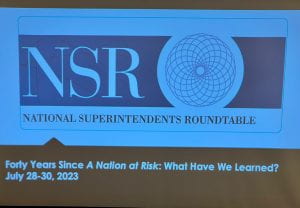
In this fourth of four blog posts illustrating forty years of educational reforms in the United States since the publication of A Nation at Risk in 1983, I am proud to reinforce some of what I knew, know, and plan to do! The report gave a start to decades of educational reforms that helped to cause a national obsession with standardized test results. Some of the momentum has been great in terms of causing an awareness of what it means for a school system to educate each child every day — some of the momentum has been horrible in terms of causing people who score “less than proficient” to be looked upon as illiterate.
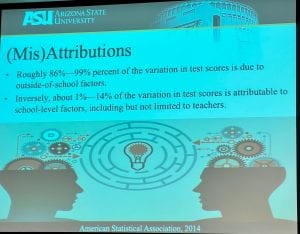
So … in a nation where soundbites rule and folks no longer read a lot of content, except for readers of this blog – of course! On a five-point scale, for example, in Illinois, at the end of year high stakes assessment, students who score a 4 or a 5 are labeled “proficient,” and anyone with a 3, a 2, or a 1 is NOT. And if you are NOT proficient, the narrative calls for you and for your school to become failures.

I know this sounds kind of dramatic, and I know it sounds overly simplified — and it is –, but that’s what 40 years of “reforms” and an obsession with standardized test scores to rate and rank the nation’s public schools have yielded. Make no mistake, I am all for accountability, and I preside over a public school district where I want each

Worthy of review and discussion especially 40 years past the “reform” movement …

child to be proficient in all of the standards (knowledge, skills, performance indicators). I absolutely understand the need for academic measures to show the public they are getting a positive return on their investment of public tax dollars, and in my district, I’m proud to report that they are.

My issues are that one score at one point in time does not accurately reflect or show the actual quality of education of the school or of the district. The child with a score of 3 (in the above example), for example, and clarity – is literate. He can read. He can compute. He is somewhere behind the “proficient” rating put upon him by the state … and in the 50 different states, there are different measuring sticks for proficiency… what else have I learned about 40 years of reform? It’s not been equally implemented. It’s not been equitably implemented; it’s not been fairly implemented.

Instead of “A Nation at Risk,” – they might have been more accurate if they entitled the report “50 states do public education differently, and we have no idea if the nation is at risk” …Our nation might have been at risk, it might be at risk today – I’m not fully qualified to make that assessment nor can I declaratively make that conclusion, I can, though, indicate that my local public school district is NOT at risk. We have work to do, and we are committed to continuous improvement. We rely on measures of culture, satisfaction, customer service, financial responsibility, student learning, and student growth, among others, to assess our successes and our needs for improvement.

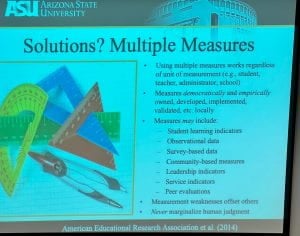
Solutions we discussed and that were presented by professor.

I do question the “proficiency” rates and the complete “wall” between a 3 and a 4 in the end-of-year Illinois test. We do all we can each day for each child to get our students’ knowledge, skills, and abilities to meet and exceed the standards set. Thanks to input and, dialogue, and intellectual discourse with leaders all across the United States, including from the District of Columbia, CA, IL, OH, IN, TX, MI, PA, MD, NY, CO, & AZ, my thinking was challenged and my analyses of the past forty years of American education in the United States was enhanced.

We talked about “the science of reading”, various political groups engaged in local school board elections, the existence of school boards themselves, local control issues, state issues, civil rights issues, and much, much more! Some among us called for a “Marshall Plan” for public education to restore the prestige and invest in getting more teachers (and educational support personnel and administrators) into classrooms, schools, and districts. We discussed the structure of education itself, the roles of state and federal, and local governments, and the pros and cons of each.

Let’s all remember that in the United States of America, we have the most patents in the world, we have the largest economy in the world, and we have the strongest military in the world. With 90% of students in our public schools, clearly, our Nation is NOT at risk due to the public schools. One could surmise that in the forty years since A Nation at Risk, we have learned much, and we are successful in many areas.

I strongly believe it’s time to change the narrative that the USA is at risk due to the public schools. In contrast, we’re doing so well BECAUSE of the nation’s public schools. I also believe it is time for us all to accept that it’s statistically impossible for “all” to be “proficient” on a bell-shaped curve – with 50 as “normal,” there will always be less than and more than. It is time to develop a more realistic accountability system that means more than “average” or “beyond or below”.
Finally, I thank the National Superintendent Roundtable for convening us so thoughtfully, so provocatively, and so meaningfully as we ponder the past forty years in US public education – and as we forecast the next decades. Our nation and our world have endured powerful changes due to public education. Let’s commit to sharing the correct narrative, and let’s believe in each child every day with rigor and high expectations, and high standards. Let’s measure what we’re actually doing and let’s get it right in the next 40 years!

Mayan Culture and History – Guatemala

Mayan Culture and History were integral parts of our overall service, learning, culture, history, and volunteer work in Guatemala.

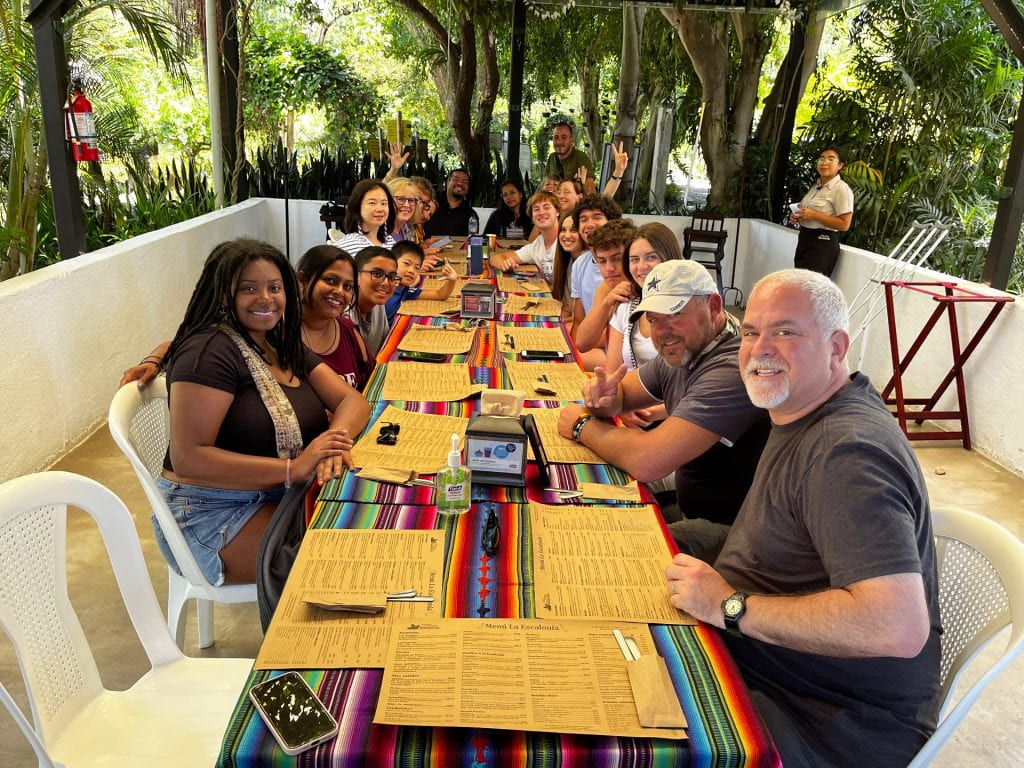
Iximiche and Antigua visits during our time in Guatemala in between and following bottle school construction projects enhanced the cultural immersion as well as the background of the people and the communities we were serving with.!
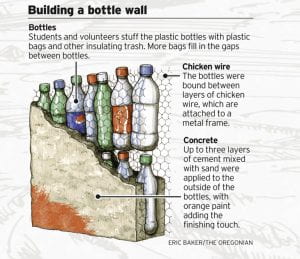
Aside from actual construction, building, in this case, tying in bottles as the walls/insulating and using them as “eco bricks” for ecological as well as construction, we learn with and from the people alongside with whom we are serving. Recall the details related to building a bottle school.

From the Hug it Forward Website

—————
That’s a long-winded way of saying we immerse ourselves with the local people, culture, history, sociology etc. One such way to do this is to hear first hand accounts of the Civil War (1960-1996), learn about migration out and the causes and reasons why, and we also visited a sacred national archeological site called Iximiche, site of the first Guatemalan capital city.
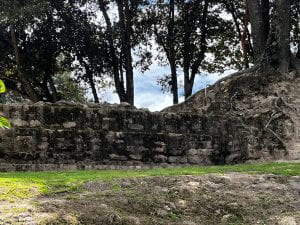
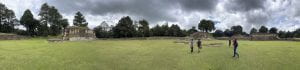
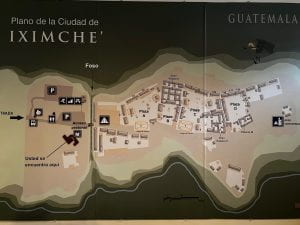
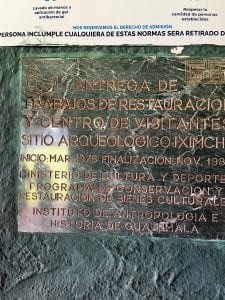
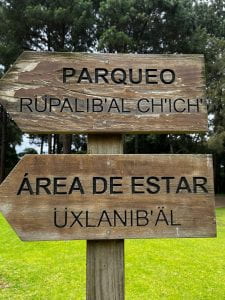
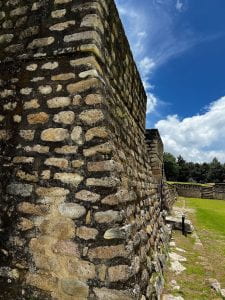
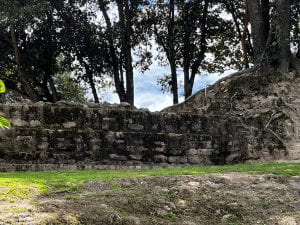
Our first excursion was to Iximche (Ishimche). This sacred Mayan archeological and
cultural site representing the Kaqchikel Maya ethnic group and the first capital city of the Guatemalan Kingdom – founded in 1470 and abandoned around 1524. The second excursion was to Antigua, also a former capital city of Guatemala and a UNESCO certified world history site.
—————-
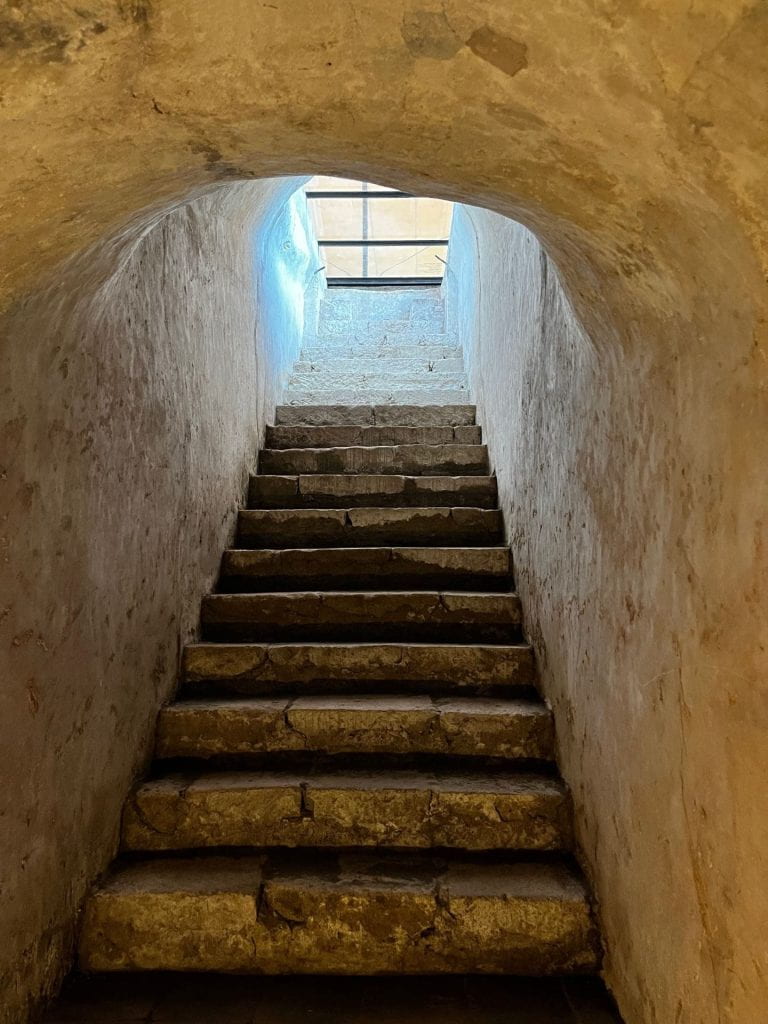
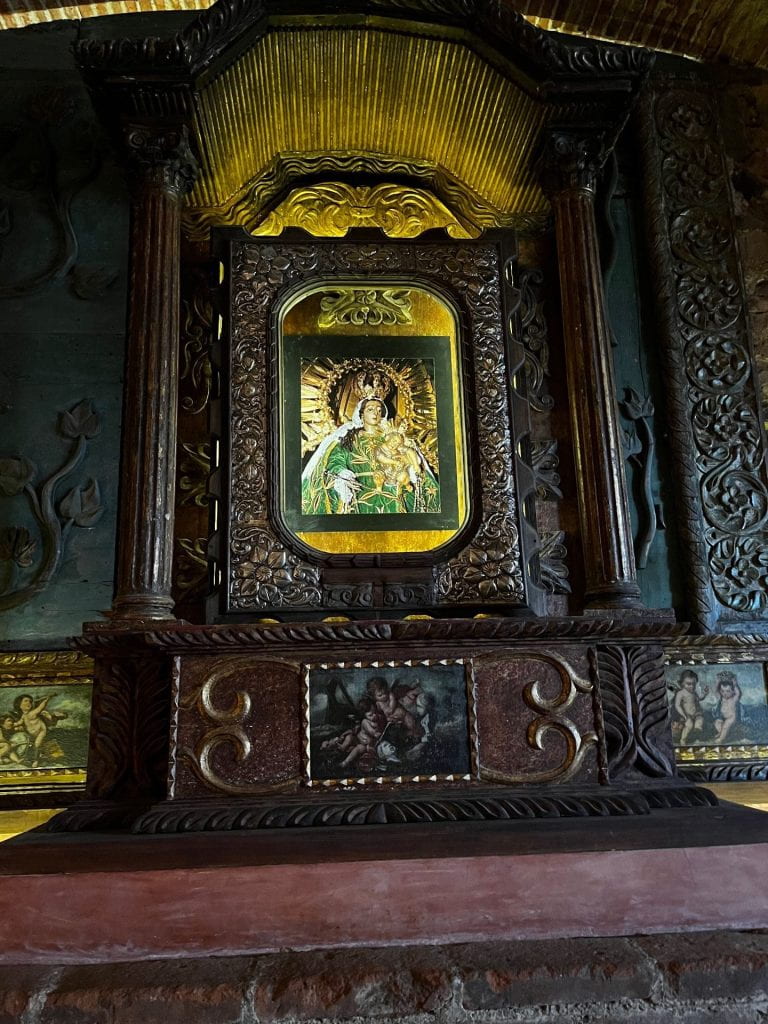
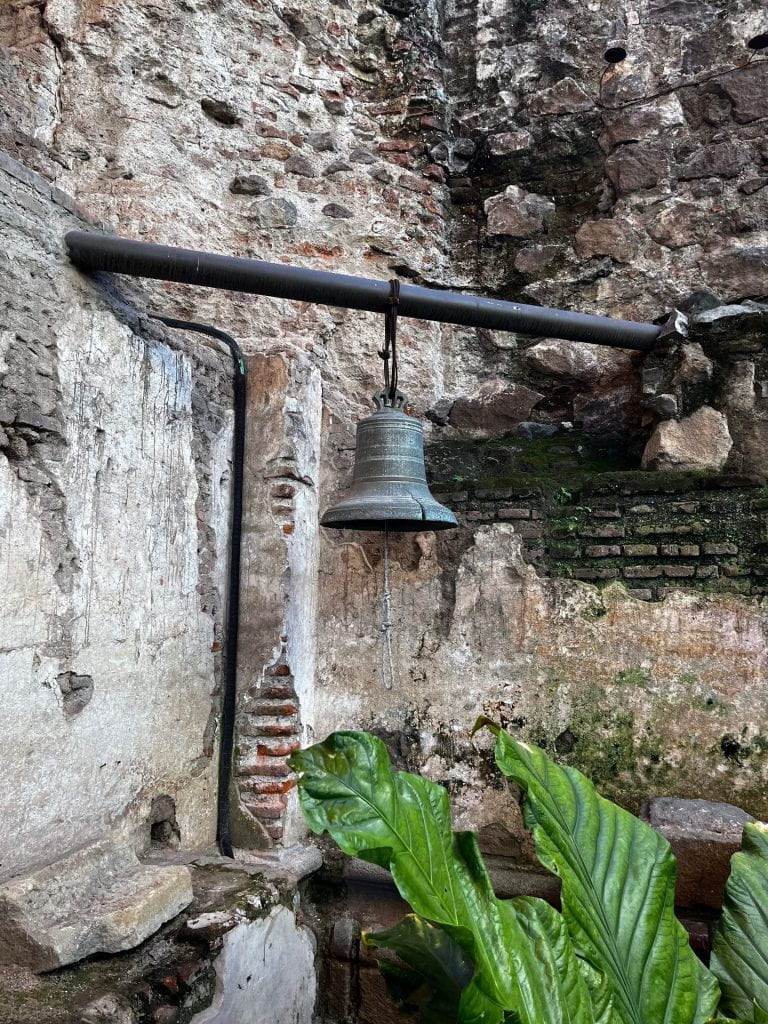
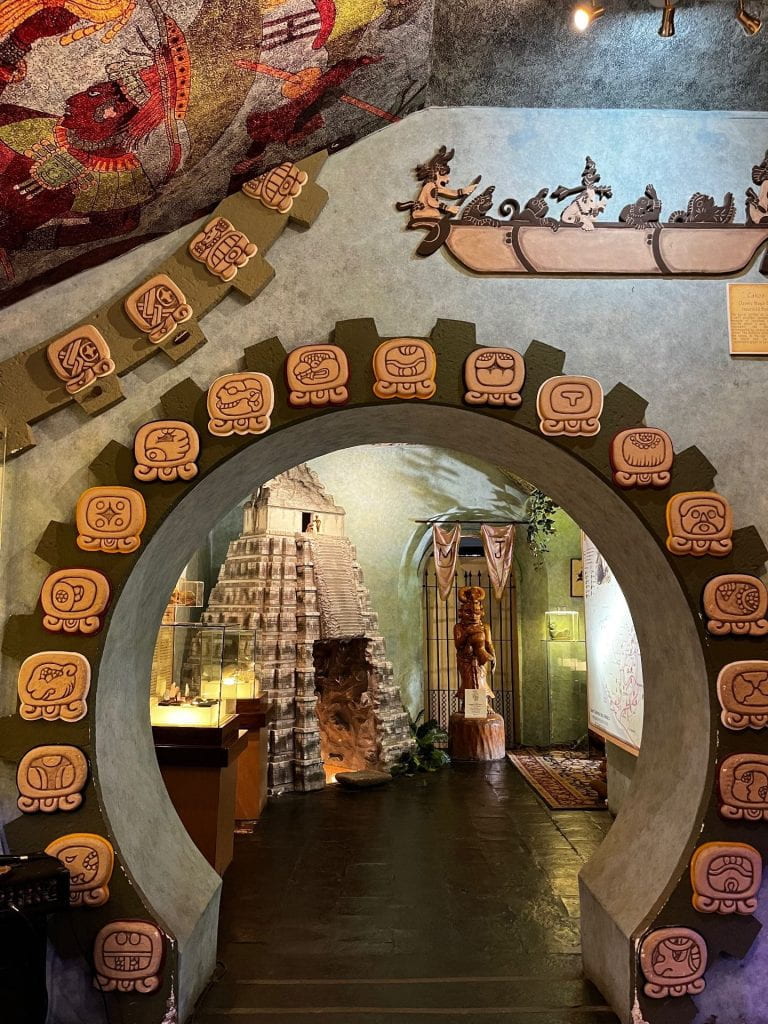
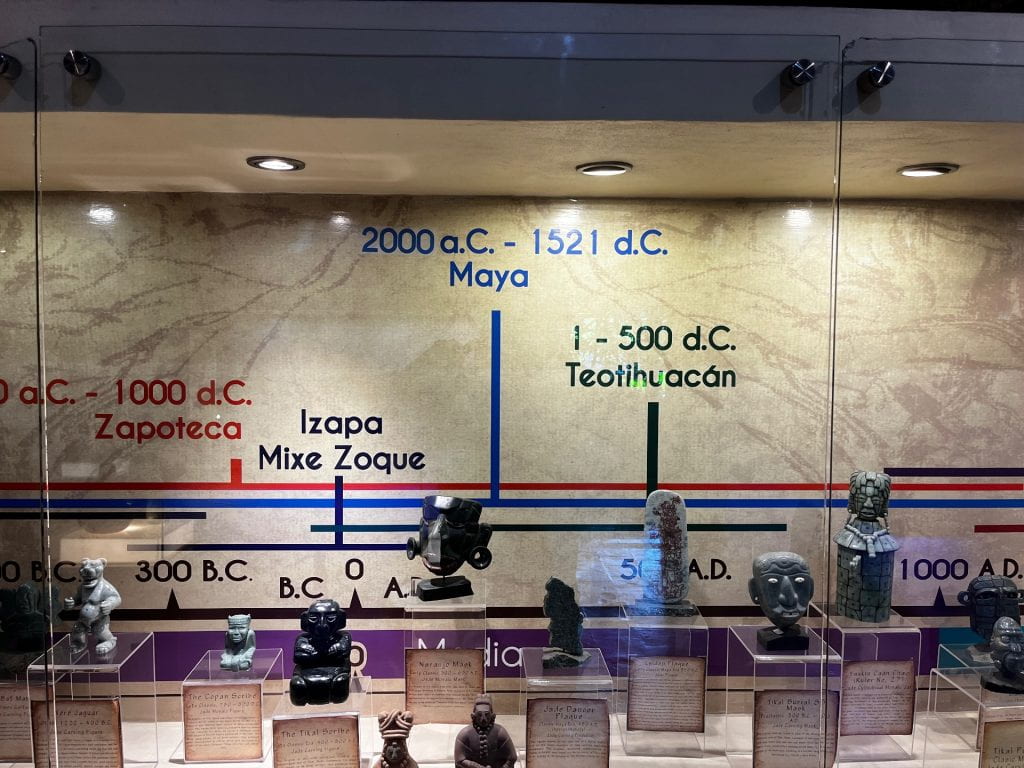
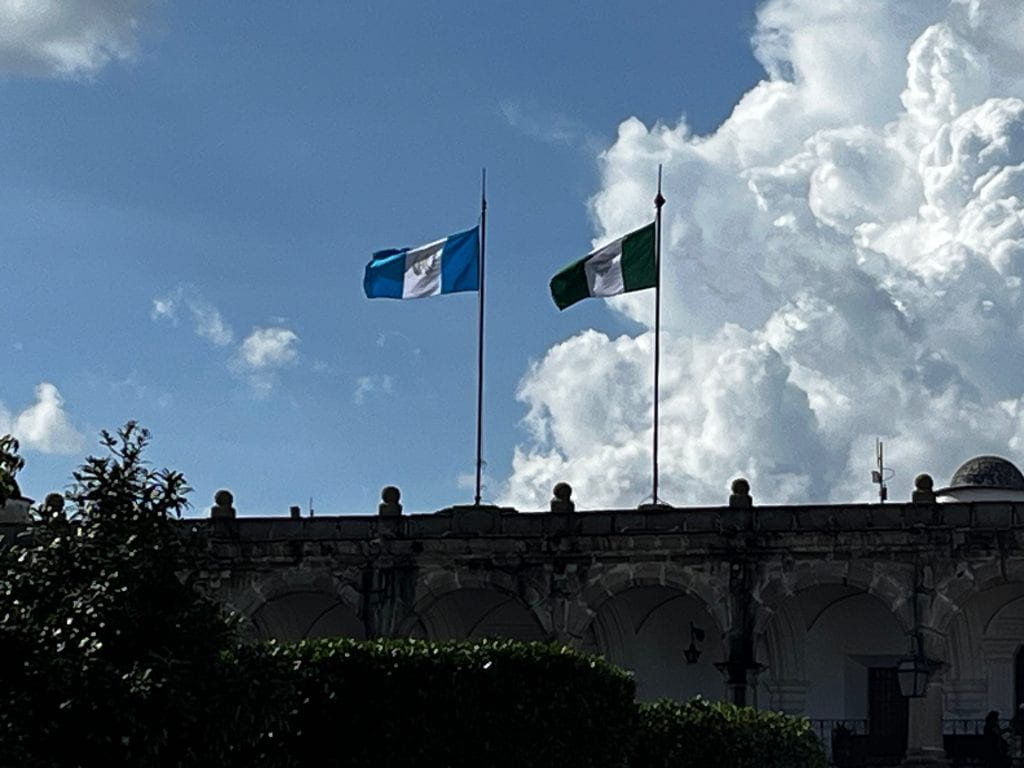
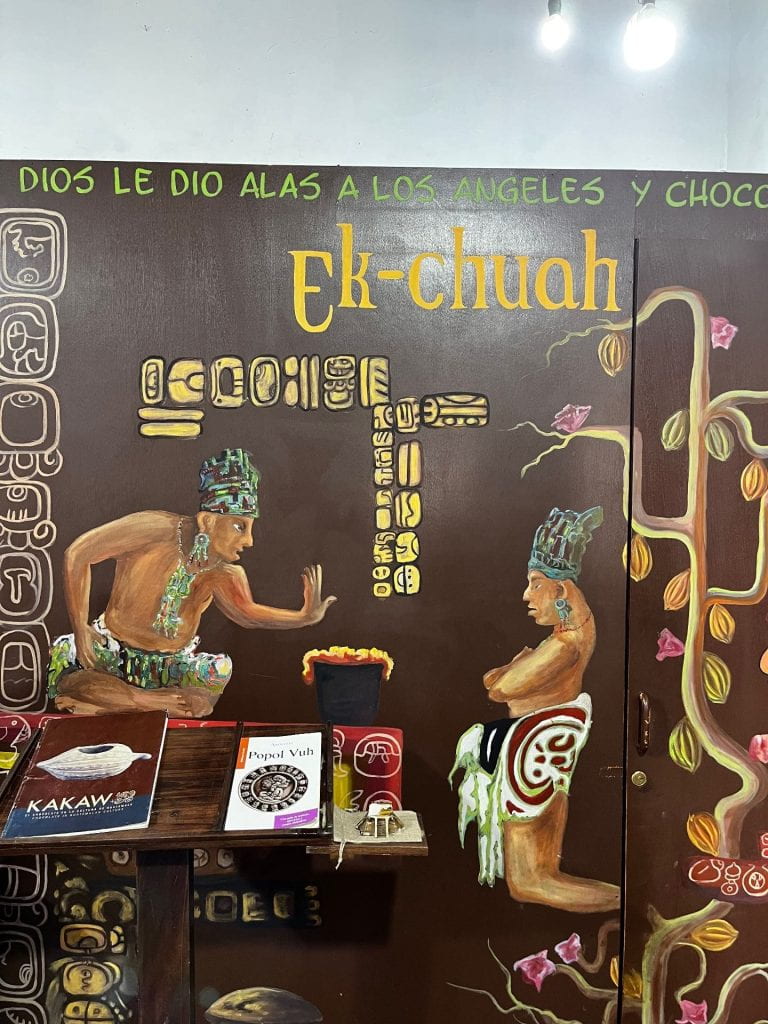
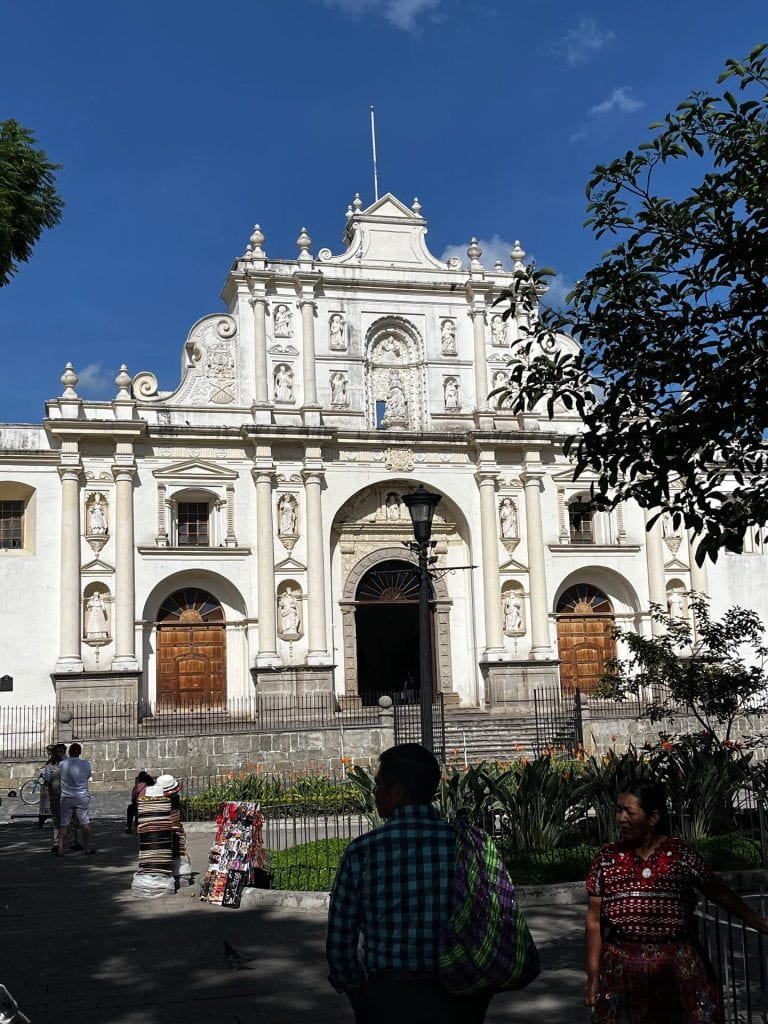
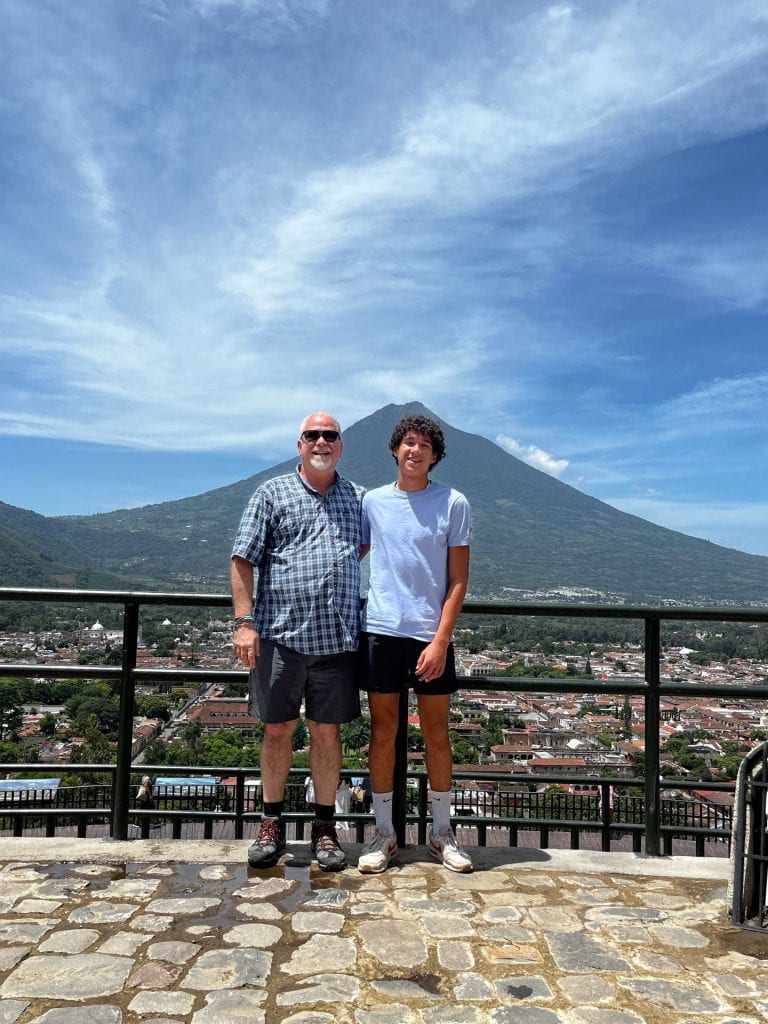
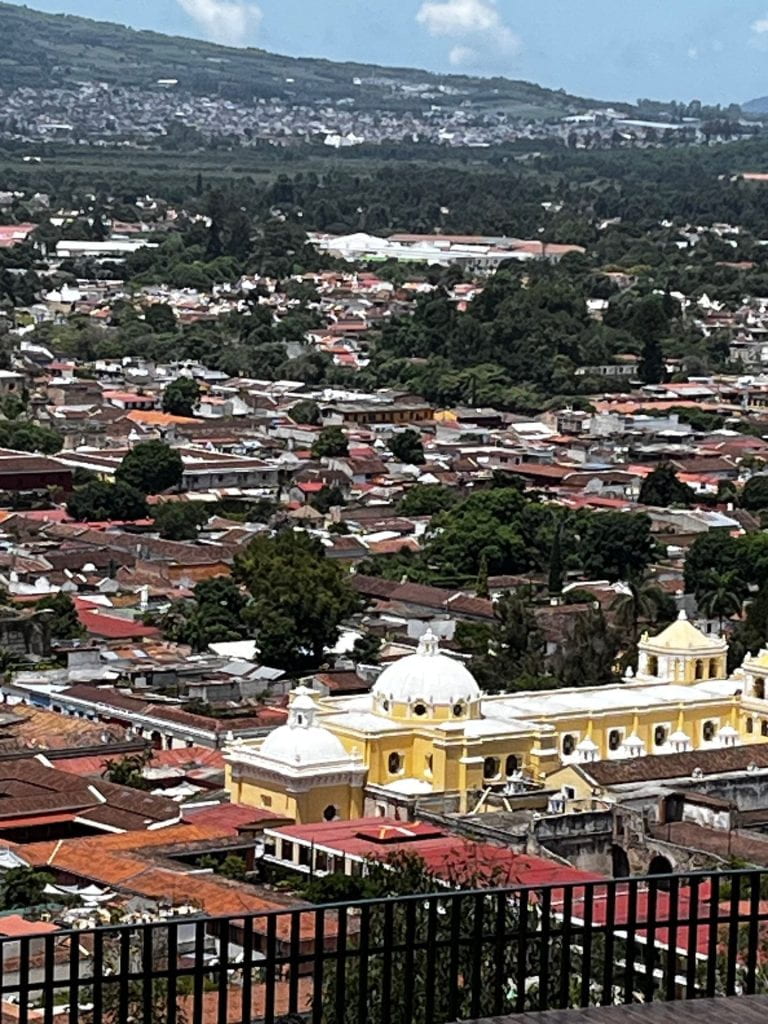
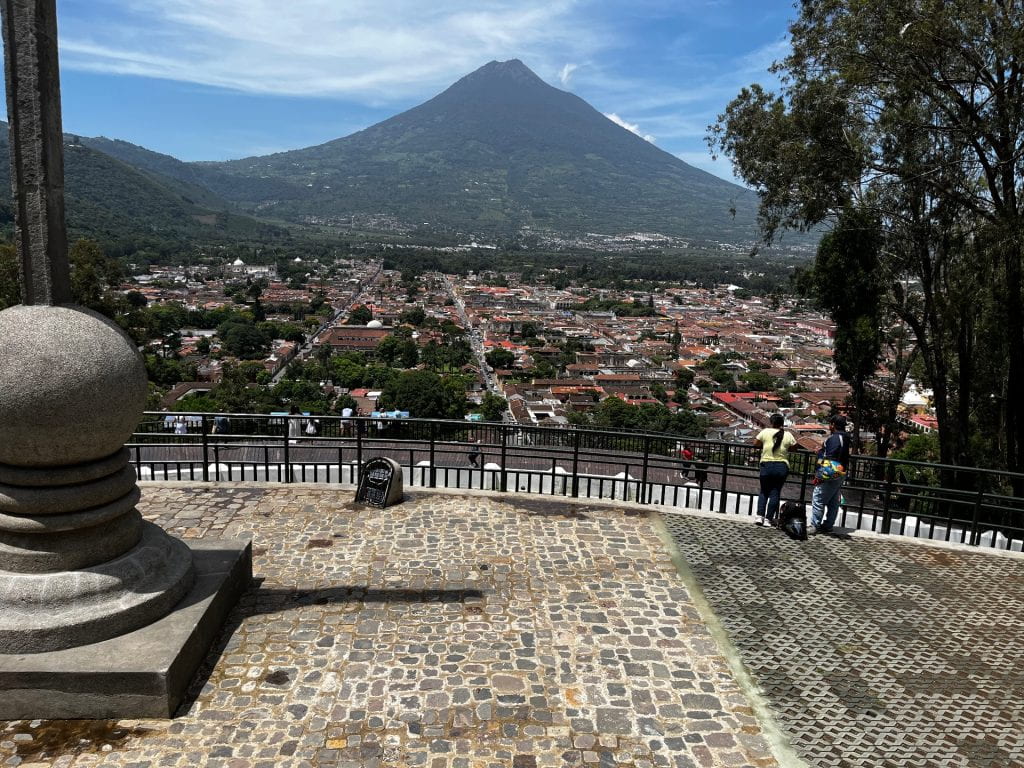
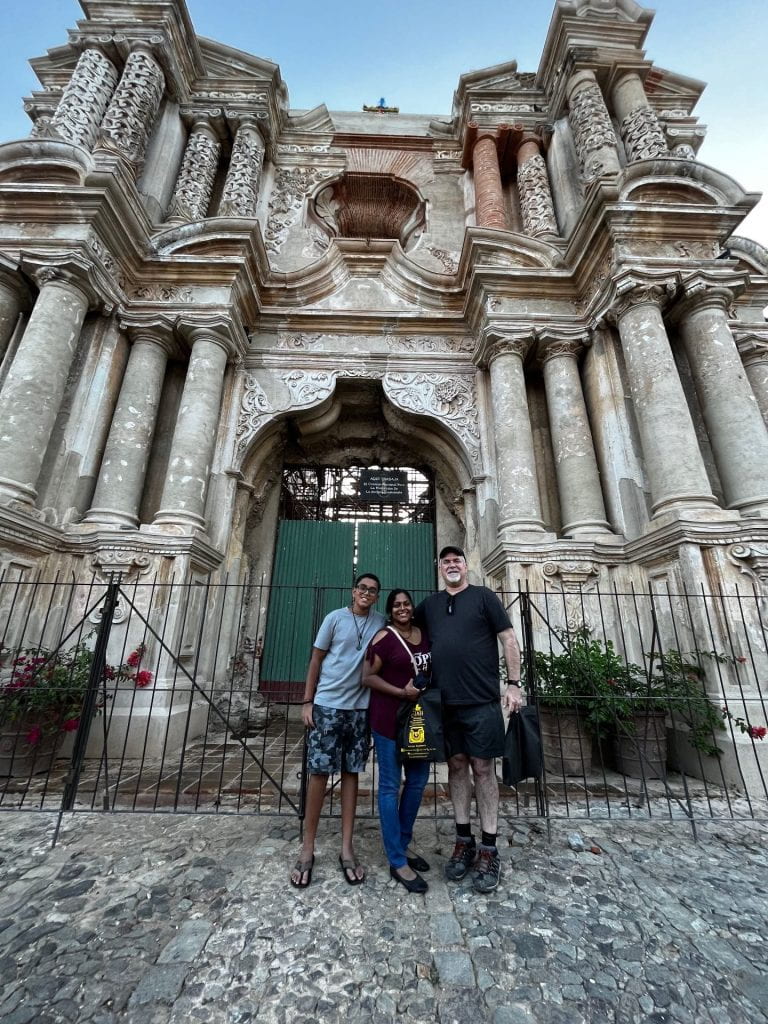
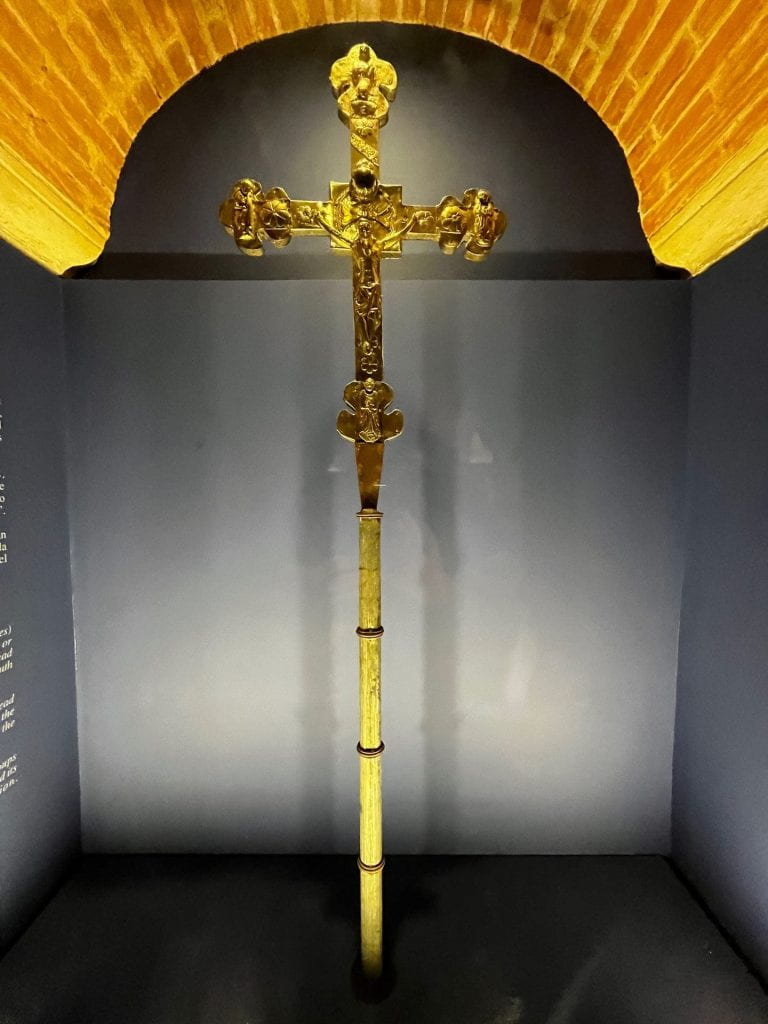
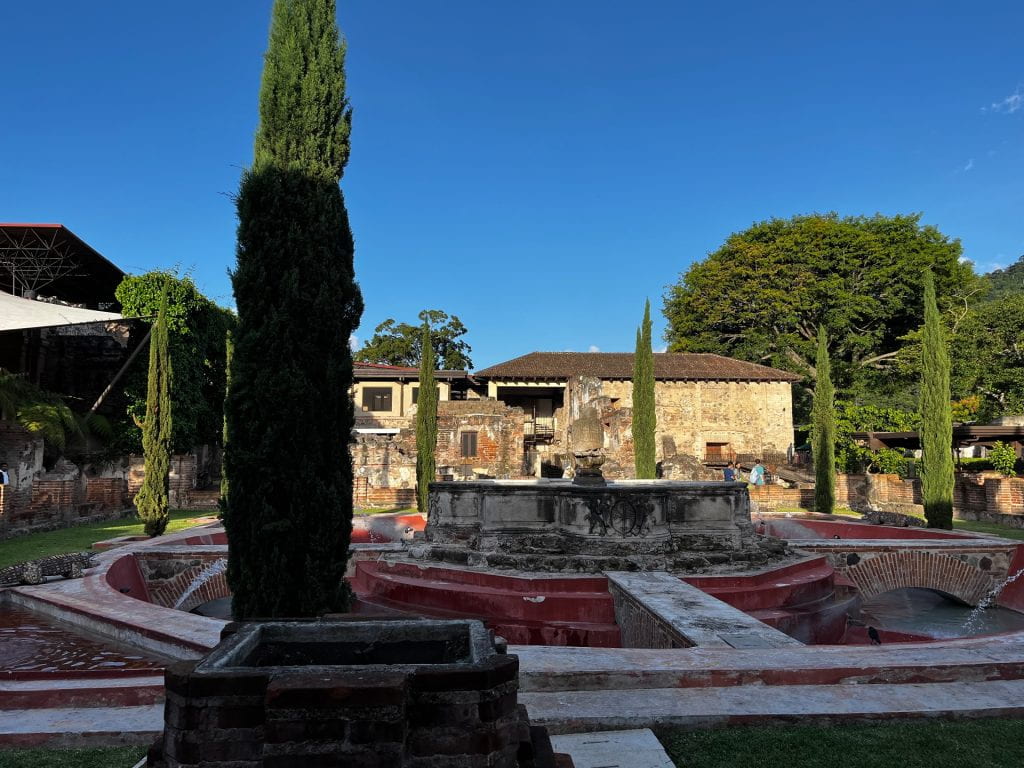
We also visited the incredible UNESCO world heritage site Antigua, Guatemala and we had a chance to explore this unbelievable city. The cobblestone roads, the colonial ruins/restorations, the beauty of the Guatemalan people and the history of the Spanish religious and archeological sites was really impressive.  We learned about cacao, chocolate, religion, jade, Mayan spiritual horoscopes, and much, much, more. If you have ever thought about visiting Guatemala – book your tickets today 🙂
Right now I am sharing images from Antigua followed by additional reflections and then imagery from Iximiche.
————
—————-
The visit to Antigua left us wanting to come back and explore even more!!
—————
During our visit to Iximiche, we visited the museum where our guide explained the more than 20 Mayan ethnic groups (not tribes, but indigenous ethnicities with unique language, history, etc.). He also explained how the Spanish invaders/conquerors are described in history and points of view; he allowed us to challenge our commonly held beliefs about the Colonial Era.
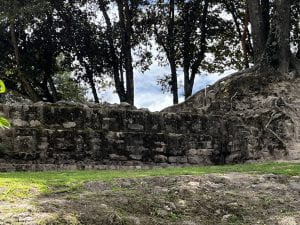
During this Hug it Forward trip, we had the privilege to learn history from people directly and personally impacted by historical events. This first hand, hands on, experiential learning proved quite powerful. In addition, we learned how the Moon temple (west) the Sun temple (east) and the Mayan Cross and the various alters in the archeological site reflected the Maya understanding of the astrological principles (directions, solstice, equinox, etc.). We also were simply fascinated by the precision construction – with no power tools – of the exquisitely constructed temples and sacred areas.
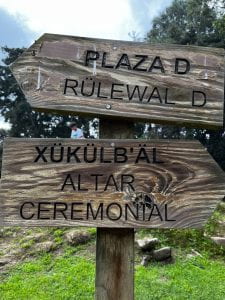
We also saw the ball court and learned about sports/recreation/conflict resolution – truly the personal guide, Alex, was an amazing teacher. Walking the serene grounds of this national park was unusually serene and tranquil – again, words alone cannot describe fully – but I’ll try with words as well as images.
__________
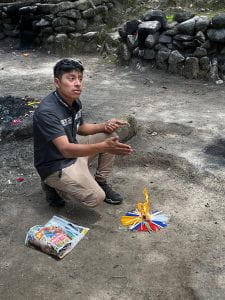
Alex also explained Mayan spirituality to us, he dispelled myths, he debunked some stereotypes, Alex allowed us into his culture and into his spirituality. We engaged in a fire ceremony with Alex – it was moving, meaningful, special, and truly spiritual!
No words or images can remotely approach explaining to you how powerful the Mayan fire ceremony was – from Alex’s deliberate and powerful explanation, to our participation in the actual ceremony, to our holding hands as a group and immersing ourselves literally in the culture – this was a PEAK moment for us all!!
—————
On my LifeTouch Memory Mission in 2016 I learned the phrase “build a school, change lives”on this trip with Hug it Forward and Serve the World, with my son, we helped to build a school, I believe we will help to change lives, and I want to close by affirming that our lives have been changed for the better and I feel like Guatemala is a new friend to us!
Building the school changes lives. Working alongside the local people builds connections. Immersing ourselves int he Culture, History, Spirituality, Traditions, Food, etc. binds us to the people of Guatemala. As we travel, serve, learn, explore, immerse, engage, and build connections for life, and also help build schools, we also change our own lives, perspectives, views, viewpoints, understanding, knowledge, and world view – and more!
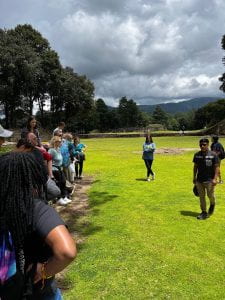
The images below are from our visit and immersion to the Iximiche archeological site.

Audio Excerpts of National Presentation – Supt and Principals – Impact on learning in #112Leads

In this episode, learn how an initiative and partnership called DMBreakthrough Teams implemented last year at the District 112 Dual Language elementary schools positively impacted student growth & achievement!

Over spring break, I went to New York with Oak Terrace Principal Lilli Melamed and Wayne Thomas Associate Principal Colleen Goodrich. In addition to learning at the conference, we were invited to present the results from an initiative implemented last year at both dual language schools, DMGroup Breakthrough Teams.

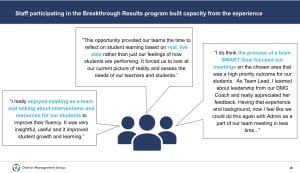
Having the opportunity to share, and specifically, hearing from Lilli and Colleen about the impact of last year’s DMBreakthrough teams 10-week program on multi-lingual learners in grades K-5 at their respective schools is incredible and made me very proud of our work, our students, and the District. Our session was titled “Learn how North Shore School District 112 (IL) supported their multilingual learners and achieved a higher percentage of students meeting their MAP growth goals after the Breakthrough Results experience.”

Our work with DMGroup to implement their Breakthrough Teams programs at our Dual Language schools last year was driven by that commitment to continuous improvement in learning. We are committed to creating conditions for equitable access to educational opportunities for each child every day. We are committed to creating conditions for teacher support and excellence every day. We are on a journey and proud to be focused on results.

En este episodio, aprenda cómo una iniciativa y asociación llamada DMBreakthrough Teams implementada el año pasado en las escuelas primarias de lenguaje dual del Distrito 112 impactó positivamente el crecimiento y el rendimiento de los estudiantes.

Durante las vacaciones de primavera, fui a Nueva York con la directora de Oak Terrace, Lilli Melamed, y la directora asociada de Wayne Thomas, Colleen Goodrich. Además de aprender en la conferencia, fuimos invitados a presentar los resultados de una iniciativa implementada el año pasado en ambas escuelas bilingües, DMGroup Breakthrough Teams.

Tener la oportunidad de compartir, y específicamente, escuchar a Lilli y Colleen sobre el impacto del programa de 10 semanas de los equipos DMBreakthrough del año pasado en estudiantes multilingües en los grados K-5 en sus respectivas escuelas es increíble y me hizo sentir muy orgulloso de nuestro trabajo, nuestros estudiantes y el Distrito. Nuestra sesión se tituló “Aprenda cómo el Distrito Escolar 112 (IL) de North Shore apoyó a sus estudiantes multilingües y logró un mayor porcentaje de estudiantes que cumplieron con sus objetivos de crecimiento MAP después de la experiencia de Breakthrough Results”.

Nuestro trabajo con DMGroup para implementar sus programas Breakthrough Teams en nuestras escuelas de lenguaje dual el año pasado fue impulsado por ese compromiso con la mejora continua en el aprendizaje. Estamos comprometidos a crear condiciones para el acceso equitativo a las oportunidades educativas para cada niño todos los días. Estamos comprometidos a crear condiciones para el apoyo y la excelencia de los maestros todos los días. Estamos en un viaje y orgullosos de estar enfocados en los resultados.

What are DMGroup Breakthrough Teams Results in D112? #112Leads

In the 2021-2022 school year, we chose to implement a robust planning and results-oriented project at both K-5 dual language (Spanish/English) schools in the District, Oak Terrace and Red Oak. Our main work has always been to create conditions that support student growth, learning, and teacher collective efficacy. In this post, I’m sharing some images that show graphically how incredible the student growth, learning, and performance was in this 10 week initiative last year.
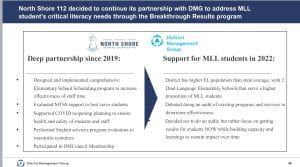
The results focused approach, led by a team from strategic partner DMGroup (from Boston, MA), helps teams of leaders, teachers, and educational support staff refine their sense of urgency and target professional efforts to impact student growth and learning. We worked with DM Group on a number of challenging projects over the past few years (reopening in COVID, Student Services/EL audit, MTSS planning and implementation).

Firstly, in District 112, our motto is Inspire, Innovate, Engage; and we firmly believe each child can learn and grow – every day. We stand firmly for equitable access to educational opportunities for each child every day. We take pride in the excellence of our teachers, administrators, support staff, parents, and Board.

 When we learn how to do better – we do better. When we make a mistake, we own it – explain it – and learn from it (and take efforts not to repeat it). After the devastating impacts of the COVID global pandemic (on society, learning, social connection, etc.) we reached out to experts in strategic leadership to see how we could improve and enhance our impact on learning to help our students emerge successfully.

Student success and district success are measured in multiple ways.  Pleasesee a previous blog post to get a sense of how I measure “success” (culture, engagement, service, assessment, etc.). Search Results for “Measure succes” – Mike Lubelfeld’s Blog

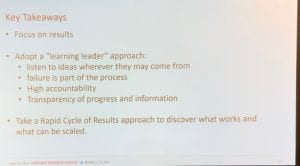
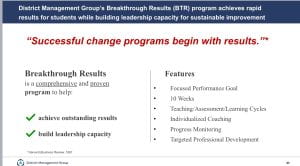
The point of working with the DMGroup on Breakthrough Teams comes from their motto: “Successful Change Programs Begin with Results”. The focus of the initiative is to focus on results – not barriers; not challenges; not the “why nots;” not the “yea buts;” but results.  Let’s make an impact.

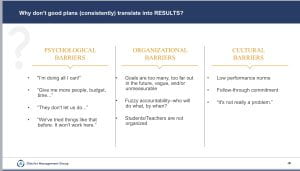
 They acknowledge psychological, organizational and cultural (org. Culture) barriers such as: “I’m doing all I can;” “It’s overwhelming;” “It’s not MY problem;” etc… .  And then share a team of strategic consultants to support the existing organizational structures and  help guide questions to and for student learning/growth and teacher learning/growth to work around, through and over those barriers to ultimately bring them down.

The cool part about working with the DMGroup on Breakthrough teams is that we had the opportunity to take existing structures (teacher team planning/group thinking time) student learning (using assessment tools), instructional coaching (District teacher leaders), administrative collaboration (co-designing and considering solutions) all to help us do our work better.
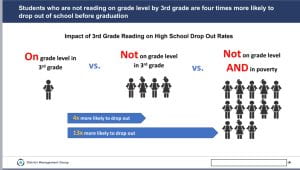
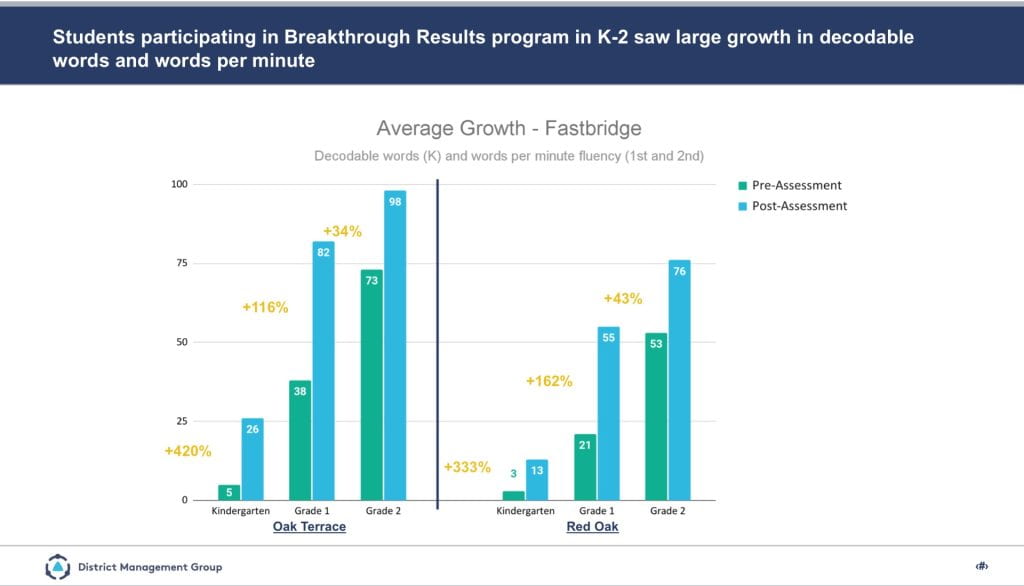
 

The DMGroup Breakthrough Teams program is focused on 10 weeks of intense, targeted, focused planning, ideation, succeeding, failing, learning, and re-ideating. The District, the School and the Teams work together to make the best decisions with the information at hand in real time on behalf of the learning. It’s an amazing professional experience – and, in D112, it yielded groundbreaking results for kids (and teachers) last year at Red Oak and Oak Terrace Schools.

We focused on our dual language schools with multi-lingual students in the District’s historic and long running magnet/choice instructional program. English Learners in the District have traditionally had challenging performance on standardized assessments, and the focus on their learning and needs, first, with this innovative program, proved that every child (regardless of “box to check”) can learn and grow in the proper conditions. We helped our teachers create the proper conditions and focus, and we co-created professional planning space to establish a results orientation.  And the results justify and support this effort.

As mentioned, in this post, I’m sharing some slides that show graphically how incredible the student growth, learning, and performance was in this 10 week initiative last year.

On April 11, at an upcoming school Board meeting, I will share a detailed presentation with two of my colleagues, Lilli Melamed (Principal at Oak Terrace School) and Colleen Goodrich (Associate Principal at Red Oak School last year and Wayne Thomas school this year).

 In June, we’ll share this year’s results from this year’s Breakthrough Teams experience at the five K-5 schools with traditional (English only) education, in grades kindergarten, first grade, and second grade.

Thanks for reading the blog! Check out the podcast, our upcoming board meetings, and general District communications as we share our journey of leadership, experiences, learning, growth, and results oriented focus.

Progress in District 112 – Solar Energy – Construction – Future #112Leads

In North Shore School District 112, we are focused on our “Big Three” – Closing of Opportunity & Achievement Gaps, the Portrait of a Graduate, and Facilities Upgrades & Modernization. We are in Year 5 of a potential 12 year, Three-Phase plan to upgrade & modernize all campuses, eliminate long standing differed maintenance challenges and to stabilize finances & facilities needs for decades to come!

With facilities issues resolved, we’ll be able to focus far more effort, energy, expertise and engagement to learning & teaching – our main mission and priorities!

Please check out the “slides” used at a recent Open House at Northwood Middle School, planned for, funded, designed, and constructed from 2018-2021; opening in the midst of the Pandemic and flourishing for students, staff, and community! Following the slides, I’ve embedded the video of the “solar tour” that highlights the community and Board commitment to the global environment. Our Future is NOW in D112 – Inspire — Innovate — Engage!

Solar Tour Video (it may not play in the slides above, or if you wish to see it separately)

Solar Panel Video FALL 2022 NSSD112 from North Shore School District 112 on Vimeo.

Post 2 of 2 – Global Service – Dominican Republic- IASA 2021

Post 2 -IASA Global Service Trip – Dominican Republic October 2021

This is the second post describing and documenting a global service trip I had the opportunity to attend in the Dominican Republic with 30 colleagues. Each member of this international travel experience was a school superintendent, school or district level administrator or elected member of a Board of Education. Under the exceptional guidance and care of our team from Education First and the Dominican people, we led, learned, served, grew, opened our minds and hearts and set the foundation for student learning and teacher learning opportunities at home.

In this blog post, I will share the rest of the story that was started in the first blog post about this incredible set of adventures and experiences. As I left off in post #1,  this post will highlight our visit to Santiago (the 2nd largest city) visiting the historical district and learning about street art history and culture. I’ll describe the visit to the artisan area in Moca where we learned how to use pottery and bricks for stoves that help reduce the use of wood and lumber by 70% in the mountain areas, our adventures on the north coast of Cabarete, the Dream School and Inspire DR.

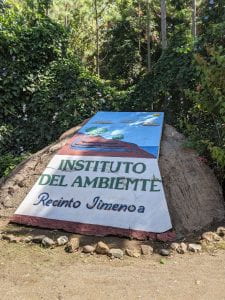
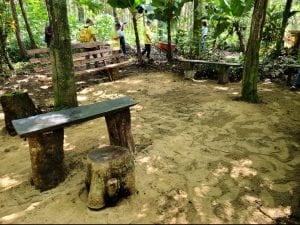
Thank you for reading the posts about of our journey in the Dominican Republic! Below I’m showing some photos from the Environmental institute I wrote about in the first post.

Trail “oasis” “after” completion

Tree Nursery

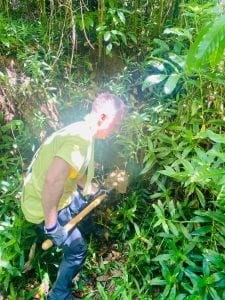
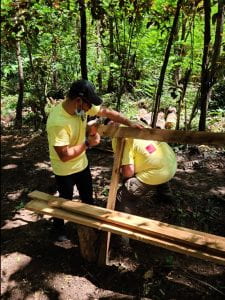
Hands on service!

Trail “oasis” “before” work

Trail Restoration Project

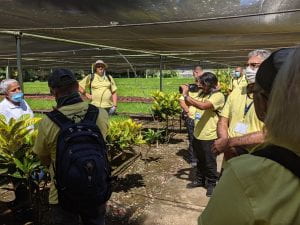
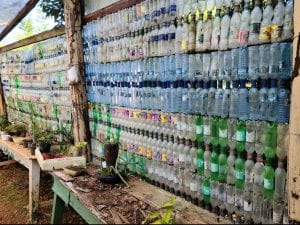
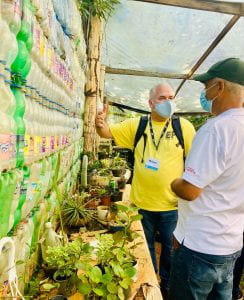
Creative reuse of plastic bottles to insulate wall of outdoor greenhouse

Discussing environmental possibilities

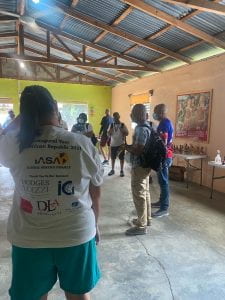
The journey from Jarabacoa towards Santiago afforded us the chance to visit with a local artisan and engage in several workshops and hands on learning experiences at a pottery shop. The artisan was located in Moca, Dominican Republic, and at our briefing we learned cultural and historically significant information as well as sustainability and direct impact on rural Dominican homes as well as the greater environment, health, and wellness.

Briefing at artisan site

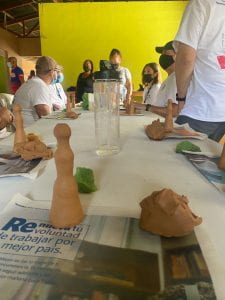
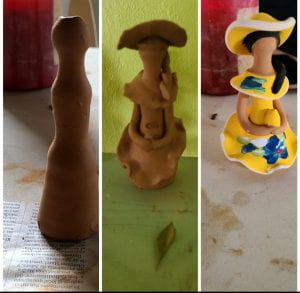
The cultural lessons centered around a faceless doll. This was a special art project that originated in 1977. Essentially, in a nod to the complex and mixed ethnic and cultural and racial ancestry of the Dominican people, with 2% Taino (native peoples), 23% Spanish, and 75% African heritage and DNA in its citizens, the artisans wanted to make a statement about the pride and complexities of the mix. Therefore, the idea of the Faceless Doll of a Dominican women was born. A proud, interesting, and creative example of telling a highly complicated and high level concept (ancestry, heritage, etc.) in a clay doll. Beyond our new learning and appreciation for the progression of “who am I” and “who are we”, we actually had the chance to make a doll (though it’s really not easy! And the art teacher was as patient as anyone could be with our amateur creations).

Attempt at making faceless dolls

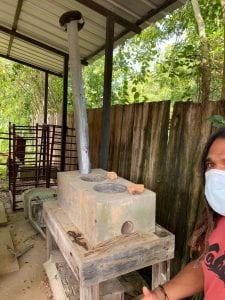
Artisan pottery – chimney brick project

Brick stove with chimney – transformation

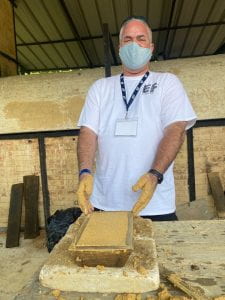
In addition to the Faceless Woman project, we also received a briefing on the stoves in the homes of folks living in the rural, mountain areas and the toll on health, especially for women and children that their old, traditional stoves were taking. For example, cooking indoors with wood, fire, and no chimney or ventilation system led to severe impact on trees (wood for cooking), severe impact on lung/respiratory health of women and children (traditionally in the home while the men go in the fields and work) and skin issues due to the smoke and its carcinogenic properties. So at this pottery artisan production center we visited in Moca, they also make bricks for new rural stoves that use bricks and chimney design to ventilate the toxic smoke, and it has benefits on health, the forest, and lungs! These brick ovens reduce the wood usage by 70% — this is already having a positive impact on the island.

Proud to learn and serve making bricks for brick stove


Our work in brick makingThis focus on sustainability is also impacting the Haitian side of the island. Together in partnership we all benefit. We on this trip are planting seeds of international cooperation and respect that we will ideally recreate so that students in our schools can learn, do, experience, and we can all pay this forward. The artisan shop is also an example of supporting the local economy as there are locally produced handcrafts for purchase.


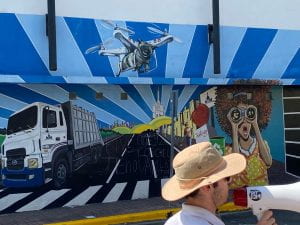
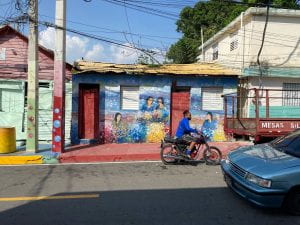
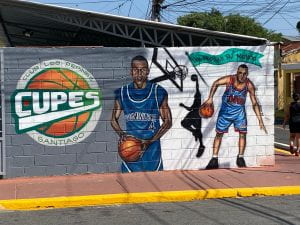
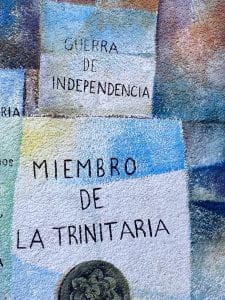
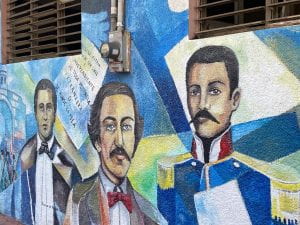
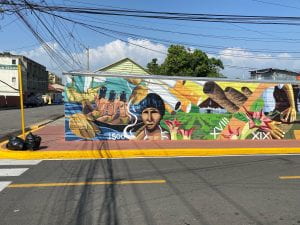
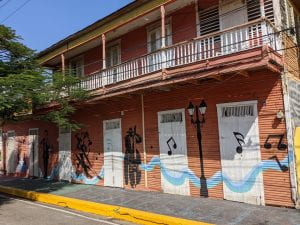
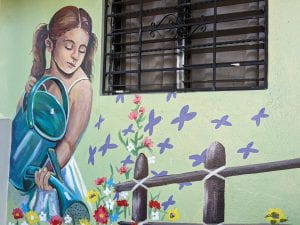
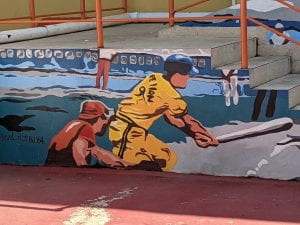
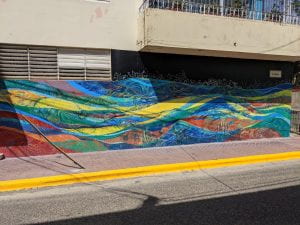
After we visited Moca’s rich artisanal history, and experienced projects of value and of meaning for us and for future student groups, we headed to the nation’s second largest city Santiago. In Santiago, there is a recently restored historic neighborhood with incredible street artwork. I’m sharing a bunch of photos from this visit – I feel that the imagery is far more powerful and descriptive than my words can be.

This visit to Santiago shared for us urban redevelopment in the historic district as well as a visual representation of culture, history and the society over time. The streets on which were were walking are centuries old and have stories of their own.

From Santiago we headed into Puerto Plata on the north coast of the island nation. Our destination was Cabarete. Cabarete is a culturally significant city with a cosmopolitan and international flair. Cabarete and the Puerto Plata coastal area was the original spot for Dominican tourism prior to Punta Cana’s creation on the southeast side of the island. Cabarete is known for international visitors and “expats” as well as kite surfing and surfing on the Atlantic Ocean.

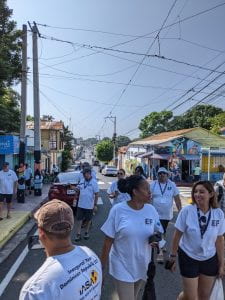
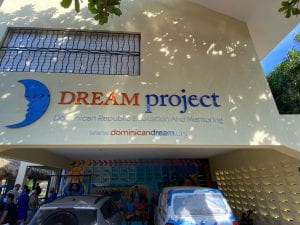
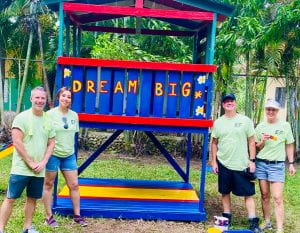
In Cabarete we visited and served at a community center/Montessori-inspired school called the Dream Center School, and we also visited Inspire, an after school and year round STEAM/Shop/Culture/Values program for boys 18-25 years old. Here are some photos of Dream Center and our on site, hands-on beautification service projects. 


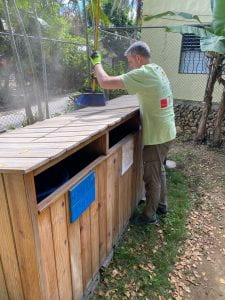
Fixing up the recycling and trash receptacle after relocating

Our take aways, amens, and epiphanies are many and varied. With the school sites, the after school social organizations, the community library, and their integration and interdependence to supplement and in some cases supplant the overall social-educational systems in place, we saw firsthand how EF works with value and mission driven local organizations and groups so our students can be part of something much larger than their typical education/school experiences. We adults were highly moved and  affected by our service, the informational briefings, and the reflections We got to experience what our students will go through. The Dream School Center allowed us to see how a private school interacts with the public school system.

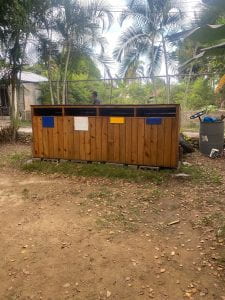
Finished project!

We saw how early childhood education up through grammar school is organized in very similar fashions to our US educational system. Montessori philosophy is popular in many settings around the world. The Dream Center shares a STEAM classroom with the local public school.

The Dream library is a community library, they have a “book mobile” as well and their outreach is community-wide, not just for the students in the school or special programs. Their Bachata sister academy for older youth (High school ages) demonstrated some Bachata music in an impressive display of musical talent!  As the photos show, we helped them with requested beautification projects and functional projects designating space for motorcycle parking, movement of a recycling and trash receptacle to the back of the grounds, as well as touch up painting throughout the classrooms.

Finished project!

The service elements, similar to what our students will experience, showed us that a group of people may start as strangers, yet they emerge as friends in part due to the opportunities that forge authentic bonds. The problem solving, skills development, team work and overall satisfaction with jobs well done meant a lot to each and every one of us every day on this fantastic set of adventures.

We left the Dream Center feeling a sense of accomplishment and satisfaction and reward. We finished up our exploration and inquiry at an after school program for boys (though they are also adding girls programming) InspireDR – Free After-School Programs in Cabarete, Dominican Republic This private foundation “NGO” community based center offers swimming instruction, computer literacy, health education, wood shop, economics, a dojo for marshal arts, and more. We were truly inspired by the emphasis on technical life skills, problem solving, positive, moral, ethical, community focused learning and living. These boys and young men were learning English, swimming safety, and we were able to engage and interact with them on site. In addition, they teach public speaking and communications. This free (privately funded) community center has a waiting list of 90 students and they are serving as many as they can free of charge. This and so many of our new discoveries would each and all make great fund-raising, sponsorship, visit/exchange, education, and of course service projects for our own youth, Rotary and other civic organizations and other foundations.

We also ate lunch at Water to Wine, a water purification team — the opportunities to serve and make our world a better place seemed to be never-ending.

As I close the photo journal and documentary accounts of our incredible 2021 IASA Global Service Project, and as I again thank Dr. Polyak and our business partners, I’ll share some final thoughts, reflections and comments. In North Shore School District 112, we are going to explore the possibilities we can create with our own local partners for a student trip and relationship moving forward. Inspire…Innovate…Engage – our aspirational motto — in action!

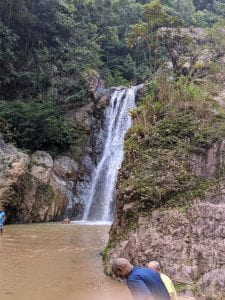
Captivating natural beauty

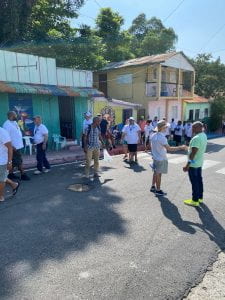
We had so many “to do” or “do now” opportunities. We had so much history and culture learning and education experiences. We were not blind to the irony of our service during the Indigenous People/Columbus Day observances (at home and in the DR). It was not lost on us that we were meeting in Columbus Park for our Santiago art/history walking tour.

We learned and lived and engaged and built lasting relationships in a relatively short period of time.

Our world is complex. Our work is complex. Our past is complex.

In order that we support and facilitate the support for teachers and students to create conditions for a sustainable and globally connected world, we must get out of our safe and small circle of our worlds at home and jump out of comfort zones and live, learn, do, think, be open minded to change, and to lead.

With experiences in the educational, social, cultural, artistic, political, geographic, environmental, and service genres (and more), I simply say Thank YOU to all who put in so much effort to create the spaces where we and I could enhance ourselves and our worlds.

Here’s to the next time … truly we are all unfinished! Opportunities like this help us frame our paths to become the next versions of ourselves.

For nearly 30 years I have been serving public education and schooling in suburban Chicago, Illinois, USA. I’ve been a public school superintendent for 12 years (so far). Each year, each job/role, each child for whom I lead, each adult with whom I lead, each family I serve, each community I serve — each one enhances my sense of self and my body of work. My answer to the call of duty in an ongoing and unfinished, never ending cycle of service is to serve, to lead, to push myself and to make my wife, my children, and my community proud and respectful.

Proud and grateful to sponsor partners