#PassILBudget United Effort Across IL

For almost two years, Illinois has operated with just a partial budget for education and a “stopgap” budget for most everything else, leading to cuts at local government entities, community service organizations and education agencies that support our families and communities. Even though education has been funded, schools and students still suffer due to the lack of certainty, inequitable funding and current unpaid bills from the state.

Let’s work together to #PassIllinoisBudget.

Illinois Budget Impasse FAQ

Q: How long has Illinois been without a full state budget?

A: As of April 24, 2017 we have operated more than 22 months without a full state budget.

Q: What does the budget impasse mean?

A: The country’s fifth-largest state has been operating with continuing appropriations and court-ordered spending, while the pile of unpaid bills grows to nearly $13 billion. The state has approved a partial budget for education and stopgap or band-aid measures for most everything else. This has meant frozen and reduced budgets at local government entities, community organizations, and education agencies that aim to support our families and all sectors of society. Without a budget we all suffer.

Q: How does the lack of a state budget impact the services provided?

A: School districts launched Pass Illinois’ Budget! in late April when school chiefs should already know their financial revenue situation for Fiscal Year 2018. Like any business, school districts need to know several months – preferably more – in advance how much money they’ll receive so that education leaders and elected board members can make thoughtful spending decisions, from hiring staff to allocations for curriculum, maintenance and repairs, and much more for the coming school year.

Q: Where does Illinois school funding currently come from?

A: The state’s education budget is primarily made up of local revenue, primarily property taxes, state funds, and federal funds. 

Q: What percentage of public school funding is Illinois responsible for and how much does it cover?

A: The state, by constitutional mandate, has the primary responsibility for funding its public schools but has never come close to covering even half the cost. Illinois ranks 50th in the nation for providing state funds for education.

Q: What is the problem with the current school funding formula?

A: The current funding formula does not adequately and equitably fund education in Illinois.

Q: Have there been any proposed solutions to fix the school funding formula?

A: There are some proposed solutions, but all require the state to pass a budget with revenue to support it.

Q: Why is the state behind on payments to school districts and which payments?

A: The state has delayed payments because there is not enough revenue being received by the state to cover the expenditures that are due. These unpaid bills are part of what’s called “Mandated Categoricals” and include funding  for special education, bilingual education, transportation, and other important services. 

Q: What are school leaders doing about the state’s financial situation?

A: More than 360 superintendents (as of 5 p.m. April 21)  are calling on the Illinois General Assembly and Governor Rauner to do the following:

  • Immediately, and with bipartisan support, end the state budget impasse.
  • Improve the state’s education funding formula and invest in students and schools, including higher education institutions.
  • Pay school districts what they are owed this year.

Q: What can parents of public school students and other Illinois residents do?

A: Speak up! Contact your local legislator. To find your local legislator, visit: https://openstates.org/find_your_legislator/ and ask them to make these three requests a priority:

  • Immediately, and with bipartisan support, end the state budget impasse.
  • Improve the state’s education funding formula and invest in students, including students in higher education institutions.
  • Pay school districts what they are owed this year.

Spread the word with friends and on social media with the hashtag #PassILBudget.

Make this logo your Facebook profile picture.

Financial impact of proposed legislation

“Do not let what you cannot do interfere with what you can do.”
– John Wooden

As a public school superintendent, I am non-partisan and publicly a-political. From time to time I post information about pending or actual legislation affecting our public schools. In Illinois, school funding is a regular source of debate, review, analysis, and concern. Right now there is proposed legislation (SB16) that would change the way the state funds for public schools would be allocated.

With this communication I am sharing factual information with the intent of sharing, educating and communicating.

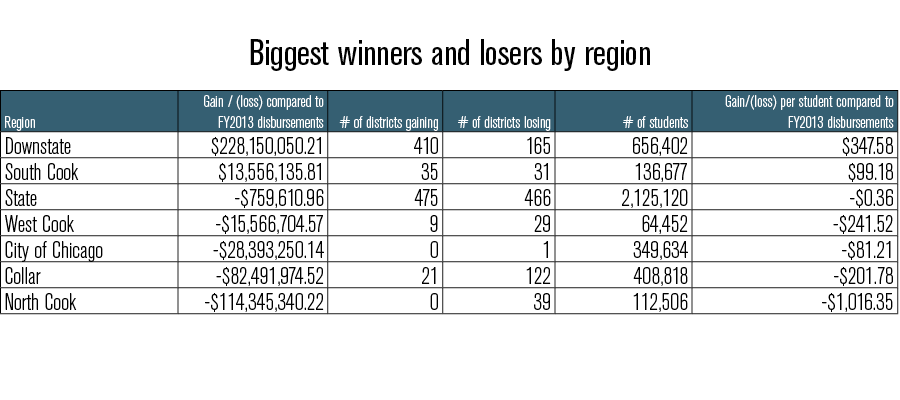
Last July, the Illinois Senate Education Funding Advisory Committee was tasked with recommending ways to improve public education funding in Illinois. The result of the task force was the creation of Senate Bill 16 (SB 16). If enacted into law, SB 16 will make sweeping changes in how the state funds education. SB 16 does not increase the level of education funding, but changes the way in which limited state funding is apportioned among school districts. All state funding, with few exceptions, would be combined under one funding formula.

Generally, school districts with higher assessed property values (including District 109) will receive much less state funding. Other districts will receive much more in state funding. This is an attempt by the state legislators to provide greater equity among school districts across the state. The Bill does not address the current issue of unfunded obligations to school districts that has occurred in recent years.

How Will SB16 Impact District 109?
The Illinois State Board of Education has calculated the amount each school district would receive next year if SB16, as written, becomes law. Deerfield Public Schools District 109 would lose over 50 percent of its state funding – or $1.3 million per year. The cuts will be phased in over a four-year period. Beginning in year five, there will be a full $1.3 million reduction in funding to the District.

District 109 spends approximately $15,800 per student; only $900 per student currently comes from the state of Illinois in the form of special education reimbursement and general state aid. If SB 16 becomes law, revenue from state sources will be just 2% of operating revenues. It is obvious that with the loss of $1.3 million in funding, District 109 will be put in a position of reducing programs and services to our students. These cuts will likely impact the District’s classrooms and result in a reduction of teaching staff leading to larger class sizes with less personalized instruction for our students.

Many North Shore residents pay high property taxes in part to access high-achieving schools. This proposed law would undermine suburban taxpayers and would significantly reduce the state funding to these high-achieving schools. SB16 will pull state funding away from schools that are successful and would in no way guarantee greater success for schools with high poverty levels. SB 16 takes from some to give to others. A far better solution would be for Illinois to fully fund education, rather than ranking 50th in the nation in education funding.

SB 16 comes at a time when many school districts anticipate a further hit from the state. The pension system that funds teacher retirement is woefully underfunded and attempts may be made to shift the state’s burden to local districts. Deerfield Public Schools would face an additional $2.4 million cost, which would be even more impactful than SB 16.

SB16 has already passed the Illinois State Senate. Click to see how the Senators voted.


What Can You Do?

The House is expected to vote on SB16 in November, following the fall election. If you are concerned about the dramatic effect on Deerfield Public Schools District 109 and the students we serve, voice your opinion on this important education bill. Use the Illinois State Board of Elections search engine to find your Representative (you’ll need your full ZIP+4 zip code). Here is a full list of Illinois Representatives.