Do you Believe? Leadership messages worth a review.

“Within you right now is the power to do things you never dreamed possible. This power becomes available to you just as soon as you can change your beliefs.”
– Maxwell Maltz

As I have written in the past, I am fortunate to have mentors, coaches, guides, and supporters at all stops along my personal leadership journey and on the leadership journey of the school district I serve. As part of my journey I consider myself quite lucky to have a master teacher Michael Hinojosa. Dr. Hinojosa, “Doc”, was a school superintendent in several states and systems, and he was honored as the Texas superintendent of the year. One of the MANY powerful leadership lessons Doc is teaching us is related to fundamentals and beliefs. One video (shown below) is a vivid example of the powerful leadership lessons as well as the constant focus on students that this master teacher and lead learner was responsible for. I share the video here on the blog as an example – and as an exemplar – of how students and our belief in them matters most – more than we sometimes acknowledge.

I am also quite proud to share the video here since our own Dr. Zoul, DPS109 Assistant Superintendent for Teaching & Learning showed this very same video at one of our district in services in support of our overall messaging about beliefs and values! It is empowering for me to be learning from the leader who found inspiration in and from the voice of a student. As a “snapshot” of the types of things that I learn and experience and think about in preparation of bringing this growth back home I proudly share with you on the blog!

Please watch the video – please hear the messages from this impressive young man – please be sure that we all believe in ALL students – each and every day. I am proud of the inspiring teachers in our District who share their belief in children every day and I am grateful to the prolific sharing of inspiration and belief on our District’s Twitter Hashtag #Engage109

From You Tube Uploaded on Feb 10, 2012
Watch this 9 year old student, Dalton Sherman, grab the attention of 20,000 adults and hold them in the palm of his hand. His inspiring and insightful speech was written by Jon Dahlander, spokesperson for Dallas ISD, and was given in 2008 to the teachers and staff of the Dallas Texas school district. Dalton’s speech immediately went viral and people from all over the country began requesting him as a keynote speaker. Impressed with Dalton’s poise and presence Ellen Degeneres and Oprah invited him to appear on their shows. This video is the first (HD) high definition version to appear on the web.

Back in the classroom – Instruction with digital resources

“An organization can only become the-best-version-of-itself to the extent that the people who drive that organization are striving to become better-versions-of-themselves.”
– Matthew Kelly, The Dream Manager

Back in March 2014 I was fortunate to have the chance to teach students at one of our elementary schools. Today I had the chance to teach students at one of our middle schools! I was a 7th grade math teacher today and it was awesome. Last year and this year (and next year too) we in the leadership team “raffle” ourselves off to the teachers as a holiday gift and an acknowledgement of their high value. Another rationale/reason for us to this is based upon our values and beliefs of the importance for us to get back into the classroom and experience a real day in the present time with real students “today” as opposed to looking at the lenses of teaching from the the time in the past when we were full time classroom teachers (for me that would be back in 1993-1997).

Another set of reasons for me to get back into the classroom is for leading learning on the macro and micro levels; and for modeling the way in terms of leadership and experiential learning as well as inspiring a shared vision with respect to (in today’s case) the 1:1 digital

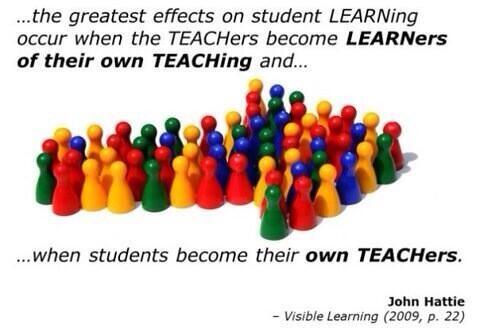
The major findings - distilling from millions of studies on what works.

The major findings – distilling from millions of studies on what works.

transformation in our District. Today I experimented with Math Tech Book from Discovery Education, one of our District’s partners in our digital transformation. Earlier in the year I shared many resources our teachers have for this new era of learning and teaching in our District. The Math Tech Book is a tool we are piloting and with which we are experimenting, along with other tools, that will enhance our 6-8 Middle School math curriculum resource needs. Today at the end of each lesson we did a “whip around” where all students had the opportunity to share their reflections on the learning – what they liked, did not like, learned, experienced. The voice of the student is powerful and the voices of our students today reinforces my opinion, observations, and support for integrating student voice and choice into the overall learning environments.

Today’s experience was fantastic. The math teacher shared curriculum standards (aligned with the Common Core) for her four one hour CORE math classes. With the partnership and help with our partners at Discovery Education, I was prepared (thanks to them) and “my” students were loaded into the Discovery Education account and I was ready to “rock and roll”. I was taking the students on a journey into 1:1 Transformative Learning via the latest and most advanced instructional tools around! Discovery is one of many partners with whom we work and one of the leading supporters of digital content across the country (and world). I’m writing to celebrate the experience, highlight the power of digital tools, and to show real live engagement in learning with “real” 7th grade students in our District.

I was humbled by the ease with which the students navigated the technology – they mastered the “what” with ease and with no fear or apprehension. They seemed innately in tune with the “why” for the learning via technology. They automatically explored the tools prior to the formal investigations in the lessons. They easily communicated and collaborated as they went from problem solving to explanation to investigation to writing about their decision making. They got the “how” quite easily in terms of the all in one experience of using their lap top – in their case a Chromebook.

Even though this experience was new to them, they accepted the journey into algebraic expressions, equivalence, scale, proportion, ratios (lesson content throughout the day) as naturally as if this was their norm! I was grateful to them for the honor and respect with which they treated me and each other during all of the lessons.

Our motto is Engage, Inspire, Empower – this experience today was all three and more!

I was engaged from the moment I discovered Math Tech Book as an option for digital integration and one of our 7th grade math teachers selected me in the raffle! I was engaged by the student engagement – literally “bell to bell” all day in each of the four classes – the students were truly and completely engaged in the exploration and learning!

I was inspired by their willingness to explore and experience math in new and motivating ways with one another for the entire learning session. I was also inspired that one of the other math teachers is going to take the chance and experiment tomorrow with her students (8th grade math) using Math Tech Book (she took the time to observe one of the classes and interact with the students and our iCoaches).

I was empowered by the reality that the individualized learning pathways created naturally and by design actually worked to allow the students to work at their own paces – the first time they ever saw Tech Book or used this as a digital tool for learning!

As part of my “PLN” – personal / professional learning network via Twitter – I am a co-moderator of #suptchat the first Wednesday of every month at 7pm CT and as part of #suptchat, we are following the model and lead of our nation’s principals with a new Twitter experience called #ASuperDay where we superintendents can share the story of leadership in our nation’s (and our continent’s) schools! The first #ASuperDay (a practice run) is February 18 – I share this blog as an example of what one superintendent did today during the day – I had the good fortune to return to the classroom! Please follow on Twitter to see the amazing work of my colleagues – Feb. 18 is the first #ASuperDay and the “main event” or big roll out will be on March 18 – our aim is to share #ASuperDay on the 3rd Wednesday of every month!

We are Future Ready!

Leading in a culture of connection, connecting and connectivity

“To reach a port, we must set sail. Sail, not tie at anchor. Sail, not drift.”

– Franklin Delano Roosevelt

As a connected educator and as a public school superintendent my mission is to engage, inspire, and empower leaders, staff, students, parents, and the community in support of student learning. In order to recharge my batteries and to sharpen my saw I engage in professional learning activities and professional coaching opportunities. My work is both inside the organization and inside professional organizations. Through connected learning and connected leading I am able to accomplish a great deal. Thanks to amazing leaders, colleagues, staff, students, Board members, and community, I’m able to enjoy a great deal of change and growth.

In our district we strive to balance change with the systems’ capacity for change and we also work to identify the focus areas that support effective culture and leadership throughout the organization. Our main focus areas are in the training (professional learning), technologies, relationship building, culture building and leadership.

Through Twitter professional learning and chats, through leadership at the state and national levels, through reading, on the job experience and through reflection, my aim is to be a superintendent who leads in a culture of connectivity. Briefly this can describe a superintendent who:

· Organizes the entire community around specific and focused goal areas
· Builds relationships constantly
· Seeks feedback, shares feedback and incorporates feedback into actions
· Communicates by listening first, processing, and responding
· Stays focused on the big picture, medium picture, and details
· Respects the Board of Education and connects with the Board professionally
· Learns about the formal structures and the informal structures and moves all forward
· Reaches beyond the “walls” of the school District and community to learn, grow, & share
· Responds to all inquiries in a timely and respectful manner
· Is connected to the modern day technology as an accelerator for teaching, learning, and leading
· Measures culture and reports on culture and deliberately works to improve organizational culture
· Keeps students, staff, and community at the forefront of all decision making
· Communicates over and over and over again – clear messages, brands, modes of communication

In support of my journey to lead in a culture of connectivity I have been fortunate for guidance, coaching, mentorship and professional learning opportunities. From January 2012-March 2014 I have embarked on an educational and personal and professional journey with other leaders around the state through the Illinois Association of School Administrators (IASA) School for Advanced Leadership. The mission of ISAL II was “To provide IASA members the experiences that build exemplary leadership, knowledge and skill sets essential for ensuring successful student learning at the local level.”
ISAL II was a challenging two-year cohort training journey that focused on a superintendent’s role through five leadership lenses: • Facilitator of shared moral purpose; • Change agent; • Relationship/culture promoter; • Capacity builder; and • Coherence maker

From the inspiration and engagement of becoming an ISAL Fellow, I sought out and was accepted into a national leadership program from the American Association of School Administrators (AASA), and since July 2014 I have been learning and honing leadership skills from the able guidance, inspiration, and stewardship of the National Superintendent Certification Program. I’m excited to continue the leadership journey with support and guidance from expert coaches and leaders around the state, region, and nation. All of this work, scholarship, practice, reflection and growth ties to our District mission of Engage, Inspire, Empower! It’s all done in support of service, education, growth, excellence.

As I’ve shared before on the blog, I co-moderate a Twitter chat for superintendents around the nation and world with my friend and colleague Dr. Nick Polyak. In closing, for this post, I’m sharing some suggestions/questions/reflection points in the spirit of #SuptChat.

Leading in a culture of connectivity means getting involved in the profession, like #suptchat on Twitter

S – Stop …now that you have read this blog post, stop and reflect on the main ideas and how have you or will you implement one or more of the suggestions:
Seek input from stakeholders – if you have done this – have you shared the data and taken action as a result? If not, will you make an action plan to seek input and co-plan the next professional development activity in your District?

U- Understand how your personal values and professional philosophy guides all of your actions and successes – have you told your story or shared your fundamental values lately? If not – please do – start with your Board at the next meeting. What is your leadership philosophy regarding professional development? Define it – write it – share it.

P – Plan for how next week you will start the process of connecting with stakeholders and leaders with respect to connected professional development. Plan a meeting with your union or faculty leadership and engage in two way conversations about professional development in your District. Take input and plan with them.

T – Think of three take-aways from this blog post you will present at your next leadership team meeting, write them down.

Chat: Pick an edchat, like #suptchat or a state edchat and participate for an hour – if you do this regularly, make a point to respond to questions; if you have not yet done this – now is the time to experience a digital form of professional development.

Connecting through Professional Learning

“You can’t fall if you don’t climb. But there’s no joy in living your whole life on the ground. ”
– Unknown

There are many ways we can learn professionally and there are many ways we can grow professionally! I am fortunate to work with amazing teachers and leaders so I am learning every day. Each month I co-moderate a Twitter Chat called #SuptChat with a friend and colleague Dr. Nick Polyak

When superintendents listen to the voice of the people and connect with them, they are connected. They are deliberate and intentional about turning learning opportunities into connections and networks, the leader is demonstrating leading by example and connecting. When a leader is asking teachers what their needs are, following up with learning opportunities reflective of those needs, and communicating through words and actions (i.e. attending conferences arm in arm) the superintendent is connecting and leading through professional development.

In my experiences and in my practice I regularly seek input from stakeholders. Leading in a culture of connectivity is all about connecting with others, leading others, and leveraging the tools of the trade to do so. As research about student learning shows, students learn and grow more when they have choices and a “voice” in their learning. Adult learners also learn and grow more when they also have a voice in their learning and development. When employees feel respected and valued they have a greater likelihood of following through with the initiatives. When the leader of the organization connects with the beliefs and feelings and desires of the members of the organization, there is greater support for changes and initiatives. There are several ways to apply connectivity in and through professional development to impact organizational culture. Connection starts in the first days on the job and/or in transition and it never stops.

The connected leader seeks feedback. An effective example is using surveys or focus groups with stakeholders, asking teachers what they need, want in professional development, the leader can demonstrate connectivity in terms of acknowledging and meeting their needs. When a leader puts forth professional development opportunities that the teachers request or identify as high value the leader is demonstrating connection with and valuing their opinions and needs. By offering options and providing choice, the professional development has a greater likelihood of becoming job-embedded and impactful! The skilled and connected leadership team meets needs of employees and provides staff development that is in tune with the needs of the teachers. While many leaders celebrate the value of differentiated instruction for student learning, a connected leader seeks out that which differentiates staff and deploys staff development at varying levels and formats as well. In addition, the superintendent who is physically present at inservice events and workshops and one who learns with the other educators is shaping the culture whether they realize it or not!

A superintendent’s direct connection with staff, aside from classroom visits is through professional learning. By sitting side by side for part or all of workshops and conferences, the superintendent is demonstrating that he/she values the work of the teachers. Often superintendents are reminded of the “need for training” as an expectation and/or a barrier toward implementation and acceptance of new educational and instructional opportunities. One way to convince teachers of this and one way to help those nervous or reluctant is to actually sit and work with them! As an example, I have helped teachers set up their Google calendars for example in an effort to support the change and to learn and teach together.

In my first 90 days as superintendent I called key stakeholders (clergy, government officials, parent organization leaders, financial officials, other educators in the area, etc.) and I held personal meetings with as many people as I could (above list, teachers, parents, students). If you have not already done so, seek out “focus groups” of people and ask them to talk to you. I treat most days like the first 90 – I actually never stop connecting and reaching out – and in doing so I open my mind to new ideas, affirm those ideas I know are correct, and work to impact change and growth and transformation for the 3000 students whose education is, in part, under my control – directly and indirectly!

Whether you have one school, five schools, or 300 schools, you can connect by reaching out and asking people to speak with you – it’s amazing how much people value time with the superintendent. Once you start these relationships, all that follows – adult learning, student engagement, problem solving, community growth – work better, smoother, and in a more fulfilling connected way. Repeat your first 90 days from time to time – relationships are an underpinning foundation for growth – professional development and growth based upon relationships and networking reflects a superintendent leading in a culture of connectivity.

A good friend and colleague, Dr. Jeff Zoul has published another book! This time he and national education expert Tom Murray share practical tips for Leading Professional Learning! Their book and the research and experiences upon which it is built speak directly to current, modern professional learning!

One of the reviews: “This is a brief, but powerful, book about making professional learning for teachers more meaningful and personal. Murray and Zoul have identified several important ways to improve how we support our teachers’ learning so that they are better equipped to support their students. The book offers practical tips that schools and districts can take and use immediately.”
Todd Whitaker, Professor of Department of Educational Leadership
Indiana State University, Terre Haute, Indiana

The traditional in-person model of conference professional development does not immediately lead to connections. But through focusing on leading in a culture of connectivity and becoming a connected educator, even the most isolated conference situation can lead to an opportunity for growth and application of connectivity. Many conferences involve attending alone, not knowing anyone; or attending with your team and not meeting anyone new. One way to turn this dis-connected experience into an experience designed to breed connectivity can be found by intentionally aiming to form a lasting relationship. The superintendent who deliberately seeks out connections and opportunities to network, share, learn, and grow is the one who is leading that way on home turf too. Seek out what types of conferences teachers or union leaders are planning to attend – and then attend with them. This practical and proactive approach to learn together builds relationships and allows for greater growth.

Some questions & suggestions for you – reflection:
At the last conference you attended did you meet anyone new? Did you try to seek out new people to meet? Did you follow up with any presenters or participants?

Have you called a neighboring superintendent this week? They say our profession is lonely – intentionally take steps to be connected, break the cycle of loneliness – reach out.

Leadership is based upon relationships

If we live truly, we shall truly live.”

– Ralph Waldo Emerson

Connecting through relationships

Leaders are effective when people listen to them. Many writers and researchers have written a lot about leadership. Many studies identify scientifically what leadership is and what traits, behaviors, and responsibilities are “research-based” and proven to have “effects” and impacts on certain behaviors (like student achievement). What makes a leader effective is not answered or described in one post, one log, one blog, one answer. Unless the writer suggests that RELATIONSHIPS – two-way, respectful, nurturing, responsible, appropriate, mutually beneficial, and based upon common beliefs and vision – can help support an assertion that leaders are effective when they build relationships and when their leadership is built upon the foundation that people-centeredness is at least a hugely impactful starting point for effective leadership.

Research on leadership essentially indicates that the most important attributes of a leader involves relationships. Listening to others, involving others, building capacity in others based upon their interests and skills, all of this is essential for a leader to be successful. Building professional relationships is foundational for all leaders who hope to find success in education, management, organizations, any industry where people are involved. The best advice I could give to an aspiring leader is to LISTEN to people involved; build RELATIONSHIPS with those around you; show RESPECT to all, and value the honor, dignity, and worth of all individuals!!

Over the years I have taught leaders how to select people strong in relationship building skills. I have extensive national experiences in staff selection through my work as a senior executive consultant for a national human capital development company as well as many years as a practitioner “scientist” in the development and selection of talent. I have discovered through feedback surveys and observations that it is very rewarding when you can participate in the selection of excellent teachers with peers who are trained in the research based methods. It is very rewarding to recommend for hire hundreds teachers, administrators, and staff with whom you have worked for four years. It is very rewarding to participate in what works in education – to join with those who “do” in education. As a public educator I am biased … yet it is still rewarding and affirming to be part of systems that truly do work, are measurable, and make lasting impacts on student learning. This is an example of leadership that is meaningful.

On July 1, 2010, I joined a new school district, my third in 18 years; I spent 4 years in my first district, and 13 years in my second district. On July 1, 2010, I became the 4th superintendent at that school district since 1945 – the 4th superintendent in 65 years – an impressive and humbling fact. In the one school, PK-8 school district where I was honored and excited to work. In 2013 I became the superintendent of schools in DPS109 where, since 1840 and 1847 respectively, we have been proudly educating children! I am humbled by the responsibility and the possibility of leadership. I take great pride in coaching, guiding, leading and sustaining leadership and education with the amazing educators with whom I work each and every day.

To that end, my entry into the new school district was framed by listening, learning, meeting, understanding, examining, observing, reviewing, interacting, visiting, … one could even say … “leading”. Transition and change are challenging concepts for many … Leadership is not easy, leadership is rewarding, leadership is not making everyone happy, leadership is staying focused and building successful relationships. We build relationships in order to Engage, Inspire, Empower each child, each teacher, each staff member, each parent – everyone – each and every day!

As part of my personal philosophy of leadership, RELATIONSHIPS and relationship building are cornerstones of any successful leadership experience.