From Urgency to Agency:
What I Learned at ASU-GSV 2026
By Dr. Michael Lubelfeld | April 2026
 There’s a moment at every major conference when the noise quiets and the signal emerges. For me, at the 2026 ASU-GSV Summit in San Diego, it came in an unlikely form: a luggage tag.
Three simple words — “Educators Are Magic.”
After three days of AI announcements, governance debates, and capstone presentations, that tag captured what the entire week was really about.
The Fellowship That Framed the Year
I arrived in San Diego, wrapping up my year as a Google-GSV Ed Leader Fellow — part  of Cohort 3, a nationally selected group of 32 superintendents and system leaders. Over the course of the year, we wrestled with the same question every educator faces: How do we lead schools through the AI transformation without losing what makes schools worth leading?
I used Genspark AI to take notes throughout my sessions at ASU-GSV. Many of the meeting notes helped me synthesize my “main points” for this blog post.
 In addition, a cool feature of Genspark is a “podcast” feature – and I used many photographs I took with my iPhone, and I asked “Genspark – to ‘tell a story’ about my experiences from the images” – here is a link to that podcast, AI – generated: PODCAST AUDIO from Pictures
Moderating “The Intentional Leader’s Playbook”
On April 13, I had the privilege of moderating a panel on behalf of Magic School AI with five leaders whose districts reflect the diversity of American public education: Dr. Barbara Mullen (Rush-Henrietta, NY), Dr. Sherri Wilson (Broward County, FL), Dr. Tamara Collins (NYC District 19), Lauren Wolf (Gem Prep, ID), and Julie Garcia (San Diego Unified, CA).
Five lessons emerged that I’m still carrying home:
“Start with friction.” Lauren Wolf’s formulation is deceptively simple. Look for the places where staff are building inefficient workarounds or where communication is breaking down — that’s where AI belongs. Not as an extra initiative. As an integrated solution.
Engage labor unions early. Julie Garcia’s district built a beautiful 70-person task force — and then ran into a wall when seven labor unions wanted language about AI as a “contractor” in their contracts. Her takeaway: governance includes all stakeholders from the first meeting.
Parents are the most under-invested audience. Every panelist said something along these lines. Dr. Sherri Wilson put parents on the task force. Dr. Tamara Collins “took the show on the road” after parents voiced cheating fears. Dr. Barbara built a “digital fluency toolkit for families” in partnership with a former Biden-administration cybersecurity director — giving parents prompts they can use at the dinner table to talk to their kids about AI.
“We’re building the plane while flying it.” Dr. Sherri Wilson’s metaphor is honest and freeing. The biggest disservice, she said, is not trying.
Library media is an equity superpower. Broward County’s “AI tinkeries” — built on a Stanford model — create non-threatening exploration spaces in library media centers, ensuring students in double reading classes still get access to AI literacy.
The Three-Act Play Every District Is Living
Alongside my colleague James Driscoll (Tempe Elementary, AZ), I presented our capstone: “AI Literacy to Creation: From Urgency to Agency.”
- Act One — Urgency: The panic that “we’re behind.”
- Act Two — Literacy: The rush to teach everyone the basics.
- Act Three — Agency: The real finish line — getting students and staff from consuming the technology to creating with it.
 James and I came at it from two angles. His Tempe district faced systemic challenges: issues with standardized assessments, and a massive in-house “Blueprint” curriculum that was overwhelming teachers. His solution: partner with Playlab to build AI bots that generate lesson plans in under two minutes and form data-driven small groups using district-approved resources. AI as a teacher cognitive offload.
My D112 work came from the student agency. A 4th-grade dual-language MagicSchool project that let 10 English learners write, speak, or type in either language. An 8th-grade class that demystified AI as “mathematical pattern-matching” — producing our Illinois State Champion, Luc Sever, who won the Presidential AI Challenge with a personalized news app. And a 5-month co-created AI policy that included students on the committee.
Link to my research from the “LOOK BOOK.”
 Two districts. Two lenses. One belief: AI must be done with people, not to them.
Scaling What Was Impossible: Bloom’s Two Sigma
Western Governors University’s vision session made a claim I’m still thinking about: for the first time in history, AI makes one-on-one tutoring economically feasible at scale. Benjamin Bloom’s famous “Two Sigma Problem” — that individually tutored students outperform classroom peers by two standard deviations — has haunted educators for 40 years because the solution was always impossibly expensive.
AI changes that math. And when you add continuous mastery assessment (replacing high-stakes finals and producing 10+ percentage-point gains in first-attempt pass rates) and portable Digital Learning and Employment Records, you start to see a post-institution future where education follows the learner, not the other way around.
Contextual Software: The Playlab Lesson
One of the most consequential conversations of the week happened in a Playlab workshop led by Hilah and co-founder Yusuf Ahmad. Their argument: generic chatbots won’t serve schools. What schools need is contextual software grounded in their specific curriculum, pedagogy, and community values.
The proof point? Their “Knowledge Graph” can ingest an entire curriculum — such as Illustrative Mathematics — so teachers never have to upload a file. Vernon Davis’s “Cooldown Buddy” runs across 174 NYC schools. And in Ghana, 70,000 teachers use a Playlab app tied to the national curriculum every day.
You cannot build that with a generic tool.
The Unexpected Keynote That Mattered Most
Then came Goldie Hawn.
 In a room obsessed with artificial intelligence, she delivered the most profound conversation about the human brain. She spoke about her MindUP Foundation, the neuroscience of mindfulness, and why a child’s ability to self-regulate is the foundation for everything else.
The technology is the accelerator. Our humanity is the steering wheel.
The Real Algorithm
Under the stars on the deck of the USS Midway, surrounded by fellow educators, business people, founders, funders, and superintendents, I kept coming back to that luggage tag.
Educators are magic.
After a week spent dissecting the future, debating billion-dollar platforms, hearing from White House officials, and sitting in on conversations that included potential multi-million-dollar ed tech/business/education partnership investments in open AI infrastructure, the most powerful truth is the one we’ve always known.
 The magic isn’t in the code. It’s in the classroom.
That’s the algorithm that can’t be replicated.
The Charge
So here’s the question I’m carrying home — and the one I’ll leave with you:
What is the one small, concrete step you can take this week to move your school or community from a place of urgency about AI to one of genuine student and teacher agency?


 ery classroom everywhere, student voices should be filling the halls, rooms, gymnasiums, cafeterias, playgrounds, buses, everywhere with “WOW” language.
 students do NOT get “do overs” – we owe them WOW moments.
 led the American Association of School Administrator (AASA) Digital Consortium Fall Conference in Seattle, WA with my good friend
 e
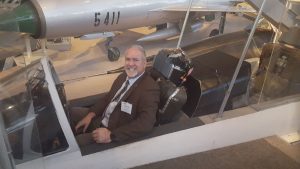
e  on at the Museum of Flight, and during our visits to the innovative schools in Highline, we were wowed and we saw wowed lessons and experiences. These experiences included students explaining to us what competency based learning means (i.e. take a year of Spanish in a few months for credit and advancement at the high school); what individualized pacing with artificial intelligence looks like (i.e. with advanced curricular resources); in addition, we learned about how the principals and teachers were building cultures of excellence and managing change. On behalf of Students, Staff, and community!
 Our challenge, and as Nick and I write about in the
  courage. As always, I welcome comments!