2025 Year in Review: Steering Through Change, Staying Grounded in People

2025 Year in Review: Steering Through Change, Staying Grounded in People

Dr. Michael Lubelfeld | December 2025

As we approach the end of another year, I am filled with pride and gratitude for the collective achievements and impressive spirit of our students, staff, families, and community. The period from January to December 2025 has been marked by significant progress, innovation, and recognition for North Shore School District 112. It is my pleasure to share some of the highlights that have defined our year and reinforced our shared commitment to excellence.

This was a year of doing many things at once—strengthening the fundamentals that families rely on every day, while also pushing the system to adapt faster to what’s coming next. Not because change is trendy, but because schools can’t afford to be late.

The headline of the year: “Who decides?”

Our most defining work with artificial intelligence wasn’t really about AI tools—it was about governance.

We reframed a common question (“How do we use AI?”) into a better one:

Who gets to decide how we use AI in school?

That shift changed everything. Instead of treating AI as just another ed-tech rollout, we approached it as a learning-and-leadership challenge grounded in people, ethics, equity, and genuine student agency.

Student voice moved from “input” to “co-authorship.”

A major focus in 2025 was making student voice authentic—not symbolic.

That meant creating structured opportunities for students to:

  • test and learn within clear guardrails,

  • build AI literacy through real tasks (not hype),

  • shape norms and expectations around responsible use,

  • and contribute meaningfully to how we think about AI in learning.

When we treat students like partners in the work, trust grows faster—and the quality of the work improves.

Adult readiness: momentum, mixed feelings, and honest concerns

We also observed an increasing use of AI by educators for planning, differentiation, productivity, and operational support. At the same time, staff and community concerns remained real and worth addressing—not to be dismissed.

In 2025, we had to hold two truths at once:

  • AI can help teachers and students in practical ways.

  • AI also raises legitimate questions about privacy, integrity, equity, and environmental impact.

My stance stayed consistent: cautious optimism with guardrails.

Culture and community: the work behind the work

Innovation gets attention. Culture determines whether innovation survives.

This year included steady, unglamorous work:

  • tightening communication rhythms,

  • reinforcing professional learning and expectations,

  • listening through disagreement,

  • and leading with clarity when consensus wasn’t available.

Public education is not a “make everyone happy” business. It’s a “be coherent, transparent, and student-centered” business.

The program reflection stayed on the table

2025 also included continued reflection on academic programming—asking hard questions about sustainability, access, and long-term direction. That includes dual language conversations and how we evaluate programs through the lenses of equity, design, and community needs.

Program evaluation is not a verdict. It’s a discipline.

Our district’s dedication to academic excellence was prominently recognized this year. On the 2025 Illinois School Report Card, all nine of our schools earned one of the top two state designations. We are incredibly proud that Braeside Elementary School achieved the highest possible ‘Exemplary’ rating, placing it among the top 10% of schools statewide, while our other eight schools earned strong ‘Commendable’ ratings. This is a powerful validation of our educators’ hard work and our students’ perseverance. It also reflects the impact of our focused instructional efforts.

Across the district, we have now seen over four years of continuous growth in literacy achievement, laying a strong foundation for student success. We remain sharply focused on our “Wildly Important Goal” (WIG) of improving English Language Arts (ELA) proficiency. This year our students performed in the 88th percentile statewide in ELA and 90th percentile in math

Modernization and sustainability remained part of our identity

This year marked a historic milestone in our long-range facilities plan. In August, we celebrated the grand reopening of Ravinia Elementary School, a project that transformed our oldest school into a state-of-the-art learning environment.

The multi-million-dollar “gut rehab,” made possible by our community’s overwhelming support of the 2022 referendum, has beautifully blended the school’s century-old architecture with cutting-edge features. A highlight of this modernization is the installation of a pioneering geothermal HVAC system – the first of its kind in a U.S. public school – which is expected to significantly increase the building’s energy efficiency.

Our commitment to providing modern facilities continues with the modernization of Sherwood Elementary School. Following a groundbreaking ceremony in February 2025, this project is now more than halfway complete. When finished, Sherwood will feature a new gymnasium, a redesigned main entrance for enhanced safety, a new library, and its own geothermal heating and cooling system.

Meanwhile, we also initiated a major renovation of Braeside Elementary School in August 2025, marking the start of the final phase of our facilities plan. 

A personal note: leadership beyond the district

Outside the district, I continued to learn publicly—through leadership networks, national conversations, fellowships connected to AI and education, and ongoing writing. I don’t separate “district leadership” from “field leadership.” If we’re learning something that matters, we should share it.

What 2025 taught me (again)

If I had to sum up the year’s lesson, it’s this:

Change is coming either way. The question is whether we lead it—or let it lead us.

I’m grateful for the students, staff, families, and community partners who stayed with us—especially when the work was complex. That’s what real progress looks like: not perfect agreement, but shared commitment to moving forward responsibly.

From my internal “End of Year Message to the Community”, sharing video messages from Symvol.io in both English and Spanish

3-minute Video Message in English from Letter (AI Created)

3 minutos Mensaje de video en espanol de una carta (creado por IA)

As we celebrate these many successes, I am also mindful of the challenges we have navigated along the way. Every achievement this year – whether a student’s academic breakthrough, a finished building project, or a community event – was the result of hard work, collaboration, and the resilient character of our District 112 family. It is truly an honor to serve a community that is so deeply invested in the success and well-being of its children.

The achievements of 2025 are a direct result of the powerful partnership among our dedicated educators, talented students, engaged families, and supportive community partners. Thank you for your support, your trust, and your shared commitment to our mission. Together, we have made this year one of incredible growth and pride for our district.

As we look ahead to 2026, I am filled with optimism and excitement for what the future holds for District 112. Wishing you a joyful and healthy new year!

Welcome Back to 2019 – Superintendent Speech – #112Leads

“Notice every step forward and take advantage of each small success.”
– Deepak Chopra

Superintendent’s Welcome Back Message to All Staff:

The opening day of a school year is an exciting time for reuniting old friends, new friends, colleagues, thought partners, and more. All of our hopes and dreams are upbeat and positive on the first days of school — our challenge is to keep this positive vibe every day!

The superintendent of schools takes great pride in welcoming all staff in the back to school institute! I’m proud of our teachers, educational support staff, administrators, Board members, community, parents, and students. In my opening remarks today I shared our “why”, our “how”, and our “what”, please see slides linked here. (this link will open a new window and you’ll need to click to advance each slide if desired)

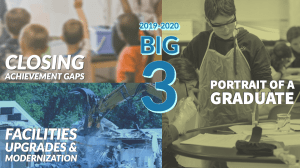
This school year we have many important initiatives on the horizon that present exciting opportunities and challenges. These big three areas of focus will represent our district’s “WHY” for the year ahead. Learn more about each at www.nssd112.org/BigThree.

The Big Three Focus areas for 2019-2020

Portrait of a Graduate – We “begin with the end in mind” and continue our The Modern Learning Committee’s work on a Portrait of a District 112 Graduate. The Vision for the Modern Learning Committee is to recommend actions for District 112 regarding the integration of technology, professional development, and the skills needed to ensure students are successful. The initiatives that result from the work of the committee are intended to serve as guideposts for all district operations. Developing the Profile of a District 112 Graduate was the major focus during the first four meetings of the committee. The profile characteristics for graduates in District 112 are – Mastery of Grade Level Performance Expectations, Self-directed Learner, Continuous Curiosity, Find and Evaluate Information, Learning and Innovation Skills, Open-minded to Other Perspectives, Positive and Active Citizens. See full descriptions of each of these characteristics.

Closing Achievement Gaps – Student Learning for ALL (special report to the Board on October 1). We are so proud of the impact and initial success of the teaching and learning reforms implemented over the past three years across the District. The department has also been very busy over the past summer working with teachers from across the District to develop curriculum and guides to prepare for the 2019-2020 school year. This included the development of vocabulary to accompany the units of study in middle school language arts; collaboration between Spanish and French teachers for implementation of the new world language resources; work to prioritize Illinois Learning Standards for implementation of the new social studies curriculum resources; Middle School math teachers worked on unit planning and attended the Math Learning Center Leadership Institute; teachers collaborated to develop Music curriculum for grades K-8 curriculum scope and sequence and pacing; and many other areas of professional development and curricular planning.

Facilities Upgrades & Modernization – Continuing the Northwood project and finalizing plans for the Edgewood Middle School modernization as well as ongoing upkeep of all school facilities. This also includes a transition of Northwood students and staff to Northwood Jr. High at Elm Place. Preliminary planning is also underway for a transition of Edgewood students in 2021. Visit www.nssd112.org/LRPConstruction for information regarding the Middle School Modernization Projects.

The Wow Factor – #engage109 #suptchat

Great things in business are never done by one person, they’re done by a team of people.”
– Steve Jobs

Every day in every classroom everywhere, student voices should be filling the halls, rooms, gymnasiums, cafeterias, playgrounds, buses, everywhere with “WOW” language.

At some recent professional leadership learning conferences I was WOWED with the experience, the possibility for extending that “wow” to all of the students and staff I serve, and reminded we CAN and we MUST WOW our communities!

As educators we have a gift in our calling to serve, teach and lead. The gift is creating the WOW every day for every child. Each child has but one year to spend with us (typically we have children in our grade level for one academic year). We adults get “do overs” annually but the children have but one time to be a 1st grader, an 8th grader, etc. Thestudents do NOT get “do overs” – we owe them WOW moments.

I believe we owe the students WOW moments all the time. My role as a superintendent of schools and a national leader affords me incredible opportunities to both have and create WOW moments. Wow moments for my own development as a leader, wow moments for colleagues and peers through national, statewide and regional leadership, and most important – helping others create WOW moments for students and staff.

Todd Whitaker (highly respected educational leader, professor, author, and speaker) says “10 days in a row” – meaning we must engage, inspire, empower – every day – every child – every learning encounter. In education our profession is too critical to mess up – to create wow moments 7 out of 10 days for example. 10 days in a row … we must do this because the students rely on us to be ready for them and to provide limitless opportunities for them every day.

The past few weeks have been quite busy for me professionally as I have participated at the state superintendent conference, an executive briefing at Apple in Cupertino, CA, I also attended a Visible Learning conference with John Hattie (himself perhaps the greatest research aggregator of our modern times), and I co-led the American Association of School Administrator (AASA) Digital Consortium Fall Conference in Seattle, WA with my good friend Nick Polyak.

At the Digital Consortium Fall Conference we spent time at three schools in the Highline School District; we also spent time at the Museum of Flight and Boeing in Seattle, WA.

So at Apple and at Boeing we educational leaders got to learn first hand what jobs are needed today as well as tomorrow at two of the planets most impactful companies. We got to see what a modern, contemporary workspace looks like. We got to see what a factory in 2017 looks like – it’s a lot different than the factory of 1917 for which the foundation of US public schooling is built. We thought leaders are doing great work disrupting archaic organizational structures in preparation for 2017 – and for 2020, 2025, and beyond.

At Apple and at Boeing I was WOWED around every corner – I cannot share photos because we are not permitted to take or share photos (corporate protection is real and necessary) though I can share with you how and why I was wowed – but more importantly and far more impact-fully I can share how and why we can and must provide WOW moments for every student every day.

I can share photos from the Museum of Flight – I am sharing photos throughout the text of this post.

While we were engaging in US and world history discussions as well as science and technology history discussions and math and engineering discussions, we were WOWED.

We learned about sociology, manufacturing, coding, computer programming, photography, digital photography, national security and more. We were engaged in our learning. We were provided both whole group and small group learning experiences. Our docent was able to differentiate, individualize and even personalize our experiences. We were learners – we were learning – we were engaged, inspired, and empowered. We connected our own interests, knowledge, and thoughts with the content (the exhibits). We were able to imagine, think, … learn.

In our 30-60 minute lesson at the Museum of Flight, and during our visits to the innovative schools in Highline, we were wowed and we saw wowed lessons and experiences. These experiences included students explaining to us what competency based learning means (i.e. take a year of Spanish in a few months for credit and advancement at the high school); what individualized pacing with artificial intelligence looks like (i.e. with advanced curricular resources); in addition, we learned about how the principals and teachers were building cultures of excellence and managing change. On behalf of Students, Staff, and community!

Our challenge, and as Nick and I write about in the Unlearning Leader: Leading for Tomorrow’s Schools Today, and what Nick and PJ and I write about in Student Voice: From Invisible to Invaluable, is to provide true and meaningful engagement for ALL students – every day.

We can do it – we have the knowledge and we must have thecourage. As always, I welcome comments!


Leadership! Episode 3 of 3 – Perspectives in Education Podcast

“Without excellence, we have lost our honor. Without honor, we have lost our integrity. And without integrity, we are all lost.”
– Anonymous

Nick and I wrote the following as the first two paragraphs of the conclusion of our book (p.95): “The premise of this book is that we all need to unlearn because old conventions stymie meaningful change. In addition, learning is very difficult to unlearn. The “wiring” in our brains is hard to alter. Once we learn what is right, it’s often almost impossible to unlearn and accept a new right. As we stated in the beginning of the book, our landscape as leaders is applied to school leadership, classrooms, pedagogy and educational systems in general.In order to change course and effectively prepare today’s youth for tomorrow, we submit that much of what we have learned in general over the course of our lives, education, and professional careers must be unlearned in order to provide a new tomorrow for our nation’s children. It’s urgent to reimagine education. It’s urgent to pack up the 19th Century and move it into a museum. It’s urgent to unlearn so we can create a modern educational system for our nation’s youth.”

The process of writing a book, going through editing, copy-editing, revisions, rewrites, and peer review was energizing and humbling at the same time. Nick and I are really proud of The Unlearning Leader: Leading for Tomorrow’s Schools Today (2017-Rowman & Littlefield). The three podcast series from Perspectives in Education allows the reader and the prospective reader a chance to get to know us, our perspectives, and the value of the book! Please reach out with any questions – share comments to this post – and if you like the book, please consider sharing a review on Amazon!


 S01 Episode 6 Part 3: Mike Lubelfeld and Nick Poylak: Superintendents, #suptchat hosts, and authors.

Episode 6 Part 3: Superintendents, #suptchat hosts, and authors.

Our guests for our 3 part mini series of episode 6 are Mike Lubelfeld and Nick Polyak.

Michael Lubelfeld, Ed.D. currently serves as the superintendent of schools in the Deerfield, IL Public Schools (District 109). He is the co-moderator of #suptchat – the superintendent educational chat on Twitter.

Nick Polyak, Ed.D. is the proud superintendent of the award-winning Leyden Community High School District 212. He is the co-moderator of #suptchat – the superintendent educational chat on Twitter.

Both are co-authors of a book called The Unlearning Leader: Leading for Tomorrow’s School Today

In this episode we discuss:

  • Characteristics of good leaders
  • How to unlearn things of the past
  • Preparing students for college, workforce, and how to be good citizens
  • Their Perspectives on Education

Please share and comment!  Would love to get feedback and suggestions.  If you are interested in sharing your story, please reach out to us!

Thi

What does the superintendent do all summer? #Engage109

“Make sure that team members know they are working with you, not for you”
– John Wooden

What is going on in #Engage109 this summer?  What do we do all summer is a common question I have been asked for most of the 25 years I’ve been in education! Well it’s official – we are in school year 2017-2018! We have a guiding Strategic Plan, we have many new leaders, we will have a new board member on the way – it’s a whole new year. Aside from running summer school with more than 500 students, overseeing major summer construction projects approaching $5Million dollars, and the on-boarding of nearly 10 new leaders, we’re also making sure we have plans for meetings, workshops, professional development, curriculum development and other milestone events for all administrators.

As far as we’re concerned, it’s time for 2017-2018 to start (Ok … we’ll wait a few more weeks …).

In addition, we’re reaching end of life for hundreds of nearly 10 year old Promethean Boards, so the Technology Team is rolling out new projection and whiteboard systems to replace the Promethean boards in all six campuses.  Our Director for Innovative Learning, Marcie Faust and many of our outstanding iCoaches have trained nearly 64 teachers in summer workshops thus far and expect another 57 on the scheduled dates in July and August!  This is in addition to widespread learning sessions in the multiple classrooms at each building that we had set up last spring as a “debut”.  

We also continue to close the fiscal year that ended on June 30, and we prepare for the annual auditors who are scheduled to come spend two weeks conducting field test at the end of the month.  

In addition, the Director of Buildings & Grounds, Charlie Privett, and the B&G team are exceptionally busy working on a variety of projects throughout the district, including:  

Caruso & Shepard Locker Rooms, Security Projects (throughout the district), Casework at Kipling & South Park, Parking Lots at South Park, Walden, Shepard, & Wilmot, Roof Project at Wilmot, Flooring Projects & Painting Projects Throughout the district, and more!

In addition, I published an article in the IL ASCD Summer Journal and I’m working on a few other writing projects.

So … while the students are enjoying much needed recreation time, the leadership team is busy making sure everything will be ready for them in August!

I always smile when folks say “It’s easier in the summer, right?” – nope – but I would not want it any other way.


Teacher & Edu Staff Appreciation Day/Week – Thank You #Engage109

This is teacher, nurse, educational support staff (and administrator) appreciation week! We can never say thank you enough to our educators!! THANK YOU!

I’m sharing a quote I have held closely for many years and I’m sharing two notes I recently sent the DPS109 community.

“How important it is for us to recognize and celebrate our heroes and she-roes.”
Maya Angelou


Dear District 109 Families and Community Members,

At its last meeting, the Board of Education declared Tuesday, May 9, 2017 as Teacher Appreciation Day in District 109. Please join the Board of Education and the District administration team in applauding our teachers and all of the educators and support staff throughout District 109 who work so hard each day. We have high-achieving, nationally recognized, innovative, warm and welcoming schools because amazing teachers engage, inspire and empower our students – your children, grandchildren, and the children of your friends and neighbors!

I encourage you to find a way to show your support to your favorite teacher, or any school staff member who makes a difference in the lives of the children in our community. Whether you write a heartfelt, handwritten note, have your child create a work of art, or just go out of your way to say a personal “Thank you,” you are giving a great gift. They deserve all the thanks that we can shower upon them!

Sincerely,
Mike


“If we neglect our gifts and talents, they, like an unused muscle, will atrophy and waste away.”  Stephen Covey

Dear District 109 Teachers and Staff,

The Board of Education recently approved our 2017 Strategic Plan. The planning process was both reflective and forward thinking, and very eye-opening to me. I realized how much we have accomplished in four short years.  I also acknowledge and thank you for being open to change. I know that’s not easy. Your leaps of faith and constant hard work have allowed our students to thrive, and schools to achieve local, regional and national recognition. In the strategic planning process we should all be proud of the input and impact of that input. Your voices and your input helped shape the goals, objectives and plans. I look forward to working with you and for you to achieve our goals in the coming years.

On April 24, the Board of Education declared Tuesday, May 9, 2017 Teacher Appreciation Day in District 109. The community will celebrate you throughout the week. To show our thanks, the District administration and Board will provide a gift and special treat at some point during the week. They are small tokens of our boundless appreciation of you and your continual work to engage, inspire and empower our students, their parents, your colleagues, and our community.

So THANK YOU, from me personally, and from the Board of Education and District leaders, for allowing us to work with the best team of educators in the nation.

Sincerely,
Mike

Our New Strategic Plan – #engage109

“If you want extraordinary results you must put in extraordinary effort.”
– Cory Booker

On Monday, April 24, 2017, the Board of Education of the Deerfield (IL) Public Schools District 109 approved the 2017 Strategic Plan! This new plan is the outgrowth of focus groups, interviews, surveys, studies, analysis, and leadership. More than 1700 voices have been heard as part of this process.

We have a Portrait of a Graduate, a mission, vision, guiding principles, goals and objectives.

This is the District’s Guiding Document! All actions, plans, initiatives, plans, programs and reviews will be aligned with and measured against this plan and its components.


From my letter to the community in the Plan:

On behalf of the Board of Education, I am proud to present the 2017 Strategic Plan. We developed this plan with input from more than 1,700 people in our community through interviews, focus groups, surveys, data analysis and student performance.

Those 1,700 people included representatives from the following stakeholder groups: teachers, parents, students, support staff, community members, business leaders, government leaders, administrators and members of the Board of Education.  The plan lays out the mission, vision, portrait of a graduate, guiding principles goals and objectives. This plan will guide our work on behalf of the children we serve. The three broad goals to which the objectives are aligned clearly share that which we value: Limitless learning experiences for ALL children.

The 2017-18 school year will mark the first year of implementation of this plan.  I look forward to working with our entire community as we embark on shaping the future of education in the Deerfield Public Schools. Thank you for your continued support as we continue to Engage, Inspire, Empower our students, each other, and our entire community.

We take the concept of limitless learning experiences for ALL children very seriously. We do believe that the current, 19th Century structures serve many of our students and families (it’s familiar and it’s a system that is not completely broken). But, there are more and more students for whom the current system simply does not work. There are more and more students for whom the current structures block their growth and potential. Just because the systems have worked for more than a century does not believe we have to continue them blindly with no options.

This current Strategic Plan allows us to move beyond the 19th Century structures. We can move beyond our 20th Century accomplishments and struggles. We can move forward in this current 21st Century with vision, mission, “the end in mind” and options!

The three goals form the umbrella of the driving forces toward our future – a future where we design, create, implement, and evaluate Limitless learning experiences for ALL children.

Tied to these goals we have six objectives each for a total of eighteen objectives. The objectives were vetted by members of the Board of Education, our research partners ECRA Group, and the Leadership Team (assistant superintendents, principals, associate/assistant principals, executive directors, directors coordinators, etc).

Tied to these eighteen objectives we have formulated eighteen action plans! We’ll tie our work to this plan. We’ll align our work to these objectives. We’ll report more throughout the next few years. In three years we’ll review the entire plan to see what is still relevant. Annually we’ll report on progress, planning, and evaluation. This will be a LIVE plan – not a plan that sits on a binder.


I Voted Today! What does this mean? Decision Making #engage109

“Teamwork is the ability to work together toward a common vision. The ability to direct individual accomplishments toward organizational objectives. It is the fuel that allows common people to attain uncommon results.”
– Andrew Carnegie

Democracy is a value ingrained in the “DNA” of Americans. Our entire education system is based upon democratic principles, our Declaration of Independence from the British Monarchy declares our rights to be independent (men and women).  “…certain unalienable Rights, that among these are Life, Liberty and the pursuit of Happiness.”

Liberty is the right most closely aligned with voting. The right to give input is a foundational right we enjoy. We apply and extend democratic principles all through the tapestry of our society.

Ten year olds “vote” for the student council (a governance model in the image of our government). Associations vote their members in for leadership positions. In the USA, we feel it is normal and just to vote for pretty much anything.

Some of you reading this will remember commercials where people voted for the better tasting soft drink on TV. Often couples will vote on which restaurant to attend. Families may vote on what colors to paint their rooms. The concept of voting, choosing, giving input is almost an assumed right as an American. The will of the majority rules so many of our institutions of government and society. The majority rule, though, is not the only rule in democratic societies. The rule of 3/5 or “super majority” as well as the rule of “plurality” (the number of votes cast for a candidate who receives more than any other but does not receive an absolute majority.)

In leadership, though, even in a democratic republic, sometimes the elected representatives vote in a different way than their constituents. This does not mean theydisregard the input, it simply means that multiple factors influence decisions.

In general, if you don’t vote can you really complain about the decisions made on your behalf? No, I don’t think so, that’s why I vote; I want to have a voice, whether it is a large voice or a small voice, whether my candidate choices win or not – at least I can say I voted! I went to the table to give my input and in some small way I contributed to our democratic way of life.

I vote for candidates who I believe will represent me, my values, my interests, and the choices I would make if I were in their shoes. I don’t expect the folks for whom I cast a ballot to always agree with me, at times, perhaps often, they will be better educated on the particular issues than I.

In the United States our government and ways of life are more Roman than Greek. That is to say we follow a republican form of government (not the political party) but it’s a representative democracy concept. We don’t employ a direct democracy where everyone gets one vote; we have a representative democracy. This means we vote for people who will represent the views of groups of people. For example, members of Congress are assigned to districts, geographic areas, representing certain numbers of people. This is why the decennial census (the population count every 10 years) is so important to political map-makers.

  • I vote in every election.
  • I vote because I can.
  • I vote because I am a free man.
  • I vote because it is my civic duty.
  • I vote because it is my responsibility as a free man to exercise this powerful right – the right to give input as to whom should represent me and my interests.
  • I vote because I hold great value in the power of representative democracy.
  • I vote because I would like to have my input considered.
  • I vote so I can share my views and values and be a responsible member of society.

One of the tenets of voting that some people overlook is that their vote is going to elect others who will represent their interests. Will those for whom I cast a ballot always vote the way I want them to? No – of course not.

Will they take my follow up input under consideration? Yes – that is the beauty of a democratic republic, the type of society in which we live. I would like everyone I vote for to become elected. But that is unlikely since there are many other voters and that is not a realistic wish. I understand this and I’m ok with this.

As a regular part of my role as the superintendent of schools, I regularly give input to our elected representatives in Washington, D.C., and in Springfield, IL. I would like them to consider my input even if they disagree with it. They may disagree in principle or they may disagree because they are better informed, or they may disagree for political reasons. They also may take my input and form, reform, or transform their beliefs!

I vote for school board members (even my own bosses!); I vote for village trustees and township trustees; I vote for friends, neighbors, colleagues, folks about whom I know a lot and at times, I vote for folks about whom I do not know a lot, but who are aligned with a political coalition I support or understand.

Many voters select based upon political party or candidate gender or candidate ethnicity. It is free choice; people can literally vote for anyone who is on the ballot (and at times they can enter a “write-in” candidate too). That is the beauty of living in a free society.

What does democracy mean in the workplace?

I consider myself to be an inclusive and collaborative leader. I seek input and views and votes from the people likely to be impacted by a decision or set of decisions. I work in an industry full of committees, viewpoints, processes, procedures, etc.

I work for an elected non-partisan school board made of seven citizens who, with me, form a governance team of 8 to manage and govern the school district. I seek input from the nearly 500 employees whom I serve and employ.

Do I always agree with every one of their votes? (no) Do I always do what the will of the majority requests? (no) The plurality (the larger number of votes when a majority is not there)? (no)

Or do I consider their input with care, concern, and respect, and make a decision based upon the combination of input, voice, votes, research, evidence, etc. YES – As a leader I truly have to balance the will of the many with the right decision – often equal or congruous with the will – but not always.

The paradox of leadership is leading with an inspired vision and per a collective plan, mission, agenda, vision, etc.

Seeking input, empowering people yet “at the end of the day” realizing that “the buck stops here” and the accountability and responsibility rests with the leader.

Not following the will of the majority is not rejecting input. Not following the will of the majority is not “not listening”. From time to time the leader must seek input, gather facts, anticipate impact and … well … lead. Sometimes leading means helping the group see a different reality than the one they think they want or the one they think is right.

Recently as part of our work, I shared committee recommendations and my administrative recommendation to the Board of Education (there were sometimes differences in the committee recommendation and my ultimate decision). These examples about which I refer are from the 2013-14 Superintendent’s Task Force for Middle Level Education. This coalition of students, parents, teachers, administrators, community leaders, and board members, a 140 member stakeholder community engagement group, made recommendations for improvement to our middle schools.

I took input from many, shared the input publicly, reviewed a number of factors, synthesized the priorities and make a recommendation. For the elective areas I took all the votes/input and I made a recommendation with some differences. The input continues to guide decision making and resource allocation. The STEM team recommendations were accepted 100%.

The challenge of a leader in a democracy is to respect input and consider the votes and then decide what is in the best interest of the many and to lead. The leader may know more and be able to see around corners the people cannot yet see. The leader often needs to have vision beyond the past experiences and limits of the group. The leader needs to lead and challenge the process and manage the change process.

Does your vote and your input guarantee that your choices will be advocated? No – just like the village trustee for whom I cast a ballot will vote his/her conscious when employees give input, or vote, if you will, they are giving input to the representatives who will ultimately decide what action to take. Your vote does guarantee that your views will be at the table and respectfully reviewed and considered!

What does a leader do when the needs of the many outweigh the needs of the few and the future for which he is leading requires systemic unlearning? Well … with compassion and conviction, he leads.


I’m proud I voted today.

I’m proud that the educators with whom I work continue to share voice, vote, values, viewpoints and vision.

I’m proud to share the Deerfield Public Schools District 109 new Strategic Plan later this month.

The mission, vision, guiding principles, portrait of a graduate, goals, objectives and action plans have been carefully prepared, reviewed, planned, and considered.

The Strategic Plan is created by reviewing input of more than 1700 stakeholders – those who voted in surveys have their voice represented. Those who participated in focus groups have their voice represented. Those who Engage, Inspire and Empower have their voice represented as we “rebrand” and “re form” our educational organization for the next several years.

Khan Academy Leader on Mastery Learning – #Engage109


“Before you are a leader, success is all about growing yourself. When you become a leader, success is all about growing others.”

– Jack Welch

I’m a longtime fan and supporter of Sal Khan and his Khan Academy. Khan started his “education empire” by helping a cousin overseas with math instruction. Then the world changed, the desire for his expertise changed, and pretty much anyone at anytime can learn – for FREE. All you need is drive, desire, and the internet connection. The subjects and topics have grown from math to pretty much everything (see image below). FREE – access for all – 24/7. This is our world today – anyone, anytime, anything at our fingertips. 

A few years ago when I was the superintendent of schools at a small school district near Chicago’s O’Hare Airport (Pennoyer School District 79 in Norridge), we experimented with the Khan Academy in 2nd grade math. It was our first foray into “1:2 computing” – we did not have the funds for one device per student, but we had the funds for one device for two students and we made it work! The courageous teachers, Melissa and Samantha did a fabulous job of demonstrating grit, perseverance, and growth mindset by shifting their construct and concept of math and by changing their instruction to meet the needs of modern 21st Century learners.

In many ways Khan and his modern work have revolutionized access, digital power, transformation, and an entire mindset shift of what education is and can be – and should become. A lot of the work I have been writing about lately is stated far more eloquently and articulately by Sal Khan!

Earlier this year I participated in a book study with Kipling School and their faculty where we took a chapter, topic, concept, and wrote reflections. The other day I was reading Pioneering from the Education Reimagined group, and I came across a 2016 video from Khan that relates to recent posts as well as current events in the Deerfield Public Schools District 109. Our journey is powerful and we have written a number of articles about successful change management and growth for staff and students. Our journey continues – the road from good to great does not end at great – it only continues to stay great.

His messages are powerful, his approaches make sense, Khan is the present and the future! Please check out his video and share any comments.

We have the research! Let’s update our practices! #Engage109

“Many people die with their music still in them.”
– Oliver Wendell Holmes


As educators, it’s our job to help them find their music!

I think that the superintendent of schools should ensure that all children have access to educational opportunities despite decades of segregation and practices that have overtly and covertly separated children who learn differently.

Segregation due to race ended by law in 1954, but there have been other ‘segregationary’ practices – some well intentioned as well – like special education, exclusionary tracking, etc..

Often districts and schools practice “sifting” and “sorting” of students, these are practices that have, in general, led to disparate equity of educational opportunity across the schools, districts, states, and nation.

Regardless of evidence and research findings, many educational programs and practices still exist because school systems and leaders don’t understand how to manage change or because they are afraid to change.

When Public Law 94-142 (the special education law) was enacted in 1975, four main purposes were:

  • “to assure that all children with disabilities have available to them … a free appropriate public education which emphasizes special education and related services designed to meet their unique needs
  • to assure that the rights of children with disabilities and their parents … are protected
  • to assist States and localities to provide for the education of all children with disabilities
  • to assess and assure the effectiveness of efforts to educate all children with disabilities”

Source: Education for All Handicapped Children Act, 1975

The reality is that since 1975, many well intentioned educational programs for diverse learners ended up creating separate (but equal) “programs” and “service delivery models” for various learners.


I also think that it’s incumbent upon a superintendent to share the latest evidence, research, information, studies, etc. with his/her community to inform and improve practices.

I believe in the concept of innovation (changing for improvement).

You have probably heard about John Hattie. Specifically, you may have heard about his research on the factors that affect student achievement. Hattie uses effect sizes to show the relative impact of each factor. An effect size of 0.4 is regarded as average or typical. His work is ongoing. To my knowledge, his results were 1st published in 1999. They became well-known after he published a book in 2008 called Visible Learning. His results were last updated in late 2016. This Hattie effect size 2016 update summarizes these new findings in the context of what went before.

Despite overwhelming evidence to the contrary, see Hattie, et. al, for example, updated in 2016, many “mythological” and ineffective educational practices are still in place all over the school systems because “that’s the way it’s always been done“. Doing what’s right is not always popular – but we have no excuses for not doing what’s right.

The figures below show the latest findings from Hattie’s meta-analyses about the most effective instructional practices.  (I have written about Hattie‘s findings from time to time): (from the figures below, the concept of teacher credibility has an effect size of 0.90 and feedback has an effect size of 0.73, acceleration has an effect size of 0.68, for example).


Hattie’s studies have found that an effect size of 0.40 reflects the average impact of an intervention; those above 0.40 are more impactful. (click on the images below to go to the source)

Teacher Credibility Defined:

According to Hattie teacher credibility is vital to learning, and students are very perceptive about knowing which teachers can make a difference. There are four key factors of credibility: trust, competence, dynamism and immediacy. In an interview Hattie puts it like that: “If a teacher is not perceived as credible, the students just turn off.”

Examples for teacher credibility: Earn trust by showing trust towards pupils. Appear highly organised in the presentation of the subject matter. Develop a powerful style of speaking that uses few verbal hesitancies such as “OK” or “you know”. Reduce distance between teachers and students by moving or moving away from barriers (e.g., desk, podiums). Source: cie.asu.edu

The impact of a teacher on a student’s learning is so important that it’s arguably the most important duty of an administrator to select teachers who are predictive of excellence.


Goals to mathematics are 0.40-0.49 effect size
Play programs to preterm birth weight are 0.50-0.59 effect size
Teaching strategies to acceleration are 0.60-0.69 effect size
Feedback (0.73) to Teacher credibility (0.90) complete the list


The role of superintendent of schools is often a mysterious role. I have found that many people don’t really know what a superintendent actually does on a daily basis. Some think it’s like an “uber” principalship, others think it’s like a “CEO” of a corporation, and still others really have no idea. From time to time I write about what a superintendent does.

From my employment contract it states my responsibilities and duties as superintendent:

The Superintendent shall have charge of the administration of the schools under the direction of the Board; he shall be the chief executive officer for the Board; he shall recommend the selection, retention and dismissal of, and direct and assign, teachers and other employees of the School District under his supervision; he shall organize and direct the administrative and supervisory staff; he shall make recommendations to the Board concerning the budget, building plans, location of sites, and the selection of textbooks, instructional material, and courses of study; he shall direct the keeping of all records and accounts, and aid in the making of all reports, as required by the Board; he shall recommend rules, regulations, and procedures deemed necessary for the welfare of the School District; and, in general, he shall perform all other duties incident to the office of the Superintendent as the Board may delegate to him or as required by law.


Subsequent blog posts will reflect on the duties of a superintendent who must lead to ensure that ALL students receive high quality education with structures and systems supported by evidence. It’s time to stop doing what is easy and wrong! It’s time to do what is right – even when it makes people change.


Just because our school system was designed in 1893 does not mean that we should still act like it’s 1893!