I Voted Today! What does this mean? Decision Making #engage109

“Teamwork is the ability to work together toward a common vision. The ability to direct individual accomplishments toward organizational objectives. It is the fuel that allows common people to attain uncommon results.”
– Andrew Carnegie

Democracy is a value ingrained in the “DNA” of Americans. Our entire education system is based upon democratic principles, our Declaration of Independence from the British Monarchy declares our rights to be independent (men and women).  “…certain unalienable Rights, that among these are Life, Liberty and the pursuit of Happiness.”

Liberty is the right most closely aligned with voting. The right to give input is a foundational right we enjoy. We apply and extend democratic principles all through the tapestry of our society.

Ten year olds “vote” for the student council (a governance model in the image of our government). Associations vote their members in for leadership positions. In the USA, we feel it is normal and just to vote for pretty much anything.

Some of you reading this will remember commercials where people voted for the better tasting soft drink on TV. Often couples will vote on which restaurant to attend. Families may vote on what colors to paint their rooms. The concept of voting, choosing, giving input is almost an assumed right as an American. The will of the majority rules so many of our institutions of government and society. The majority rule, though, is not the only rule in democratic societies. The rule of 3/5 or “super majority” as well as the rule of “plurality” (the number of votes cast for a candidate who receives more than any other but does not receive an absolute majority.)

In leadership, though, even in a democratic republic, sometimes the elected representatives vote in a different way than their constituents. This does not mean theydisregard the input, it simply means that multiple factors influence decisions.
In general, if you don’t vote can you really complain about the decisions made on your behalf? No, I don’t think so, that’s why I vote; I want to have a voice, whether it is a large voice or a small voice, whether my candidate choices win or not – at least I can say I voted! I went to the table to give my input and in some small way I contributed to our democratic way of life.

I vote for candidates who I believe will represent me, my values, my interests, and the choices I would make if I were in their shoes. I don’t expect the folks for whom I cast a ballot to always agree with me, at times, perhaps often, they will be better educated on the particular issues than I.

In the United States our government and ways of life are more Roman than Greek. That is to say we follow a republican form of government (not the political party) but it’s a representative democracy concept. We don’t employ a direct democracy where everyone gets one vote; we have a representative democracy. This means we vote for people who will represent the views of groups of people. For example, members of Congress are assigned to districts, geographic areas, representing certain numbers of people. This is why the decennial census (the population count every 10 years) is so important to political map-makers.

  • I vote in every election.
  • I vote because I can.
  • I vote because I am a free man.
  • I vote because it is my civic duty.
  • I vote because it is my responsibility as a free man to exercise this powerful right – the right to give input as to whom should represent me and my interests.
  • I vote because I hold great value in the power of representative democracy.
  • I vote because I would like to have my input considered.
  • I vote so I can share my views and values and be a responsible member of society.

One of the tenets of voting that some people overlook is that their vote is going to elect others who will represent their interests. Will those for whom I cast a ballot always vote the way I want them to? No – of course not.

Will they take my follow up input under consideration? Yes – that is the beauty of a democratic republic, the type of society in which we live. I would like everyone I vote for to become elected. But that is unlikely since there are many other voters and that is not a realistic wish. I understand this and I’m ok with this.

As a regular part of my role as the superintendent of schools, I regularly give input to our elected representatives in Washington, D.C., and in Springfield, IL. I would like them to consider my input even if they disagree with it. They may disagree in principle or they may disagree because they are better informed, or they may disagree for political reasons. They also may take my input and form, reform, or transform their beliefs!

I vote for school board members (even my own bosses!); I vote for village trustees and township trustees; I vote for friends, neighbors, colleagues, folks about whom I know a lot and at times, I vote for folks about whom I do not know a lot, but who are aligned with a political coalition I support or understand.

Many voters select based upon political party or candidate gender or candidate ethnicity. It is free choice; people can literally vote for anyone who is on the ballot (and at times they can enter a “write-in” candidate too). That is the beauty of living in a free society.

What does democracy mean in the workplace?

I consider myself to be an inclusive and collaborative leader. I seek input and views and votes from the people likely to be impacted by a decision or set of decisions. I work in an industry full of committees, viewpoints, processes, procedures, etc.

I work for an elected non-partisan school board made of seven citizens who, with me, form a governance team of 8 to manage and govern the school district. I seek input from the nearly 500 employees whom I serve and employ.

Do I always agree with every one of their votes? (no) Do I always do what the will of the majority requests? (no) The plurality (the larger number of votes when a majority is not there)? (no)

Or do I consider their input with care, concern, and respect, and make a decision based upon the combination of input, voice, votes, research, evidence, etc. YES – As a leader I truly have to balance the will of the many with the right decision – often equal or congruous with the will – but not always.

The paradox of leadership is leading with an inspired vision and per a collective plan, mission, agenda, vision, etc.

Seeking input, empowering people yet “at the end of the day” realizing that “the buck stops here” and the accountability and responsibility rests with the leader.

Not following the will of the majority is not rejecting input. Not following the will of the majority is not “not listening”. From time to time the leader must seek input, gather facts, anticipate impact and … well … lead. Sometimes leading means helping the group see a different reality than the one they think they want or the one they think is right.

Recently as part of our work, I shared committee recommendations and my administrative recommendation to the Board of Education (there were sometimes differences in the committee recommendation and my ultimate decision). These examples about which I refer are from the 2013-14 Superintendent’s Task Force for Middle Level Education. This coalition of students, parents, teachers, administrators, community leaders, and board members, a 140 member stakeholder community engagement group, made recommendations for improvement to our middle schools.

I took input from many, shared the input publicly, reviewed a number of factors, synthesized the priorities and make a recommendation. For the elective areas I took all the votes/input and I made a recommendation with some differences. The input continues to guide decision making and resource allocation. The STEM team recommendations were accepted 100%.

The challenge of a leader in a democracy is to respect input and consider the votes and then decide what is in the best interest of the many and to lead. The leader may know more and be able to see around corners the people cannot yet see. The leader often needs to have vision beyond the past experiences and limits of the group. The leader needs to lead and challenge the process and manage the change process.

Does your vote and your input guarantee that your choices will be advocated? No – just like the village trustee for whom I cast a ballot will vote his/her conscious when employees give input, or vote, if you will, they are giving input to the representatives who will ultimately decide what action to take. Your vote does guarantee that your views will be at the table and respectfully reviewed and considered!

What does a leader do when the needs of the many outweigh the needs of the few and the future for which he is leading requires systemic unlearning? Well … with compassion and conviction, he leads.


I’m proud I voted today.

I’m proud that the educators with whom I work continue to share voice, vote, values, viewpoints and vision.

I’m proud to share the Deerfield Public Schools District 109 new Strategic Plan later this month.

The mission, vision, guiding principles, portrait of a graduate, goals, objectives and action plans have been carefully prepared, reviewed, planned, and considered.

The Strategic Plan is created by reviewing input of more than 1700 stakeholders – those who voted in surveys have their voice represented. Those who participated in focus groups have their voice represented. Those who Engage, Inspire and Empower have their voice represented as we “rebrand” and “re form” our educational organization for the next several years.


Assessment is far more than a grade – A caring teacher’s impact on me


“Either write something worth reading or do something worth writing.”
– Benjamin Franklin


With President’s Day approaching (February 20, 2017) I thought it would be a good time to share some thoughts about how a college professor from an undergraduate course on the American Presidency from many years ago impacted my life and my professional journey. A journey that currently has some powerful meaning/relevance with our district’s move to standards based grading and reporting at the middle school. With this blog post, I’ll draw the connections!

As a former 6th and 8th grade social studies teacher (U.S. history, civics, law, world history, reading, etc.) I have a deep interest in our nation’s culture, history, values, beliefs, celebrations, etc. In addition, I hold a degree in political science, so I have been a “policy wonk” for many years, and to this day I follow the news, politics, etc. With President’s Day approaching I am reminded of the powerful impact a professor’s act of kindness and care from many years ago and from an undergraduate course on the American Presidency.


While I was a student at the University of Illinois at Chicago, UIC, I had some of the best teachers in my life. The late Dr. Twiley Barker Jr., Dr. Kevin Lyles, and Dr. Andrew McFarland, to name a few. During a course on the American Presidency, POLS 229, an event took place in my life that impacted my philosophies, beliefs, and actions as a teacher and educational leader over the past 25 years. In some ways it likely shaped my philosophies and impact as a teacher and as an educational leader so many years later. Right now there is a current challenging transition from percentage grades to standards based grades at the middle school level in my district. Looking back at my personal educational history, I’m reminded of why meaningful feedback, teacher /student relationships, and the mastery of content and the flexibility of instruction supersedes any percentage grade or mark in terms of meaningful feedback and communication about learning.


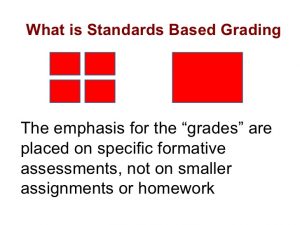
In our district right now we are engaged in a transformation/change process with learning, teaching, grading, reporting and assessing. The implementation of standards based grading, reporting and assessment is ongoing in our school district; there were pretty much no problems when we made the change at the elementary school level (K-5) four years ago.


This is the first year of the middle school implementation of the standards based system, the transition is challenging in part because there is confusion and inconsistency as well as the fact that it is change and that in and of itself causes challenges.

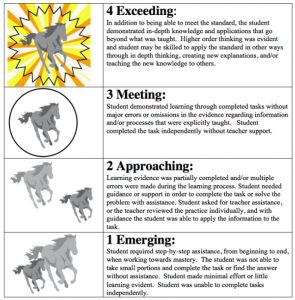
One of the cornerstones of transitioning to standards based learning, grading, etc. is the mindset shift and the concept shift. For example, with the concept shift of instructional change, the zero goes away. The concept of NO MORE ZERO grades and the concept of mastery (or do-over) becomes the focus. Grades/reporting/assessment results are NOT used for “responsibility” or “reward” or “preparation for the next level in education”, instead grades/reporting/assessment results are used to communicate what is learned, what needs to be learned and what is next to be learned. With this blog post, I’m reflecting on the congruity of an impactful event in my life during an undergraduate course, and the realization that this impactful event has impacted my beliefs whether I consciously knew about it or not. This is an “aha” moment for me – this is partially why I so strongly believe the growing pains and transition are worth the time, effort, energy, and extra work involved in the middle school standards based grading situation.

Change is hard (I’ve written a lot about the change process) – Unlearning is hard (I have also written about this concept).

My college professor Dr. Andrew McFarland gave me a chance in the “real world” -when I was in college. Because he knew me, he knew what kind of student I was – he knew my passion for political science he treated me like I was more than a percentage or a score. Dr. McFarland also taught so that students would learn. He had high standards for each and every student and he held himself to high standards too.

So what is this all about? What is this big event that caused me an “aha” moment? Dr. McFarland called me one night while I was eating dinner with my parents; it was 5:30pm – I don’t know how I remember this fact, but I do. This event took place in 1988 or 1999 and I still vividly remember our call!

He called me that night because earlier that day when I took the final exam, I inadvertently forgot to answer one or two additional questions. If Dr. McFarland graded or assessed based on the “old” system I would have received an F. Dr. McFarland, though, was using standards based learning and instruction (whether he or I knew it or not). He called me on the phone and asked me to respond to the final exam question prompts – for 30 maybe 60 minutes. Because he cared about learning – not about percentages or “harsh” lessons, I was able to demonstrate mastery and competency of the American Presidency course (in which I did earn an A, not only because of what I learned, but more importantly, because my professor cared about discovering what his students knew).

He assessed my knowledge acquisition in an alternative learning setting because my teacher was more concerned about assessing my learning and mastery than he was about issuing a grade or a percentage. Had this caring professor used traditional methods I would have failed the exam. In my opinion and in my experiences, standards based grading, reporting, learning, and assessment actually prepares people for real life by holding them accountable to learn. Thank you Dr. McFarland!


You see, opponents to mastery grading, or standards based grading & reporting systems think the “old” 100, 90, 80, 70, 60, 50 percentage system somehow makes sense (it does not) and somehow prepares people for “the real world” (it does not) or prepares them for high school/college.

Well it doesn’t do any of that; but it’s hard for people to unlearn what they know and what they think they know.

It’s hard for people to accept new research studies and effects when those new studies and effects are different than what they experienced.


Our district will transition and in partnership with parents, teachers, administrators, and students, we will do what is best for students. I’m grateful to a wonderful college professor who made a lasting impact on me. A teacher’s impact is lasting and forever; let’s use grades, reporting, and assessment to build strong learned people. Let’s use modern instructional strategies to maximize the impact and effect. Let’s help people unlearn practices that make no sense other than to have been used in their past school experiences. Preparing students for the future world requires teaching them content that is meaningful in learning environments that are powerfully purposeful and full of clear, regular, meaningful feedback and opportunities to learn and demonstrate learning.

5 Minutes in 5th Grade – Podcast of Student Voice – #Engage109

“Without continual growth and progress, such words as improvement, achievement, and success have no meaning.”
– Benjamin Franklin

Many years ago when I taught 8th grade students U.S. history and reading at Blackhawk Middle School in Bensenville, Illinois, the team of teachers with whom I worked grappled with the home/school communication conundrum. We did not have ready access to email or blackhawkmiddleschoolwebsites back then, and we did not always have the most compelling “packets” and paper reminders going home.

So we set up a weekly communication for the parents called “Behind the Nothing”. This was a letter which was a letter written by each student each week for their parents to see and learn what the students learned that week.

You see for most of our students, back then, when their parents would ask, “What did you learn today at school?”, the student would almost always reply, “nothing”. So we decided to create a communication from the student voice and from the student perspectives as a new way to inform their parents what they were learning! Well . . . a lot has happened in education, communication, and technology since 1993 when I first started teaching! Of course students were learning then and they are learning now!

In today’s blog post I’m sharing 5 minutes in 5th grade, a five minute podcast withwhatdidyoulearn students telling the listener what they learned at a recent outdoor education experience. Today’s teacher is equipped with far more tools for communication than the teacher of 1993. Using the application AudioBoom, I recorded the student’s voices on my iPhone. Click the link below to spend 5 minutes in 5th grade!

Special thank you to Dr. Dave Sherman, Ms. Megan Chin, Ms. Keidan, Ms. Kramer, and Mr. Templer and their awesome South Park School 5th grade students!

ENGAGE, INSPIRE, EMPOWER

ENGAGE, INSPIRE, EMPOWER

Reflections from a Book Study – Khan Academy – #Engage109

“We cannot change the cards we are dealt, just how we play the hand.”
– Randy Pausch


bookstudyThere are many ways to lead professional learning for staff. Often there is a meeting of the whole staff, a team meeting, a department meeting, an in-service, a conference, online learning, etc. From time to time in our district we engage in book study experiences to learn together, share common experiences, engage and interact with one another, and participate on their own time.

Recently at Kipling School the principal Anthony McConnell invited me and some other central office administrators to participate in a book study with his staff for Sal Khan’s oneworldschoolhousebook The One World Schoolhouse. This is a professional learning activity in which members of team can engage at any time and at any place is an activity that inherently differentiated. I was happy to be invited and I was happy to contribute.

Every few days another staff member writes a post from one part of the book and several other staff members write comments about the postings. It’s really powerful learning to see, read, think about, and begin to understand the multiple perspectives emerging from the shared experiences of reading this book from an EduRock Star! Khan Academy programming is in use in our schools, in other schools where I have served, and quite frankly, all over the world. Khan’s experiences, origins, purposes, and mission motivates educators and educational leaders at all levels in all settings.

This is a link to the blog with the current post listed first; and then all other posts follow. My section was on an early part of the book: No Frills Videos, Focusing on the Content – cornerstones of Khan’s experiences, background, and methods. I’m sharing excerpts of this post below:

Khan started out tutoring his cousin and using basic technology for the purpose of assisting his efforts at tutoring. He did not set out to become a phenomenon, though he did! Khan aimed to bring back fun to learning. The chalkboard (represented virtually by the black background on which he draws) symbolizes perhaps a simpler time when school was fun. My hope is that school is fun everywhere and every day! My hope is that Khan’s influence in bringing fun and joy back to school permeates the walls of our district and districts all over.

Khan’s videos started out as “no-frills” in part because he was simply tutoring a few people and in part because he is a self-Khanphotodescribed austere person (page 27). What flows throughout the book (and not to get too far ahead of my part here …) is a research and evidence base. Khan’s work and the successes he and the Academy enjoy are actually grounded in research, evidence, study, and affirmation. Though he appears to start out whimsically, he shares small nuggets of evidence and research as the base for his decisions. For example, in this chapter, he spends a few pages identifying why the length of his videos rests around 10 minutes.
I encourage readers to check out the public book study (everything on the internet is public of course) as well as consider my endorsement of Khan’s book as a worthy read!

For more on my experiences with the Khan Academy, and our district’s future focus and commitment to innovation and change, please see earlier posts from this blog:

Online Learning Tool-The Khan Academy from 9/3/2013,

More on the Future of Education – What is School For? from 11/2/2015

The overall purposes of all of these blogs, study groups, books, videos, opportunities and learning is to improve educational opportunities for children and teaching opportunities for staff!

ENGAGE, INSPIRE, EMPOWER

ENGAGE, INSPIRE, EMPOWER

Let’s continue to push the envelopes of change and create new and better realities where we unlock restrictions on learning and we unleash the power of synergy in our classrooms, board rooms, and communities!


Through learning opportunities like this blogging book study, we get to learn with and from one another while gaining new perspectives on current trends. It’s a great experience and I applaud the leadership and staff at the school for letting me tag along on their journey!

Communication is Essential – Leadership in #ENGAGE109

“In union there is strength.”
– Aesop

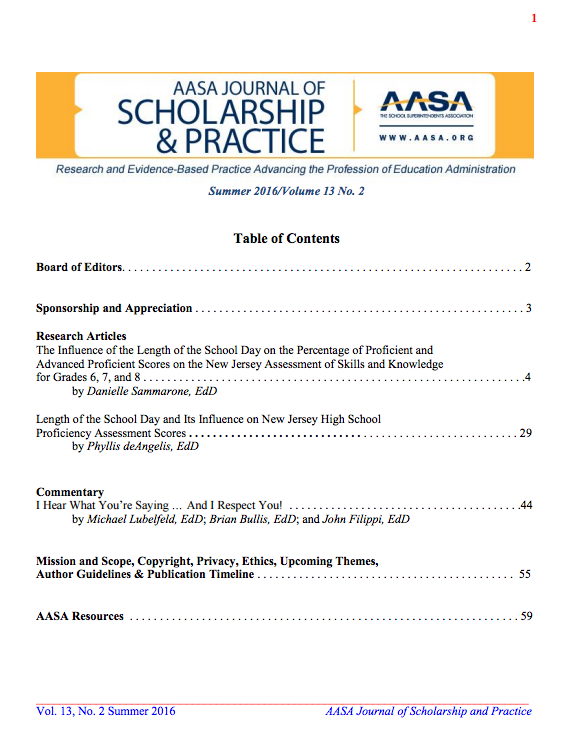
I’m proud to share via the blog a recent Journal article I co-wrote with Dr. Brian Bullis and Dr. John Fillipi, principals at Charles J. Caruso Middle School and Alan B. Shepard Middle School, respectively, in Deerfield Public Schools District 109.

We have focused on organizational culture as a core foundation of our leadership and service.

Please click the image below to link to the article (also linked here)

Our article starts on Page 44

Our article starts on Page 44


We seek input on a regular basis through various modes of collection, including, but not limited to:

Innovation Has Many Forms – #ENGAGE109

“Humility is not thinking less of yourself. It’s thinking of yourself less.”
– C.S. Lewis

IL In our school district we take pride in the words and actions ENGAGE, INSPIRE, EMPOWER. We aim to do this each and every day with and for each and every student, staff member, and the community! Since July 2013 our Big 5 have been driving our actions and initiatives:
Common Core State Standards (a/k/a Illinois New Learning Standards), Next Generation Science Standards
Teacher Evaluation – Charlotte Danielson Frameworks for Effective Teaching
Technology
Organizational Culture
Superintendent’s Task Force for Middle Level Education

ENGAGE, INSPIRE, EMPOWER

ENGAGE, INSPIRE, EMPOWER

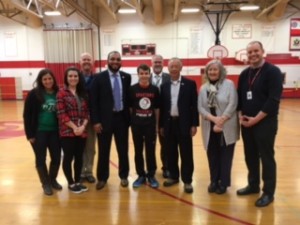
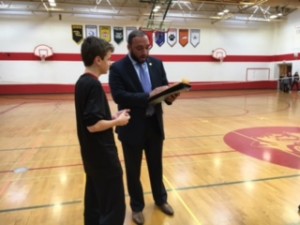
We often write about innovation and we often share examples of the teacher’s innovative practices in blogs, Twitter, Facebook, principal newsletters, emails from the district, in person events, etc. Today I’m writing to celebrate an innovative project experience from 7th grade English Language Arts. In the 7th grade ELA class this year the students had to complete a project entitled:  Change the World. One of our students sent a letter to the Illinois Department of Homeland Security. The boy’s letter was so impressive to the staff that the Deputy Director, James Joseph, called principal, Dr. John Filippi, and he shared his delight at the letter. In addition he offered to come visit the student and his classmates!

IMG_0039 IMG_0035 IMG_0034 IMG_0028 (1)

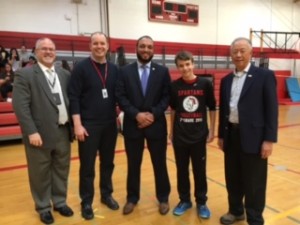
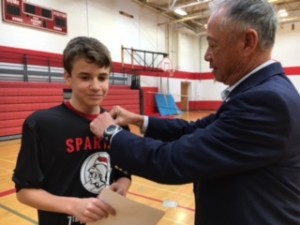
Today Mr. James Joseph, the Director of the Illinois Emergency Management Agency (IEMA) and Deputy Homeland Security Advisor came to Alan B. Shepard Middle School and visited with the student, his classmates and teachers.

In addition he made a brief presentation and answered questions from the students. In the pictures shown to the left we also show another special guest, retired Major General Robert G.F. “Bob” Lee. Gen. Lee was visiting the Governor’s office and it fit into his schedule to join Director Joseph. Gen. Lee shared information about his fascinating service to our country as well as to his home state of Hawaii. Security is a national concern and it’s nice to know we have such able, knowledgeable, talented and able leaders helping defend our nation and our state.

The power of a letter, the power of a communication, the power of an inquisitive student can lead to the highest levels of government, society, agencies, companies, etc. Our amazing teachers are taking learning to new levels with engagement, inspiring lessons and empowerment of students to reach out to “real people” in the world who do the work about which we are learning!

Check the podcast for a 5 minute excerpt of today’s visit:

In Deerfield we truly believe, and we teach our students, that, in the words of Margaret Mead:

Never doubt that a small group of thoughtful, committed citizens can change the world; indeed, it’s the only thing that ever has.

Our students, through agency and voice, are learning that they matter not only in school and at home, but as part of the larger world. It’s wonderful, especially as a public school leader, to show the power ofittakesavillage education and the value of our innovative public education in terms of meaning and relevance.

We are grateful to General Lee, Director Joseph, as well as other dignitaries who have visited our schools like Governor Bruce Rauner, U.S. Congressman Hon. Robert Dold, Illinois Senator Hon. Julie Morrison, Illinois Representative Hon. Scott Drury, Lake County Regional Superintendent of Schools Hon. Roycealee Wood, Deerfield Mayor Hon. Harriet Rosenthal, and many others who visit to engage with students, learn from our teachers, interact with our world class facilities, and in one way or another, show support for meaningful, effective public education!

March Notes – From Staff Newsletter – #Engage109

“Certain things catch your eye, but pursue only those that capture the heart. ”
– Ancient Indian Proverb


Each month we share a newsletter for staff and I open it with some news, views, and information. I’m sharing an excerpt of my portion in the blog today:

As we approach spring it’s exciting to think about how fantastic it is to work in District 109 – and I’ve recently done some really fun work that has allowed me to see, firsthand, the sharing of learning and teaching across the district. In December, I shadowed a 4th grade South-Parkstudent in Samantha Johnson’s class at Walden, and in February, I was honored to teach Emily Wallace’s first graders at South Park as my “Presence is Present” gift. I loved being a teacher again – and I think the students were happy to have me; at least their notes expressed their appreciation! Across the nation there is a movement and news called “Shadow a Student Day” – I’m thrilled to be part of this in Deerfield. I’m so proud of my administrative colleagues who are also shadowing students, substitute teaching, and walking a mile in the shoes of employees!

bad59220-e2f2-4066-93db-3ae2f394b2b6We like to share the great things that are happening in our schools with other educational professionals worldwide.

Many of you use #engage109 and your school hashtags to share your stories with the Twitter world. It’s fun to see the photos and stories scrolling on the District home page, and the school pages! Many of our administrators also write articles and present at conferences about our schools and our work.  I’m proud to share an article that Greg Himebaugh and I wrote for UPDATE magazine, a publication of the Illinois Association of School Business Officials. The article shares how we’ve managed change in District 109 for the benefit of our schools, our students, and our community. Next week, Caruso will host the Illinois Association of School Boards Lake County Division Dinner; board members, superintendents and other educational professionals from all over the county will come for tours of Caruso’s science, STEM and CMA labs, and will hear from District 109 band, orchestra and chorus students. It will be a full-STEAM evening! Thanks to the staff members who are helping us show off!

As I mention often, this is one source of what’s happening in District 109; you can get more information from Board Briefs, found on the Board of Education Meeting Information page of the website, and feel free to check my blog for periodic postings about leadership, education, and District news.

Thank you for continuing your excellence and dedication to the students in the District and for your efforts to engage, inspire, and empower students, families, the community, and each other every day.

District Leaders: Focus on Content First, Tech Second

“True teams are made when you put aside individual wants for collective good.”
– Chiney Ogwumike

Today I’m attending a professional conference hosted in our district and jointly organized by local school districts – North Shore School District 112, Township High School District 113, and our District, the Deerfield Public Schools – District 109; we also welcome our friends from the Bannockburn School District 106. At #TechCampNS, Tech Camp North Shore, we have an impressive collection of workshops, presentations, tools, messages, and professional camaraderie that strengthens our community and our communities as we educate all children PK-12th grades.

One of the main messages about our innovative future focus is that at the heart of all of our purpose is, has been, and will remain STUDENT LEARNING! We are fortunate to have an abundance of high quality devices and resources and it’s important to keep the human factor in content curation and it’s essential to keep the teacher-student relationship at the heart of our work!

I published the following information, related to the TechCampNS focus at http://blog.discoveryeducation.com/blog/2015/08/20/district-leaders-focus-on-content-first-tech-second/

Much has been written about districts and schools “going 1:1,” issuing tablets, computers, or other electronic devices to every student. As the quantity of devices in the hands of students grows, many leaders like me believe these changes cannot succeed without supporting transformative change in student learning experiences. Namely, I’d like to see a focus on content first, tech second. It is far more important to enhance learning via high quality content and instructional transformation than it is to simply replace a pencil with a tablet and hope for the best.

There are numerous recent blog posts in the wake of #pencilchat on Twitter, where educators and others discussed the popular “pencil analogy” regarding technology in the classroom. The points made (no pun intended) in this discussion are varied, but an important theme emerged that I feel warrants attention: simply putting a pencil in a child’s hand won’t make them a great writer. However, if you give a student a pencil coupled with powerful, meaningful content and exceptional instruction from an energized and committed educator—a great writer may just emerge. When that occurs, is it the pencil or the content that deserves the credit?

As Andrew Marcinek writes in his book, The 1:1 Roadmap Setting the Course for Innovation in Education: “Technology is more than just ‘Computer Class;’ it is a literacy that must be threaded throughout the fabric of a school. In a 1:1 environment, you’re preparing students to be responsible citizens of the physical and digital worlds. But it’s easy to get overwhelmed with devices; you have to have a plan for technology that keeps learning at center stage.”

Marcinek’s point regarding keeping the focus on learning cannot be lost in the rush to embrace ed tech as a panacea. Though I am a strong advocate for instructional change as the catalyst for a substantive change in student outcomes, content is as important as instruction in the classroom. Content is curriculum, content is resources that support curriculum, content is the “what” being taught in our classrooms.

device-tablet-2

In the recent era of No Child Left Behind, accountability has been “king.” Many who advocate for the Common Core State Standards or other Learning Standards believe content is “king.” I believe that transformative instruction combined with exceptional content is “king.”

In the 1:1 Transformative Learning Environment era, it is incumbent upon leaders to insist on a new instructional focus. One that is student-centered with supportive, rich, and dynamic content. We must also be certain we are teaching actual digital content, rather than merely digitized content. Simply taking a standard textbook and making it available as a PDF is not digital content—it will not transform our schools or help students achieve.

True digital content is accessible on the myriad device options in classrooms and supports progressive instructional practices that focus on the student as the driver. Digital content changes, updates, and links to real people and current events as they are happening. Textbooks are decades old in many places, making content outdated and stale. Tech books and truly digital content is updated, revised, refreshed, and real. This allows for and supports a concept of content rich and instructionally fresh approaches to learning.

These devices are often revolutionary. But a device does not magically create innovation, nor does a device magically increase student engagement. What we need are devices deployed in an environment rich with dynamic content and full of engaging instruction. Only then will we produce outstanding results. I see it every day and my aim is to support every classroom’s transformation into an engaging, motivating, challenging learning space for our nation’s most precious assets – our children!


lubelfeld_4About Mike Lubelfeld (on the Discovery Blog site)

Mike is a public school superintendent who believes in the writings and messages of Michael Fullan, Thomas Sergiovanni, John Maxwell, and others in the field of leadership. They give clear guidance in areas of leadership like culture building, relationship building, servant leadership and effective change agency. Mike finds great value in both the boardroom and in the classroom as all decisions for his superintendency are based upon what’s best for students. Conscious of the impact on staff as well, his aim is to cause enough disruption as needed to move the “organization’s needle to the right” on its transition and transformation into becoming a highly disciplined school system whose focus is on excellence at all levels. The motto Engage, Inspire, Empower is alive and well in this superintendent.

Sharing a post from another blogger – Dear Teacher,

News and Notes from Oklahoma Educator Rob Miller

Dear Teacher . . .

image

Dear Teacher,

Hi, you don’t know me yet, but I will be a student in your class this year.

For the next nine months, you will be one of the more important people in my life, though I will never say this to you or anyone else.

On some days, you will be the MOST important person.

Thank you for being my teacher.

Thank you for giving me and other children enough hope to continue struggling against the poverty, prejudice, abuse, alcoholism, hunger, and apathy that are a daily part of so many of our young lives.

Many of my fellow students, who come from homes where they are loved, will come to school ready to learn.

Others, like me, will come to school first to be loved.

I know you went into teaching to make a difference. I am here to tell you, I am that difference. I am a child who needs you. I promise, if you reach me, you will change my life. You might not see the difference today or tomorrow, but if you stick with me, you will make a difference in my life that no test can ever measure.

I must warn you. It will not be easy.

I will sometimes be hard to handle and I may take every ounce of patience you have. I have learned to push buttons well in order to get attention from adults. There will be times that I challenge you in ways that make you second guess what you are doing. But I need you. I need you to keep pushing me. I need you to set limits and help me understand them.

I will also pretend like I don’t like school to avoid admitting that I am not as book smart as some other kids. Yet school is the most stable part of my life. I don’t know how I would survive without it.

I know you don’t know me. If you did, we would get along a lot better. I look and sound like many of the other kids, but I am different in so many ways. To survive in my world, I will always portray myself as tough on the outside. It will take work to discover the softness inside me. I hope you can do it.

You might be the only one who can get to the real me. It will take time and patience. It might even take learning about something you know nothing about. But, teacher, I need you. I need you to give it your all to see me—the real me.

I will be bringing a lot of baggage to your classroom everyday. I am dealing with things someone my age should not be expected to handle. Yet, I will fight to keep my personal life a mystery to you because I have to learn to trust you first. I have to know that you won’t use this information to judge or embarrass me. I have made this mistake before.

I know you have 25 other kids in class. All of them will need you sometimes too. I will need you every day. I need you to find my good qualities because those other kids won’t see them. My teacher last year didn’t see them, and most days, if not all, I don’t even see them.

But, please, teacher, I need you to fight to get to know me. I can’t tell you with my words what I need you to know, so I might act out instead. Take that as my sign that I need you. You might be all I have.

I know I throw fits. I’ll talk when I am not supposed to. I will fidget because I cannot sit still for very long. I know I will occasionally disrupt your class and the lesson you had planned for that day. But teacher, I need you to believe in me. I need you to believe that my actions are a cry for help, not an act against you. Please don’t take it personally. I need you to believe that I want to fit in, but just don’t know how.

Finally, I want to thank you for consistently giving respect to children like me who don’t know what to do with it and don’t realize what a valuable gift you are offering.

And for caring about children whose own families don’t care — or don’t know how to show that they do.

Thank you for spending your own money on pens and pencils, erasers and chalk, paper, tissues, bandages, birthday gifts, treats, clothing, shoes, eyeglasses — and a hundred other things that your students need and don’t have.

Thank you for raiding your own children’s closets to find a pair of shoes or a sweater for a child who has none.

For spending sleepless nights worrying about children like me, wondering what else you might do to help overcome the obstacles that life has placed in our paths.

For putting your own family on hold while you meet with my family or that of another struggling student.

For believing in the life-changing power of education.

For maintaining your belief that I can learn if you are patient and learn how to teach me.

For risking your job to give me a much-needed hug instead of just a high-five.

For taking on one of the most difficult, challenging, frustrating, emotionally exhausting, mentally draining, satisfying, wonderful, important and precious jobs in the world.

Thank you for being YOU and for loving ME!

image

  1. Rob, may I share this with the other teachers at my school? This is SUCH a good reminder for August…and September…and October…and every day of the school year.

    I have those students who remind me of the Herdman’s. Remember those kids from _The Best Christmas Pageant, Ever?_ Every year I meet a new cast of Herdman’s kids…eager, but bossy and awkward, unaware of certain morays or traditions or what not. These kids are wise beyond their years, but no test can EVER score their intelligences.

    And as the mom of a kiddo with learning differences, I feel it is so very important to reveal each kid’s gifts to them — to show them and their classmates what geniuses they all truly are! This is how I see maker spaces enter into a system driven by testing data. As librarian, I can offer a place where students can come and create and problem solve…and perhaps even open up to me in the process.

    So, thank you, again, for this incredibly moving blog entry. ((Sniff. Sniff. Please pass me a tissue!))

    • Of course you can share, Cathy. I love your example. The maker space movement is one of the best things to come to media centers since the dewey decimal system!

  2. Rob, I read this before I realized this was from you. It resonated with me so much with the work I do at KIPP every day. I hope it is ok to print n share with my peers. Thank u for the mrssage and I hope you have a great year.

Put students in the right place at the right time every day

“Leadership is about making others better as a result of your presence and making sure that impact lasts in your absence.”
– Sheryl Sandberg

As a teacher and as a teacher advocate and as a supporter of public education and education for ALL students I often think about creating systems and structures that allow our students the benefits of “being in the right place at the right time“. Often I have written about we educators only having one year to make the absolute best impact on our students. Students only have one chance to be in kindergarten, 1st grade, 2nd grade, etc. We have around 175-180 days per year to facilitate learning in the most meaningful way possible. We don’t get do overs for our students – we have tremendous power over their lives and we have tremendous responsibility to ensure that all of our students are in the right place at the right time.

As leaders it is incumbent upon us, in my opinion, to create and sustain optimal learning structures so that the right place at the right time is not due to chance but due to deliberate planning and creation. Look at the quote at the start of this post from Facebook’s COO (Chief Operating Officer), substitute the word “leader” with “teacher” … our work is to make others better. We can make others

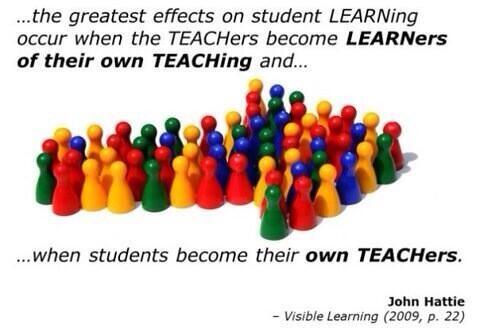
The major findings - distilling from millions of studies on what works.

The major findings – distilling from millions of studies on what works.

better by adopting a Right place at Right time mindset. When every day in school is a day of meaningful discovery and when every day we create sustainable structures that allow for differentiated, individualized, and ultimately to personalized learning, we will be living this concept of helping ALL students be in the right place at the right time.

Think about your own life’s experiences, when have you felt you were in the right place at the right time?

When have you described someone’s “luck” or “good fortune” as saying “X” was in the right place at the right time?

Let’s challenge one another to make every day one in which ALL students are in the right place at the right time!

ENGAGE, INSPIRE, EMPOWER

ENGAGE, INSPIRE, EMPOWER