PlayLabAI in Grade 6: A Journey into Generative AI Learning
By Dr. Mike Lubelfeld
There’s something magical about watching sixth graders light up when they realize that artificial intelligence isn’t some distant, incomprehensible technology—it’s something they can understand, critique, and eventually build themselves. Over the past month at Northwood Middle School, my colleagues and I have had the privilege of facilitating exactly that kind of awakening through our PlayLabAI program, a ten-part exploratory curriculum designed to demystify generative AI for our youngest learners.
The Why Behind the Program
Let me be straight with you: AI isn’t going away. It’s already woven into the fabric of how our students learn, create, and explore their world. Rather than pretend we can shield them from it, we made a different choice. We decided to invite them into the conversation. We want our students to understand how AI works, recognize its limitations, and learn to use it responsibly and thoughtfully. That’s the heart of PlayLabAI.
The program is structured around a deceptively simple end goal: by May, each student will have designed and built their own functional AI chatbot. But getting there? That’s where the real learning happens.
Session One: The Big Picture
We kicked things off on March 12th with what I like to call “AI Archaeology”—digging into where this technology actually came from. Too many students (and honestly, too many adults) think ChatGPT invented artificial intelligence. Not even close.
Our opening activity was a timeline relay game in which students physically organized AI milestones across six decades. They discovered that the term “artificial intelligence” was coined way back in 1956 at Dartmouth College. ELIZA, the first chatbot, arrived in 1966—before most of their parents were born. Deep Blue beat Garry Kasparov at chess in 1997. The Roomba hit shelves in 2002. And then, suddenly, in 2022, ChatGPT exploded into the public consciousness.
T hat last point matters. AI didn’t suddenly become powerful overnight. What changed was access. We called this concept an “arrival technology”—something that became suddenly and widely available to the public without any gradual adoption period or meaningful public input. One day, AI was something scientists worked on behind closed laboratory doors. The next day, your average teenager could use it to help with homework.
We also dove into some thorny ethical territory right from the start. I had the students grapple with a real-world example: OpenAI’s decision to partner with the Department of Defense versus Anthropic’s decision to walk away from a similar deal over concerns that AI could be used for surveillance or weapons systems. These aren’t abstract philosophical questions—they’re the kinds of decisions that shape how AI gets developed and deployed in the real world. And our sixth graders were ready to think critically about them.
Sessions Two Through Four: Becoming AI Analysts
If session one was about history and ethics, sessions two through four were about getting our hands dirty—metaphorically speaking—and understanding how chatbots actually work.
Here’s what I’ve learned: students grasp complex concepts fastest when you flip the traditional teacher-knows-all dynamic on its head. So we had them become “AI Analysts.”
In session two, we introduced three Playlab chatbots: Future You (which predicts what you’ll be like at eighty), Lyric Lab Jam (which generates song lyrics), and Lame Joke Creator (which does exactly what it sounds like). The students interacted with these tools and then analyzed what happened. Dean noticed that the “Future You” bot became obsessed with tacos because he’d once mentioned liking them—the AI had essentially overestimated the weight of that single data point. Caleb tried generating lyrics about rocks and got nonsensical output that he perfectly described as “a hard read.” These weren’t failures of the lesson plan; they were exactly the point.
 One of the most powerful moments came when we asked a fundamental question: Does AI understand, or does it predict? The answer fundamentally changed how students thought about everything that followed.
The truth is this: AI doesn’t understand anything. It’s a prediction machine. Behind the scenes, an AI model converts language into mathematical units called tokens and calculates the probability of what comes next. When you ask ChatGPT to complete “The sky is…,” there’s about a 98% chance it will predict “blue.” But there’s a small chance—based on its training data—that it might predict “falling” (from Cloudy with a Chance of Meatballs) or “delicious.” The AI isn’t reasoning. It’s doing math.
To really drive this home, we had students play the “Human Chatbot” game. One student was designated as the chatbot and given a small, predetermined list of words—their “training data.” The other student asked questions, and the chatbot had to answer using only those words. The results were hilariously nonsensical. Students asked what tacos are, and their “AI” answered “a happy sandwich.” When asked to name an animal, it confidently said “pizza.”
After the laughter died down, the real learning kicked in. Students realized that the nonsense they’d generated was a direct result of limited training data. And here’s the kicker: real AI does the exact same thing. It will confidently give you an incorrect answer because it has no real understanding of right and wrong. It only knows what its training data taught it. And if that training data is incomplete, biased, or simply wrong? Well, the AI will happily perpetuate those errors with absolute confidence.
This led to what might be the most important takeaway of the entire program: the human is the verifier. AI will always provide an answer. It’s the student’s job—the user’s job—to critically evaluate that output and determine whether it’s actually true.
Session Four: Breaking the Bot (On Purpose)
By session four, we decided to give our budding AI analysts a new mission: intentionally break the chatbots. And boy, did they succeed.
We gave students creative freedom to confuse the AI however they saw fit. They tried conflicting instructions, information overload, repetitive inputs, nonsensical language, and unusual questions. What happened was remarkable.
Some students managed to completely overwhelm the AI, causing it to display “Load failed” messages. One discovered that spamming the number “9” repeatedly would cause the chatbot to reject the input entirely.

Another tried prompting the bot in Greek, a language it wasn’t trained on, and got nowhere. A student had a particularly funny interaction where she repeatedly told her bot it was a tree. Eventually, it gave up: “I give up, you bamboozled me.”
But here’s what really fascinated me: the students also discovered the guardrails—the safety features deliberately programmed into these systems. When a student called a bot a “booby head,” it got ghosted. When another student threatened to shut down the bot’s servers, the conversation terminated. These weren’t bugs or glitches. They were features designed to prevent AI from generating harmful content.
One student typed random characters and got back: “It looks like a cat’s on your keyboard.” The AI had been trained to recognize that specific pattern. This sparked a beautiful discussion about intentional design choices embedded in AI systems.
The Bigger Picture: Bias, Ethics, and Real Consequences
Woven throughout all four sessions was a thread that I think is non-negotiable in modern education: understanding the ethical implications of AI.
We talked about what I call “bias in, bias out.” One facilitator shared a video where an AI image generator was given the prompt “little girl flying a kite on the beach.” Guess what it generated, over and over? A white, blonde-haired girl. Never mind that data shows kites are most popular in the Middle East and Asia. The AI’s training data didn’t reflect that diversity, so it couldn’t produce it.
We also discussed the real-world consequences of copyright infringement in AI training. Anthropic—the company behind Claude—was sued for using authors’ copyrighted books in its training data without permission, resulting in a billion-dollar settlement. These aren’t abstract legal squabbles. They’re about whose voices, whose work, whose perspectives get included (or excluded) from the AI systems that are increasingly shaping how information flows through our world.
What Comes Next
We’re pausing now for spring break and state testing, but we’ll be back mid-April to continue this journey. Due to the success and engagement we’ve seen, we’ve added two or three additional sessions to the original ten-part series.
The next phase will build on everything our students have learned about how AI works—the prediction engines, the limitations, the biases, the ethical dimensions—and move toward the creative application: designing and building their own chatbots. They’ll learn prompt engineering, the art and science of asking AI the right questions in the right way. They’ll design chatbots that serve real purposes within our school community. And they’ll do all of it with their eyes wide open about both the possibilities and the pitfalls.
Final Thoughts
What’s struck me most over these first four sessions is how ready sixth graders are to think critically about technology. They ask harder questions than many adults I know. They spot the logical inconsistencies. They understand, on a deep level, that just because something sounds smart doesn’t mean it’s true.
That’s exactly the kind of thinking we need in a world where AI is becoming ubiquitous. Not blind acceptance. Not fearful rejection. But thoughtful, informed, nuanced engagement.
PlayLabAI isn’t just teaching our students about artificial intelligence. It’s teaching them how to think like educators, ethicists, engineers, and citizens in an AI-driven world. And that, frankly, might be the most important skill we can offer right now.
Dr. Mike Lubelfeld is Superintendent of Schools at North Shore School District 112 and author of “The Unfinished Teacher” (2024) and “Leading for Tomorrow’s Schools Today (2026). This PlayLabAI program is being piloted at Northwood Middle School with Monika Patel from PlayLab AI and classroom teacher Jon Mall.
Note on AI Usage – I recorded our live lesson sessions with my Apple Watch using Genspark – Genspark then made “AI Meeting Notes” – from the Notes I made a Google Doc – from the Google Doc, I made edits and prompted Genspark to reformat the notes for a BlogPost – for accessiblility, I prompted Genspark to simplify the text and make a content summary as well.


 authors provide a roadmap for fostering growth, embracing innovation, and driving meaningful transformation in schools. The book emphasizes the importance of change and growth planning, highlighting proven approaches to cultivating a positive school culture, empowering teachers, and enhancing student outcomes. With a focus on both the challenges and opportunities that lie ahead,
  New Book Alert!!






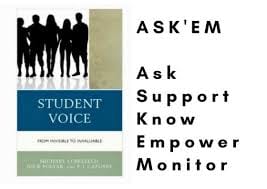 the conclusion of our book and highlights the special end of chapter feature we created: ASK’EM. It’s an acronym for what we suggest throughout the book about how leaders can incorporate student voice … just “ask’em”. The letters represent Ask, Support, Know, Empower, & Monitor, and throughout the book we share examples, suggestions, calls to action, etc. that leaders (and readers) can implement to incorporate student voice in their schools, organizations, communities, and settings! At the end of our book we have a special offer from human capital management firm










/polyak-1.jpg "polyak digital consortium fall 17") The purpose of the AASA Digital Consortium is to support school district administrators as they scale successful models in support of engaging, effective learning experiences using digital media in order to be the leading national voice for digital innovation in our nation’s public schools.
The purpose of the AASA Digital Consortium is to support school district administrators as they scale successful models in support of engaging, effective learning experiences using digital media in order to be the leading national voice for digital innovation in our nation’s public schools./lubelfeld-1.jpg "lubelfeld digital consortium fall17")