Culture of “Nice” vs Culture of “Honesty” #suptchat

“Make the most of yourself, for that is all there is for you”
– Ralph Waldo Emerson

In terms of organizational culture, many (Drucker & others) are clear that culture “eats strategy for breakfast”. Meaning – focus on culture or you’ll have nothing on which to focus! Culture is not just important – it’s everything! I write about culture a lot, folks a lot smarter than I (Fullan, Marzano, and others) write and research a lot about culture too! So … if we know how important it is to create it, measure it, build it and sustain it (in education especially) … why are we so “nice” instead of “honest” in the context of leading and managing change?
So this year in the Deerfield Public Schools District 109, two more of our six schools earned the highest education award in our nation – the National Blue Ribbon Award. They join two other of our six schools who earned this distinction last year.

In two years four out of our six schools earned the highest honors. Leadership, Culture, Focus, Excellence, and Joy define the experiences for children and adults at these schools. What are the leaders doing with respect to culture at these schools that it making the difference?

Are these leaders confronting brutal questions? Are these leaders acknowledging when good is good and when good is not enough? Are these leaders honestly and respectfully addressing that which needs to be addressed even when it ruffles feathers? “You bet they are!”

In education many of us have been faced with “niceness” and an aversion to “critical review” for whatever reason – we don’t know why – “that’s the way we have always done it” (TWADDI). In conversations, training workshops, conversations, discussions etc. with school leaders, I have discovered many report that the toughest part of supervision/evaluation/coaching is giving honest, direct feedback. 

Often the “culture of nice” supersedes the “culture of honest”. With this post I’m hoping to highlight how the culture of honest impacts the organization in measureable and powerful ways. The culture of honest is pervasive in the Deerfield Public Schools!

If you’re reading this blog and you are wondering why your particular organization is not changing or is not making progress – perhaps you should check your culture and communication.

Is everything in our district’s culture perfect? – NO – of course not; but we as a matter of leadership assess, measure, and lead with respect to culture and dimensions of culture every year. Our school principals are held accountable for their school’s culture. We expect increases in dimensions especially when action plans are centered around growth, acknowledgement and honesty. This year 93.81% of all employees report that they are highly engaged and highly satisfied with their work in our district!
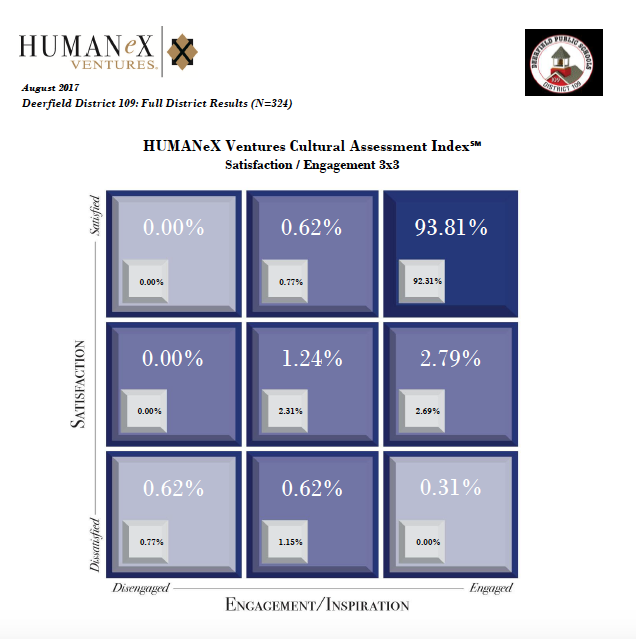
2017 Organizational Culture Results – DPS109


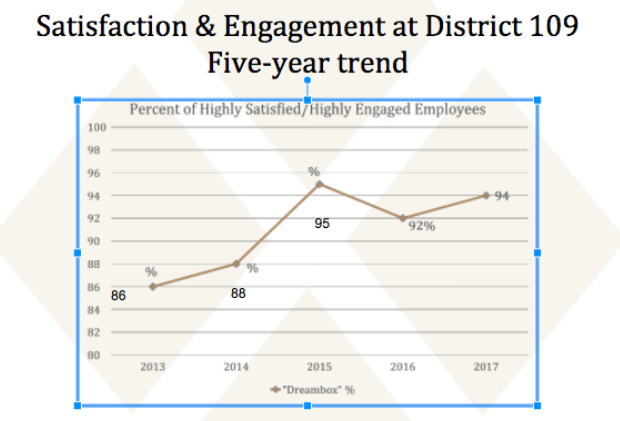
In In 2013 the average “dream box” (top right) score was 61.90% from a database of more than 10,000 education employees in the USA. Our district’s “dream box” score in 2013 was 85.75%. See below for a look at the past five years’ worth of dream box organizational culture for the Deerfield Public Schools:


In our district we are far from perfect – highly successful but never satisfied!

We are on a journey toward excellence with a focus on continuous improvement. Over the past two years we have had a failure in the execution of middle school standards based learning. There are a number of reasons for this. One of the reasons was the “culture of nice” superseding the culture of honesty; and our deliberate decisions to “compromise” in the spirit of cooperation (compromise with the best of intentions – but it was really appeasement).

Students of history remember what happened when Neville Chamberlain appeased Adolph Hitler … well – appeasement doesn’t work so well in leadership

honesty and courage work. Granted I’m oversimplifying a really complex and life and death time in history with the day to day leadership of a school system … you get the point.

Strong, direct, honest, dignified, respectful conversations and coaching are required – are imperative – are expected – are to become the norm when success is desired. With honest, direct, clear communication people know what the shared vision is – what the direction is and to what they’ll be held accountable. The three goals shown above reflect the current strategic goals in our district; clear, concise, coherent.

Five years ago the principals in our district began a process of becoming honest and clear culture leaders. They started to address student growth, teacher performance, stretch goals, limitless opportunities for ALL as well as innovative, future focused leadership. As a result, we have four of our six schools honored with the nation’s highest educational honor, we have administrators with regional honors, and we have shared the DPS109 story around the USA. Is it easy to lead in a culture of honesty? No – but I don’t go to work for an easy time … I go to work for a meaningful, impactful time!


I would love to hear your thoughts about culture – “nice vs honest” and leadership overall! If your leaders are too focused on management and not on leadership – excellence will be out of reach! Those who can manage and lead with courage, power, honesty, and in line with the shared vision – those leaders will be successful!
Our Leadership Journey in DPS109 – #engage109

“Things turn out best for the people who make the best of the way things turn out.”
– John Wooden

ENGAGE, INSPIRE, EMPOWER

ENGAGE, INSPIRE, EMPOWER

For the past three years we have moved from the past to the present in support of the future! Guided by our Big 5, the Board, leadership team, teachers, staff, parents, community, and students have worked collaboratively to create engaging, inspiring, and empowering learning opportunities! The short slide show below depicts in graphics, images, and text a look at our last three years and a look into the next 100 years!

In May we’ll report our State of the District to the Board of Education and Community, we’ll also post here on the blog! Comments are always welcome.

Supporting instruction aligned with the Common Core and 1:1

“Leadership is the capacity to translate vision into reality.”
– Warren G. Bennis

This year we prepare for many changes. This year we prepare for the best year ever! This year we are asking our teachers to do A LOT – new curriculum maps, new instructional practices, transformation with the 1:1 learning environment initiative, new middle school exploratories, implementation of STEM/Communication Media Arts, new science programming … to name a few!

This is another in a series of how we are supporting teachers this year in the anticipation of transformative public education in DPS109!

These tools are being shared in no particular order – the point/aim/goal is to share, celebrate, communicate, and publicize the many leaders and the many tools that will enable others to act – challenge the process, inspire a shared vision – and support improved teaching and learning! While company information and logos are shared it is not our intention to use this as “advertising” – we are simply sharing with whom we are partnering to support our mission. The name(s) of the people leading these services is/are provided – feel free to contact them with any questions or comments about the tools.

Many of these web based subscriptions will allow for 24/7 – school/home access! The possibilities are endless for our learning as we truly become a COMMUNITY of learners.

(Scott Schwartz) Star Walk Kids Media:

At StarWalk KidsMedia we are committed to serving a community of educators who are trying to instill their students with 21st Century digital literacy skills. In order to achieve this, we have created a library designed to support educators who are looking for high quality, well-written trade books, particularly nonfiction books, to support Common Core (CCSS) Reading and Writing strategies. The StarWalk Kids collection is tightly curated for excellence, showcasing the work of award-winning authors and illustrators that educators know and trust. Familiar and respected names in the StarWalk Kids catalog include not only Seymour Simon, but also David Adler, Doug Cushman, Diane deGroat, Johanna Hurwitz, Kathleen Krull, Newbery Honor author Kathryn Lasky, Stan Mack, Caldecott-winner Emily Arnold McCully, Doreen Rappaport, Hudson Talbott, New York Times Best Illustrated Book Award winner Laura Vaccaro Seeger, and more. The collection is approximately 60% nonfiction, and covers Pre-K through 8th Grade.
Each eBook in the collection has been expertly adapted and professionally narrated in preparation for digital streaming via the best-in-class, proprietary StarWalk Reader™, and all titles are accompanied by a “Teaching Links” document developed by nationally known literacy expert and StarWalk Kids Director of Education Linda Hoyt. The Teaching Links match each eBook to relevant CCSS standards, and provide suggestions for CCSS-appropriate teaching activities and further inquiry.

(Eileen Brett and Tracy Hoyt) CoreStand:

What is CoreStand?

CoreStand is a teacher-driven professional ecosystem that’s devoted to
collaboration around best practice and career readiness. Created by teachers (in Evanston) for teachers, CoreStand’s mission is to equip and empower educators to actively shape how standards movements like the Common Core are implemented in classrooms across the country.

What are some of the resources and tools now available to you?

Virtual Learning Communities (VLCs). These are teacher-led groups devoted to collaboration and professional dialogue, and now you have the ability to create your own and invite others to join. As easy to use as email, you can start discussions, post documents, embed videos and photos…all with the click of a button. VLCs streamline and extend face-to-face collaboration around anything: vertical alignment, school wide initiatives, best practice strategies, etc. To see a short video on how they work, click here:

http://www.corestand.com/video-tutorials/virtual-learning-communities-vlc-tutorial/

Evidence and Evaluation “Vaults”. You can also use VLCs as a way to gather evidence as part of your evaluation cycle. Doing so provides an easy, streamlined way to organize and archive work, annotate lessons, and save successes for the future.

Reference Guide Library. We’ve unpacked the CCSS into over 5,000 student-friendly “I can…” learning targets for E/LA, math, and literacy in social science/history and science/technology, grades K-12. Once logged in, click on “Reference Guides” in the beige strap at the top to access these digital and print-friendly resources:

http://www.corestand.com/what-are-the-core-standards/reference-guides/

Unlimited Downloads. Visit our “Lessons & More” page and use either our yellow search field or our “Browse By Category” tool to find CCSS-aligned lessons, units and activities uploaded by our School Share Network members. For example, here’s a link to a popular line of argumentation modules produced by the CoreStand team:

http://www.corestand.com/lessons-and-more/products/?s=con-text

The tools mentioned above are embedded within a robust ecosystem of resources. Because of this, you’ll have access to the resources and tools we offer our free members, too: our blogs, best practice videos, our Standards By Grade posters, and our CoreWeekly newsletter (it contains literacy templates tied to current event articles…sign up for it on the Lessons & More page).

Should you have any questions, please don’t hesitate to contact us at team@corestand.com

(Anthony McConnell) School City:

Schoolcity is an assessment system and learning management system that will allow us access to nearly 100,000 common core aligned assessment items. This system can be used to create everything from quick formative assessments to large scale district benchmarks. Assessments can be administered online and students will have access to a variety of resources such as LearnZillion and Kahn Academy. Student data can be viewed by performance on assessments or by specific standard over any time frame. This system is designed for assessment for instruction and will be a key resource for us as we move to standards based learning and reporting.

http://www.schoolcity.com/

inquiry.

You be the Judge – Do Illinois’ current measures make sense?

Last year Illinois “raised the bar” and as the following data shows, pretty much all schools that used to be honored as being “excellent” are no longer “excellent” … this is as a result of the numbers change – arbitrary number change. While we are all for accountability and we are all for high standards – we are not for arbitrary or capricious changes that turn successful schools into failures.

Here in DPS109 we have HIGH EXPECTATIONS FOR ALL LEARNERS. We support the 4 R’s: Relevance, Rigor, Relationships, and Results. We have accountability measures in place. We chart student growth, we want to create learning environments where all children are intellectually engaged and meaningfully and creatively motivated to learn and grow. I am proud of the 23 schools statewide that earned this mark of excellence and I celebrate their great work and performance!

I also scratch my head wondering how 431 schools went from excellent to not excellent – I know we all have work to do – public educators, private educators, all educators. At the same time, though, I’m not sure that the math in the Illinois shift from 2012 to 2013 makes any sense. In any event, I encourage you to read the results, visit the site linked, click on the graphs in this post – and YOU BE THE JUDGE.

I feel that the “results” shown here, and linked via: show a flawed measurement decision by the Illinois State Board of Education. I find it hard to accept that 454 schools were “excellent” in 2012 and then by some set of actions 431 of those same schools became “not excellent” the next year. This is curious.

I’m writing to share the information in an effort to see what others think about this oddity in terms of STATE measurement of school excellence. (NOTE – PLEASE CLICK ON THE GRAPH/PICTURES TO OPEN UP IN A LARGER WINDOW FOR VIEWING)

“2013 Academic Excellence Awards
Academic Excellence Awards recognize 23 schools that have sustained very high academic performance over at least three years. Some of these schools receive national recognition, placing them among the nation’s most outstanding.

In elementary and middle schools, at least 90 percent of the students met or exceeded state standards in both reading and mathematics for at least three consecutive years. In high schools, at least 85 percent of the students met or exceeded standards on the Prairie State Achievement Exam in 2011-2012 and 92.5 percent in 2013. All Academic Excellence schools achieved Adequate Yearly Progress (AYP) for years 2011-2013.

At a number of high schools that received Excellence Awards in prior years, 85 percent or more of all students continue to meet or exceed standards on the Prairie State, but these schools did not meet the criteria for AYP due to rising standards and higher cut scores on state tests.

Achieving and maintaining excellence is not easy in any school. The critical strategies for success cited in Billman, Mission Possible also operate in the schools winning the Excellence Award.

FACTS ABOUT 2013 ACADEMIC EXCELLENCE AWARDS

AEA_total_by_year03-13

AEA_types_schools13

Academic Excellence High Schools

Number indicates total times the award was received.
Jones College Prep, Chicago (10) Northside College Prep, Chicago (10)
Payton College Prep, Chicago (9) Young Magnet, Chicago (9)

Test Scores – Moving More Students into the Exceeds Range

Four elementary schools showed increases in scores over last year even though they started at a baseline above 90 percent of students meeting or exceeding standards.

Half Day School, Lincolnshire
Iles Elementary, Springfield
Lincoln Elementary, River Forest
Edison Elementary Regional Gifted Center, Chicago
Ten elementary schools showed decreases in test scores, but stayed above the 92.5 percent mark.

Low-Income Enrollment (“Low-income” is designated by eligibility for free or reduced lunch.)

The 11 Academic Excellence schools in Chicago enroll 13 percent to 46 percent low-income students.
Of the 23 Academic Excellence schools, 11 (or 48 percent) enroll fewer than 15 percent low-income students.

Geographic Distribution of 23 Academic Excellence Awards
AEA_geographic13

School Size

Young Magnet High School in Chicago is the largest Academic Excellence school with 2,116 students. The five high schools earning an Academic Excellence award enroll between 842 and 2,116 students.
Elementary enrollments range from 192 students in Poe Elementary Classical School in Chicago to 814 students in Skinner Elementary School, both in Chicago.
Four of the 23 (or 17 percent) elementary schools enroll 400 or more students.”