For emphasis I am sharing a few use cases for Generative AI in this blog post
All content is actually my own and content from speakers (with their consent) via AI tools (glasses, iPad, phone, & other).
I took my “bespoke” notes – that were enhanced, reviewed, proofread and modified by various Gen AI tools and finally, with a prompt to Gemini, Using Canvas and 2.5Pro – see the prompt (unedited)
Is this a good blog post for my post? I’m Mike lubelfeld from mikelubelfeld.edublogs.org, Today, we are at GooglePlex in Mountain View, California. We are greeted by a Google For Education quote that reads, “Elevate education with simple, flexible, and secure tools.” The entire atmosphere is positive, composed, future-oriented, and innovative. I have visited GooglePlex before, and each experience has been as exceptional or more so than the previous one. From the imaginative furniture, billiards, micro and macro kitchens, G-Bikes, and the rich history to the electrifying energy of each learning session, the visit to Google is truly inspiring.
Then Gemini gave insights and feedback and a few suggestions for improvements – I then prompted Gemini to make the suggested edits … here is the Human inspired, Gen AI improved, blog post!
Okay, Mike, here is a revised version of your blog post draft incorporating the suggestions. I’ve focused on improving flow, clarifying the use of AI tools, adding structure with headings (using markdown), and slightly refining phrasing for conciseness and clarity.
Reflections from GooglePlex: AI, Innovation, and the Future of Education
(By Mike Lubelfeld, mikelubelfeld.edublogs.org)
Greetings from GooglePlex in Mountain View, California! Stepping onto the campus, we were immediately met with a powerful Google For Education quote: “Elevate education with simple, flexible, and secure tools.”This set the tone for an experience steeped in a positive, future-oriented, and innovative atmosphere. Having visited GooglePlex before, each visit seems to surpass the last – from the imaginative furniture and G-Bikes to the palpable energy in every learning session, it’s truly inspiring.
Our District’s Journey with Google Tools
Our school district has been leveraging Google’s tools for some time now, starting when Gemini was still known as “Bard.” As a Google For Education Advanced Workspace district, we actively employ a suite of tools including Gemini, Google’s NotebookLM, Vids, Veo, Deep Research, AI Studio, and more. Google is clearly concentrating heavily on generative AI, and the rapid advancements and daily improvements across their tool suite are remarkable.
This post, much like previous reflections, aims to share personal insights, journal entries, and “experience sharing” about the lessons learned and their broader implications.
Session 1: AI in Practice & What it Means for Education
Our day kicked off with an engaging session titled “AI in Practice & What it Means for Education.” We started with a light-hearted LLM exercise involving “sniglets.”
A sniglet is a word that isn’t in the dictionary but perhaps should be – often humorous and describing something nameless. We used Gemini (Gemini.Google.Com) with a prompt asking it to act as a superintendent and compose two humorous, education-related sniglets. (Sharing these creative outputs was a fun icebreaker!)
From there, we dove into the evolution of generative AI, tracing the path from traditional programming to neural networks and today’s large language models. A key moment highlighted was Google’s introduction of the Transformer (the “T” in GPT) back in 2017. Now, in 2024, we’re firmly in the era of multi-modality – integrating text, images, video, and audio. It was fascinating to hear how technology, like Osmo equipping computers with a sense of smell, is attempting to replicate human senses to better support us.
AI Adoption: Students vs. Teachers
We discussed the current landscape of AI adoption. A 2024 Digital Education Council report indicated that 86% of students are using AI tools. However, this usage contrasts sharply with teacher adoption rates. According to Education Week in October 2024, only 36% of teachers nationwide reported using AI tools. This gap highlights a critical area for professional development and support.
We also watched and discussed the impressive video “Airhead Made by Shy Kids,” created using OpenAI’s Sora video generation model, prompting thoughts on creative potential and ethical considerations.
Google’s Approach: AI Principles and Tools
Google emphasized its core AI principles: pursuing bold innovation while ensuring responsible development and deployment, fostering collaborative progress, and maintaining a sense of togetherness.
We explored SynthID, Google’s tool for watermarking AI-generated content, a crucial aspect of responsible deployment. The discussion centered on AI as a tool – like a hammer or calculator – and how we can create conditions where it effectively enhances learning and solves problems of practice, rather than simply being a novelty.
This led naturally to the importance of metacognition: understanding how we know what we know. In an age where knowledge is ubiquitous, developing the critical skills to discern, interpret, and effectively learn how to learn is paramount for our students.
Deep Dive: Harnessing NotebookLM
One tool we’ve explored extensively over the past few months is NotebookLM.Google.com. Building on insights from a previous post, we explored innovative ways to leverage this powerful resource.
As a practical demonstration, I used one of my own blog posts as a “source” within NotebookLM:
- Source URL:
https://mikelubelfeld.edublogs.org/2025/04/28/learnings-from-the-unfinished-unlearning-leader-112leads/
Using this source, NotebookLM helped generate an audio podcast summarizing the key takeaways.
- Listen to the NotebookLM-generated podcast: “The Deep Dive” Summary
Beyond NotebookLM, we also touched upon Deep Research and Gemini Canvas, which offer promising approaches for initiating research, coding, and fostering collaborative learning.
Peeking into the Future: Project Astra and AI Glasses
Looking ahead, Project Astra, a Google initiative exploring the future of AI assistants, was captivating. The potential integration with hardware like Google Glass, combined with multi-modality, hints at a revolutionary shift in human-computer interaction.
Real-World AI Application: Transcribing and Summarizing with Multiple Tools
Here’s a practical example of integrating AI tools during the event:
- Capture: I wore my Even Realities AI Smart Glasses during a session (with the presenter’s consent). I used the glasses’ Transcribe feature, which displayed the text on the lens in real-time and saved the full transcript via Bluetooth to an app on my phone.
- Initial Summary (Gemini): I copied the raw transcript from the Even Realities app and pasted it into Gemini (using the 2.5 Pro Experimental version) with a prompt to “summarize.”
- Refined Summary (ChatGPT): I then took Gemini’s summary and input it into OpenAI’s ChatGPT 4o-mini, prompting it to “make a concise summary of this summary of a meeting transcript suitable for inclusion in a blog post.”
Below is the AI-assisted, multi-step generated summary:
The discussion explores how generative AI is reshaping the workforce, drawing comparisons to past technological advancements such as the automobile and the personal computer, which disrupted certain jobs but also created new opportunities. Key points include:
- AI and Jobs: AI may automate up to 30% of work hours, but like previous technologies, it is expected to create more jobs by shifting the types of roles available, particularly in areas requiring human skills.
- Future-Ready Skills: Essential skills for future success include critical thinking, communication, creativity, adaptability, and social-emotional intelligence, referred to as “durable skills.” These are vital for navigating AI-driven changes.
- Teaching Future Skills: Educators emphasize methods like project-based learning (PBL) and self-assessment to foster durable skills. Real-world PBL examples include adaptive technology creation and community collaboration projects.
- Google’s Educational Initiatives:
- Grow with Google: Offers career certificates and AI courses.
- Be Internet Awesome: Teaches digital citizenship and AI literacy to younger students.
- AI Quests: A gamified program helping middle schoolers build AI models for social good.
- Partnership Ideas: Suggestions for Google included integrating digital citizenship in Google Classroom, addressing tech access gaps, and offering simulations for practicing durable skills.
This summary underscores the importance of adapting education to future workforce needs, where AI and human-centered skills intersect.
The Future of Education: Policy and Learning Science
Policy is evolving rapidly. As of our meeting (late April 2025), 26 US states have formal AI policies for education, while 24 do not. Google shared insights on creating impactful AI tutors, grounding their work in 5 Learning Science Principles:
- Inspire Active Learning
- Manage Cognitive Load
- Deepen Metacognition
- Stimulate Curiosity
- Adapt to Learner
Evaluating AI tools against these principles provides a meaningful framework, especially from an education perspective focused on privacy, data security, and responsible use.
We also got a glimpse of Project Mariner, an experimental “agentic” workflow automation tool designed to assist after research is completed. Imagine this workflow: a student submits a quiz, AI provides rubric-based feedback, an email goes to the parent, and an action plan is co-created with the student. This isn’t science fiction; it’s becoming reality.
Developing Skills: Google for Education Programs
Google highlighted resources available for educators and students:
- General Resources: Edu.google.com
- Professional Development: Training & Certifications
- Digital Citizenship (Grades 2-6): Be Internet Awesome
- Leadership Development: AASA & Google ELP Partnership (Ed Leadership Program)
Session 2: Fostering a Culture of Innovation
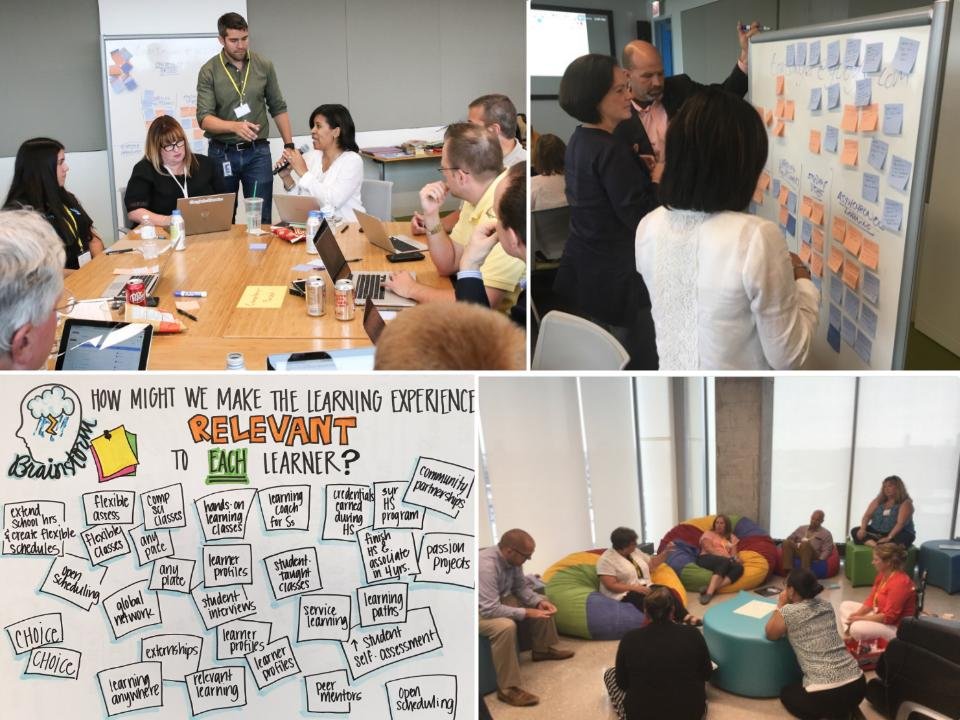
Konner Brewer, Google Product Manager and Stanford Lecturer, led a fantastic session on Google’s culture of innovation. A key takeaway was Project Aristotle, Google’s internal research which found that psychological safety is the single most important factor for high-performing, innovative teams.
Google’s values underpin this:
- Respect the User: Understand their deep needs.
- Respect the Opportunity: Act responsibly with resources.
- Respect Each Other: Foster psychological safety.
The session drew heavily from the Stanford “d.school” design thinking elements:
- Need finding: Empathize (understand the verb – e.g., “I need to hydrate“) and Define (avoid locking into a solution too early – e.g., “I need a glass of water”).
- Leveraging: Ideate based on existing strengths and resources.
- Failing Fast: Prototype and Test small, learn quickly, and iterate.
Another AI Application: Audio Transcription and Summarization
For another insightful session, I used a different AI workflow:
- Capture: Recorded the audio using the Apple iOS Voice Memo app.
- Transcription: Used the Apple Intelligence feature within the Notes app to transcribe the audio recording.
- Initial Summary (Apple Intelligence): Used Apple Intelligence within Notes to summarize the lengthy transcript.
- Refined Summary (Gemini): Finding the Apple summary less concise than desired, I pasted the full transcript into Gemini 2.5 Pro Experimental for a more condensed summary.
Here is the Gemini-generated summary of the 50-minute session on innovation:
- Psychological Safety is Key for Innovation: Google’s Project Aristotle found psychological safety (feeling safe to take risks/be vulnerable) is the most critical factor for effective teams, more vital than individual high performers. Innovation needs a blameless culture focused on learning from failures.
- Google’s Innovation Principles: Respect the user (understand deep needs, like the Oreo story example), respect the opportunity (act responsibly), and respect each other (foster psychological safety/diverse voices).
- Embrace Failure & Quantity: Innovation has a high failure rate (~95%). Google learned from failures (Loon, Glass). Generating many ideas (quantity yields quality) via methods like 20% time (Gmail’s origin), incubators, and external ventures is crucial.
- Design Thinking Framework:
- Need Finding: Start with the user need (verb), not a pre-defined solution (noun). Understand real challenges (student engagement, change resistance).
- Leveraging: Utilize existing resources/skills (like Hermès moving from saddles to bags via leather skills).
- Failing Fast: Test ideas quickly/small scale, learn, iterate (Google’s “dogfooding”).
- Real-World School Examples (Glen, NJ Superintendent):
- Mr. Rogers Project: Paired students needing experience with businesses needing social media help.
- Swim Lessons/Lifeguarding: Identified unmet needs and built programs incrementally.
- Farmer’s Market: Leveraged school space/student interest for entrepreneurial opportunities (“Pirate Pickles”).
- Overall Message: Successful innovation in education requires deep need understanding, safe experimentation environments, leveraging resources, learning from failure, starting small, and community connection.
Wrapping Up: GooglePlex Tour and Reflective Thoughts
The day also included a walking tour of the GooglePlex global headquarters – always a highlight! The serene grounds, history, outdoor art, and intentional building design (even a dinosaur!) offer much to absorb.
This was an action-packed, high-energy, heavy-thinking day with a ton to unpack and process! I’m energized to bring back numerous ideas, affirmations, and opportunities for growth to our organization. A huge thank you to AASA and Google for this incredible experience.
Next up on the journey: our visit to Stanford… stay tuned for more!
Thanks for reading! What are your key takeaways or questions about AI and innovation in education right now? Share your thoughts in the comments below!