Now What – So What – Inspiration & Learning

Define Superintendent (education) – to Chat GPT – 4o – Gen AI …

Here’s an inspirational version of the definition for your blog post intro:

A superintendent is more than an administrator—they are a visionary leader, a champion for children, and the steward of a community’s hopes for its future. In public education, the superintendent guides a school district’s mission, ensuring that every child has access to opportunity, every educator has support to thrive, and every decision reflects a commitment to equity, excellence, and growth. At their best, superintendents inspire transformation, shaping not only schools but the lives they touch.

So, as I resume my “normal” routine as a superintendent after an exceptional professional learning experience, I offer tremendous thanks to Nick Polyak, Scott RoweMatt Montgomery, and the entire AASA Staff! The AASA Innovation for Transformation Consortium Spring Event was outstanding.

Human Centered Artificial IntelligenceI’m grateful to Google, Stanford, JASON Learning, and Magma Math for support.

I’m grateful to so many for the tremendous insights, inspiration, ideas, innovations, empowerment, and more.

My two earlier blog posts highlight and detail learning and experiential opportunities. Gen AI usage as superintendent – Reflections from Google – AASA ITC Learnings from the Unfinished & Unlearning Leader #112Leads

So What – Now What – After learning, After studying, After reflecting, After sharing – now what? and … So What? Those are critical questions I consider each time I learn, study, do, act, and attend or lead a conference. In this blog post, I’ll reflect on our power-packed visit to Stanford as well as a few of my own “now what/so what” ideas!

On our final day, we visited Stanford University – WOW! Beautiful, Iconic, Serene, Cool, Fun, Nice, Impressive, Innovative, Inventive, Creative, Forward Thinking, Cutting Edge … I could go on …

Stanford U - Grad School of Education

We enjoyed fabulous lectures and presentations by Isabelle Hau, the Executive Director of Stanford’s Accelerator for Learning, whom we also met on our first day, the Dean, Dean Dan Schwartz of the Graduate School of Education at  Stanford and some other really inspiring folks at Stanford who are making a difference each and every day!

We explored concepts like,

What do people need to learn, and how should people go about this? We pondered …AI and Automation – we were reminded of an old but very important study that implicates “automation” and our industrious approach as a nation over decades to learn more and do better … we pondered the Iconic Stanford1897 “Curve of Improvement” where people studied productivity in terms of the number of letters people could send per minute… morphing into the number of weeks of practice…

This 19th-century example resonates with our 21st-century Gen AI “automation” craze in which we are living right now. Discussions of the The curve of improvement – “Power Law of Learning” -80/20 rule – when you first learn, you learn really quickly … all of this relates to our leadership development and teaching PK-12/20.

This is what AI does – automate… so many cool and provocative concepts for our thinking, reflecting, and ultimately for our “So What Now What moments – so much TIMELY and RELEVANT insights from the dean and Infospherethe faculty! We ideated and thought about how we are using AI for Learning – Automation and Efficiency – kids taking speeded tests – no mistakes … scrounging – end of with personalized automated tutors – ONE Trajectory… so many ideas and thoughts … the lectures were great, the preparation was meaningful and we felt highly valued and cared for on our learning visits!

Sometimes, as an educator, teacher, researcher, student, superintendent, human, after we visit a really cool and impactful set of places, like on this AASA consortium visit, it takes a while to reflect and “unpack” all of the learning. I’m the kind of person who likes to get his thoughts out in writing (like via blog posts) in an effort to synthesize and integrate new learning with existing learning. My aim is to learn and grow as a person with a growth mindset, and to also learn and grow so I can best support the adults who support the adults who support the students in our organization.

So my “now what so what” is multi-phased. Now what? I read, I reflect, I write, I think of ways to share this learning with colleagues, leadership team members, the Board of Education, teachers, students, and the community. I reach out to others and reflect together on potential joint projects. I do something with what I learned so that the value proposition is to “pay it forward”.

For example, at Stanford, we learned how to build an educational/teaching “bot,” and it was “hands-on,” and it was inspiring. With guidance from Josh Weiss Director of Technology and Innovation, Stanford Accelerator for Learning, and Reuben Thiessen, Emerging Technology Lead at Stanford Accelerator for Learning, we gained really cool exposure to a sophisticated, yet elegantly simple “bot” to build for learning support. This was so powerfully impactful for me that we followed up after the visit. Members of my team and I will be attending a follow-up training session. Part of my own learning includes reviewing my notes, the audio files, the transcripts, the slides and resources the partners shared, and more!

As an example of applied learning, the “building a bot” experience allows us to consider engagement and  creation via “Bloom’s Taxonomy” – the original taxonomy of the cognitive domain that every teacher learns in college – “knowledge, comprehension, application – then analysis, synthesis & evaluation”. The “updated” taxonomy is similar, “remembering, understanding, applying, analyzing, creating, evaluating”.  With respect to “what can Gen AI tools do” – as an example – well – they can do a lot … tutor, advisor, teacher assistant, thought partner, etc. One of the coolest parts of the building a bot from the Stanford expert thinkers is that it allows the creator to contemplate various roles at the outset to “guide/train/help” the AI do it’s “job”.  Creating the persona, users, tone,  learning theories, process, limitations & adjectives is all at the “front end” of the design – Gen AI is not just a “fancy search tool” – on the contrary -with the proper thinking and input it can be so much more.

So now we move into the Age of Creation … we pondered some motivators like what people do for hobbies (when they “CAN”) vs “work” when they “HAVE” to do something. Motivational goals are essentially set forth so that “we” do something to get rewarded – an example was that some people take “terrible” flights, just to get more “points” and so on! Beyond that, we also got to think and see in a robotics environment – we got to see, learn about, and touch OceanOne  Thanks for all the inspiration … we have so much to learn, do and consider.

Our School District’s motto is Inspire, Innovate & Engage – the experiences this past week fully illustrated the essence, spirit, and illustration of our motto!

Ocean One

Gen AI usage as superintendent – Reflections from Google – AASA ITC

For emphasis I am sharing a few use cases for Generative AI in this blog post

All content is actually my own and content from speakers (with their consent) via AI tools (glasses, iPad, phone, & other).

I took my “bespoke” notes – that were enhanced, reviewed, proofread and modified by various Gen AI tools and finally, with a prompt to Gemini, Using Canvas and 2.5Pro – see the prompt (unedited)

Is this a good blog post for my post? I’m Mike lubelfeld from mikelubelfeld.edublogs.org, Today, we are at GooglePlex in Mountain View, California. We are greeted by a Google For Education quote that reads, “Elevate education with simple, flexible, and secure tools.” The entire atmosphere is positive, composed, future-oriented, and innovative. I have visited GooglePlex before, and each experience has been as exceptional or more so than the previous one. From the imaginative furniture, billiards, micro and macro kitchens, G-Bikes, and the rich history to the electrifying energy of each learning session, the visit to Google is truly inspiring.

Then Gemini gave insights and feedback and a few suggestions for improvements – I then prompted Gemini to make the suggested edits … here is the Human inspired, Gen AI improved, blog post!

Okay, Mike, here is a revised version of your blog post draft incorporating the suggestions. I’ve focused on improving flow, clarifying the use of AI tools, adding structure with headings (using markdown), and slightly refining phrasing for conciseness and clarity.


Reflections from GooglePlex: AI, Innovation, and the Future of Education

(By Mike Lubelfeld, mikelubelfeld.edublogs.org)

Greetings from GooglePlex in Mountain View, California! Stepping onto the campus, we were immediately met with a powerful Google For Education quote: “Elevate education with simple, flexible, and secure tools.”This set the tone for an experience steeped in a positive, future-oriented, and innovative atmosphere. Having visited GooglePlex before, each visit seems to surpass the last – from the imaginative furniture and G-Bikes to the palpable energy in every learning session, it’s truly inspiring.

Our District’s Journey with Google Tools

Our school district has been leveraging Google’s tools for some time now, starting when Gemini was still known as “Bard.” As a Google For Education Advanced Workspace district, we actively employ a suite of tools including Gemini, Google’s NotebookLM, Vids, Veo, Deep Research, AI Studio, and more. Google is clearly concentrating heavily on generative AI, and the rapid advancements and daily improvements across their tool suite are remarkable.

This post, much like previous reflections, aims to share personal insights, journal entries, and “experience sharing” about the lessons learned and their broader implications.

Session 1: AI in Practice & What it Means for Education

Our day kicked off with an engaging session titled “AI in Practice & What it Means for Education.” We started with a light-hearted LLM exercise involving “sniglets.”

A sniglet is a word that isn’t in the dictionary but perhaps should be – often humorous and describing something nameless. We used Gemini (Gemini.Google.Com) with a prompt asking it to act as a superintendent and compose two humorous, education-related sniglets. (Sharing these creative outputs was a fun icebreaker!)

From there, we dove into the evolution of generative AI, tracing the path from traditional programming to neural networks and today’s large language models. A key moment highlighted was Google’s introduction of the Transformer (the “T” in GPT) back in 2017. Now, in 2024, we’re firmly in the era of multi-modality – integrating text, images, video, and audio. It was fascinating to hear how technology, like Osmo equipping computers with a sense of smell, is attempting to replicate human senses to better support us.

AI Adoption: Students vs. Teachers

We discussed the current landscape of AI adoption. A 2024 Digital Education Council report indicated that 86% of students are using AI tools. However, this usage contrasts sharply with teacher adoption rates. According to Education Week in October 2024, only 36% of teachers nationwide reported using AI tools. This gap highlights a critical area for professional development and support.

We also watched and discussed the impressive video “Airhead Made by Shy Kids,” created using OpenAI’s Sora video generation model, prompting thoughts on creative potential and ethical considerations.

Google’s Approach: AI Principles and Tools

Google emphasized its core AI principles: pursuing bold innovation while ensuring responsible development and deployment, fostering collaborative progress, and maintaining a sense of togetherness.

We explored SynthID, Google’s tool for watermarking AI-generated content, a crucial aspect of responsible deployment. The discussion centered on AI as a tool – like a hammer or calculator – and how we can create conditions where it effectively enhances learning and solves problems of practice, rather than simply being a novelty.

This led naturally to the importance of metacognition: understanding how we know what we know. In an age where knowledge is ubiquitous, developing the critical skills to discern, interpret, and effectively learn how to learn is paramount for our students.

Deep Dive: Harnessing NotebookLM

One tool we’ve explored extensively over the past few months is NotebookLM.Google.com. Building on insights from a previous post, we explored innovative ways to leverage this powerful resource.

As a practical demonstration, I used one of my own blog posts as a “source” within NotebookLM:

  • Source URL: https://mikelubelfeld.edublogs.org/2025/04/28/learnings-from-the-unfinished-unlearning-leader-112leads/

Using this source, NotebookLM helped generate an audio podcast summarizing the key takeaways.

Beyond NotebookLM, we also touched upon Deep Research and Gemini Canvas, which offer promising approaches for initiating research, coding, and fostering collaborative learning.

Peeking into the Future: Project Astra and AI Glasses

Looking ahead, Project Astra, a Google initiative exploring the future of AI assistants, was captivating. The potential integration with hardware like Google Glass, combined with multi-modality, hints at a revolutionary shift in human-computer interaction.

Real-World AI Application: Transcribing and Summarizing with Multiple Tools

Here’s a practical example of integrating AI tools during the event:

  1. Capture: I wore my Even Realities AI Smart Glasses during a session (with the presenter’s consent). I used the glasses’ Transcribe feature, which displayed the text on the lens in real-time and saved the full transcript via Bluetooth to an app on my phone.
  2. Initial Summary (Gemini): I copied the raw transcript from the Even Realities app and pasted it into Gemini (using the 2.5 Pro Experimental version) with a prompt to “summarize.”
  3. Refined Summary (ChatGPT): I then took Gemini’s summary and input it into OpenAI’s ChatGPT 4o-mini, prompting it to “make a concise summary of this summary of a meeting transcript suitable for inclusion in a blog post.”

Below is the AI-assisted, multi-step generated summary:

The discussion explores how generative AI is reshaping the workforce, drawing comparisons to past technological advancements such as the automobile and the personal computer, which disrupted certain jobs but also created new opportunities. Key points include:

  • AI and Jobs: AI may automate up to 30% of work hours, but like previous technologies, it is expected to create more jobs by shifting the types of roles available, particularly in areas requiring human skills.
  • Future-Ready Skills: Essential skills for future success include critical thinking, communication, creativity, adaptability, and social-emotional intelligence, referred to as “durable skills.” These are vital for navigating AI-driven changes.
  • Teaching Future Skills: Educators emphasize methods like project-based learning (PBL) and self-assessment to foster durable skills. Real-world PBL examples include adaptive technology creation and community collaboration projects.
  • Google’s Educational Initiatives:
    • Grow with Google: Offers career certificates and AI courses.
    • Be Internet Awesome: Teaches digital citizenship and AI literacy to younger students.
    • AI Quests: A gamified program helping middle schoolers build AI models for social good.
  • Partnership Ideas: Suggestions for Google included integrating digital citizenship in Google Classroom, addressing tech access gaps, and offering simulations for practicing durable skills.

This summary underscores the importance of adapting education to future workforce needs, where AI and human-centered skills intersect.

The Future of Education: Policy and Learning Science

Policy is evolving rapidly. As of our meeting (late April 2025), 26 US states have formal AI policies for education, while 24 do not. Google shared insights on creating impactful AI tutors, grounding their work in 5 Learning Science Principles:

  1. Inspire Active Learning
  2. Manage Cognitive Load
  3. Deepen Metacognition
  4. Stimulate Curiosity
  5. Adapt to Learner

Evaluating AI tools against these principles provides a meaningful framework, especially from an education perspective focused on privacy, data security, and responsible use.

We also got a glimpse of Project Mariner, an experimental “agentic” workflow automation tool designed to assist after research is completed. Imagine this workflow: a student submits a quiz, AI provides rubric-based feedback, an email goes to the parent, and an action plan is co-created with the student. This isn’t science fiction; it’s becoming reality.

Developing Skills: Google for Education Programs

Google highlighted resources available for educators and students:

  • General Resources: Edu.google.com
  • Professional Development: Training & Certifications
  • Digital Citizenship (Grades 2-6): Be Internet Awesome
  • Leadership Development: AASA & Google ELP Partnership (Ed Leadership Program)

Session 2: Fostering a Culture of Innovation

Konner Brewer, Google Product Manager and Stanford Lecturer, led a fantastic session on Google’s culture of innovation. A key takeaway was Project Aristotle, Google’s internal research which found that psychological safety is the single most important factor for high-performing, innovative teams.

Google’s values underpin this:

  • Respect the User: Understand their deep needs.
  • Respect the Opportunity: Act responsibly with resources.
  • Respect Each Other: Foster psychological safety.

The session drew heavily from the Stanford “d.school” design thinking elements:

  1. Need finding: Empathize (understand the verb – e.g., “I need to hydrate“) and Define (avoid locking into a solution too early – e.g., “I need a glass of water”).
  2. Leveraging: Ideate based on existing strengths and resources.
  3. Failing Fast: Prototype and Test small, learn quickly, and iterate.

Another AI Application: Audio Transcription and Summarization

For another insightful session, I used a different AI workflow:

  1. Capture: Recorded the audio using the Apple iOS Voice Memo app.
  2. Transcription: Used the Apple Intelligence feature within the Notes app to transcribe the audio recording.
  3. Initial Summary (Apple Intelligence): Used Apple Intelligence within Notes to summarize the lengthy transcript.
  4. Refined Summary (Gemini): Finding the Apple summary less concise than desired, I pasted the full transcript into Gemini 2.5 Pro Experimental for a more condensed summary.

Here is the Gemini-generated summary of the 50-minute session on innovation:

  • Psychological Safety is Key for Innovation: Google’s Project Aristotle found psychological safety (feeling safe to take risks/be vulnerable) is the most critical factor for effective teams, more vital than individual high performers. Innovation needs a blameless culture focused on learning from failures.
  • Google’s Innovation Principles: Respect the user (understand deep needs, like the Oreo story example), respect the opportunity (act responsibly), and respect each other (foster psychological safety/diverse voices).
  • Embrace Failure & Quantity: Innovation has a high failure rate (~95%). Google learned from failures (Loon, Glass). Generating many ideas (quantity yields quality) via methods like 20% time (Gmail’s origin), incubators, and external ventures is crucial.
  • Design Thinking Framework:
    • Need Finding: Start with the user need (verb), not a pre-defined solution (noun). Understand real challenges (student engagement, change resistance).
    • Leveraging: Utilize existing resources/skills (like Hermès moving from saddles to bags via leather skills).
    • Failing Fast: Test ideas quickly/small scale, learn, iterate (Google’s “dogfooding”).
  • Real-World School Examples (Glen, NJ Superintendent):
    • Mr. Rogers Project: Paired students needing experience with businesses needing social media help.
    • Swim Lessons/Lifeguarding: Identified unmet needs and built programs incrementally.
    • Farmer’s Market: Leveraged school space/student interest for entrepreneurial opportunities (“Pirate Pickles”).
  • Overall Message: Successful innovation in education requires deep need understanding, safe experimentation environments, leveraging resources, learning from failure, starting small, and community connection.

Wrapping Up: GooglePlex Tour and Reflective Thoughts

The day also included a walking tour of the GooglePlex global headquarters – always a highlight! The serene grounds, history, outdoor art, and intentional building design (even a dinosaur!) offer much to absorb.

This was an action-packed, high-energy, heavy-thinking day with a ton to unpack and process! I’m energized to bring back numerous ideas, affirmations, and opportunities for growth to our organization. A huge thank you to AASA and Google for this incredible experience.

Next up on the journey: our visit to Stanford… stay tuned for more!

Thanks for reading! What are your key takeaways or questions about AI and innovation in education right now? Share your thoughts in the comments below!


Learnings from the Unfinished & Unlearning Leader #112Leads

I’m sometimes thought of as the UNLearning Superintendent, based on my and Nick Polyak’s 2017 book, The Unlearning Leader: Leading for Tomorrow’s Schools Today … but this week I’m writing as the “Learning Leader” as a superintendent on a professional development conference with our national leadership group, the AASA!

The AASA Innovation and Transformation Consortium spring 2025 convening is being held in San Francisco/Bay Area California, featuring Google and Stanford.

The Superintendent’s Association (AASA) has been supporting superintendent leadership growth and development for over a century and a half. As a full-time public school superintendent for the past 15 years, I have benefited from numerous visionary leadership offerings.

This convening appears to be one of the best ever, with thoughtful planning and anticipation of the current needs of leaders across the nation.

Educators and school leaders from various states, including Illinois, West Virginia, Texas, Washington, Pennsylvania, Ohio, Wisconsin, California, New Hampshire, District of Columbia, Virginia, New Jersey, Maryland, and New York, will bring diverse and unique perspectives and approaches.

One of the key questions we will explore, discuss, analyze, and “work through” is how schools should effectively plan, implement, and evaluate innovation to achieve meaningful change. Additionally, the event will cover various topic areas, including AI in Education, Research and Innovation, Policy, Best Practices, and more.

I’m thrilled about the opportunity to learn at Google and Stanford! In this blog post, I’ll share some exciting highlights and insights.

One notable development nationally is the recent Executive Order issued by the President to promote AI literacy in schools. I was curious about how this initiative would be implemented, so I took the text of the Executive Order and used Google’s Notebook LM AI tool to generate a frequently asked questions document. I’ve included the document below.

Frequently Asked Questions on Promoting AI Literacy (generated by artificial intelligence from the actual text of the Order)

Q1: What is the primary goal of this initiative regarding artificial intelligence (AI) education?

The central aim of this initiative is to promote AI literacy and proficiency among Americans of all ages. To achieve this, the initiative aims to integrate AI education into K-12 schooling, provide comprehensive training for educators, and foster early exposure to AI concepts and technologies. Ultimately, the goal is to develop an AI-ready workforce and cultivate the next generation of American AI innovators, ensuring the United States maintains its global leadership in AI.

Q2: How will this initiative integrate AI into the education system, particularly at the K-12 level?

The initiative seeks to integrate AI into K-12 education through several strategies. These include establishing public-private partnerships to develop online resources focused on foundational AI literacy and critical thinking skills for students. Additionally, the initiative will identify existing federal AI resources to support partnerships with state and local educational agencies. Furthermore, the Secretary of Education will issue guidance on using grant funds to improve educational outcomes through AI-based instructional resources, tutoring, and college/career pathway exploration.

Q3: What specific measures will be taken to equip educators to teach and utilize AI?

To enhance AI training for educators, several steps will be taken. The Secretary of Education will prioritize the use of AI in teacher training grant programs, focusing on areas such as reducing administrative tasks, improving teacher training and evaluation, providing professional development to integrate AI fundamentals across subjects, and offering training in foundational computer science and AI. Additionally, the National Science Foundation and the Department of Agriculture will prioritize research and programs to create teacher training opportunities for effectively integrating AI tools and modalities in classrooms.

To foster student achievement and innovation in AI, a Presidential Artificial Intelligence Challenge will be established. This challenge will feature multiple age categories, distinct geographic regions, and diverse topical themes to encourage broad participation and interdisciplinary exploration of AI applications. The challenge aims to highlight student and educator accomplishments in AI and promote collaboration between government, academia, philanthropy, and industry.

Partnerships are crucial for the success of this initiative. Public-private partnerships with AI industry organizations, academic institutions, and non-profit entities will be sought to develop K-12 AI education resources. Collaboration between educators, industry leaders, and employers is also emphasized to create educational programs that equip students with essential AI skills. Furthermore, the initiative encourages collaboration between federal agencies and private sector entities to support the Presidential AI Challenge.

In the context of AI, the initiative will address workforce development and lifelong learning.

The initiative recognizes the significance of workforce development and lifelong learning. The Secretary of Labor will prioritize the development and growth of AI-related Registered Apprenticeships to increase their participation. Funding will be utilized to engage industry and facilitate the creation of these programs. States and grantees will be encouraged to use Workforce Innovation and Opportunity Act (WIOA) funds to develop AI skills and support work-based learning. Efforts will also be made to identify and promote high-quality AI skills education coursework and certifications nationwide, including opportunities for high school students.

The newly established White House Task Force on Artificial Intelligence Education will be responsible for implementing the policy of promoting AI literacy and proficiency. It will coordinate federal efforts related to AI education, including establishing plans for and overseeing the Presidential AI Challenge, fostering public-private partnerships, and identifying existing federal AI resources to support educational initiatives. The Task Force will be chaired by the Director of the Office of Science and Technology Policy and will include representatives from various federal departments and agencies.

This initiative aims to maintain the United States’ leadership in the AI field by focusing on early and comprehensive AI education. It seeks to equip American youth and the broader workforce with the necessary skills and understanding to use and create future AI technologies. By fostering AI competency, sparking curiosity and creativity, and nurturing the next generation of AI innovators, the initiative aims to propel the nation to new heights of scientific and economic achievement. This will ensure that the United States remains a global leader in the rapidly evolving field of artificial intelligence.

So, with my own professional learning journey as a superintendent, my open mind, and my eagerness to learn, this new directive from the federal government, and a local follow-up to a survey in the fall on Gen AI usage and needs in the district, everything is coming together serendipitously!

The ITC convening from the AASA offers a variety of thought-provoking sessions, workshops, opportunities, and anticipated takeaways.

At the first set of workshops, the theme was “Inspire, Innovate, Transform: Leading the Charge in Educational Excellence.” Over 100 of us gathered to learn, lead, and grow!

Our first speaker was a student at Stanford University! She’s a freshman in college at Stanford, but when she was in high school, she was a student school board member at Leyden High School in Franklin Park, Illinois. Our keynote address was “Innovation Through the Student Lens: From PreK-12 to College and Beyond,” delivered by Joyslyn Maldonado. Thank you to Joyslyn for her powerful and impactful presentation! She shared her experiences as a student board member.

Who do we work for? Students.

Why do we make policy? Student learning.

Why do we learn innovative practices? For students.

Why are we gathered here in Silicon Valley? For students.

It was truly impactful for us to begin our learning journey together with a student from Stanford. Consider incorporating student voice into your board’s decision-making process. Explore various ways to involve students in leadership roles. In our 2018 book, titled “Student Voice: From Invisible to Invaluable,” Nick Polyak, PJ Caposey, and I provide insights into how school leaders can effectively incorporate student voice into their leadership strategies. Joyselyn’s keynote speech exemplifies the real-life impact of student voice and empowerment.

She also discussed the use of AI at Stanford. Each syllabus now includes a notice about AI usage, emphasizing its role as a tool to enhance learning outcomes. AI is encouraged as a supportive resource, a suite of tools, and even a “TA” (teacher assistant) for teaching coursework and curriculum. Tools like Notability are used to summarize and create quizzes.

Following her remarks, we engaged in a question-and-answer session about the use of AI, being a student on a school board, and the overall experience of being a recent K-12 student and a current college student in today’s world. Her speech served as a powerful reminder of the purpose of our learning and the importance of continuous improvement as educational leaders.

Dr. Dave Schuler, the Executive Director of the American Association of School Administrators (AASA), also shared the Public Education Promise, which outlines five key tenets:

1. Student-Centered Education: Learning that prioritizes the needs and interests of students.

2. Learning: Emphasizing the development of real-world skills and knowledge.

3. Teaching: Ensuring that teachers provide effective instruction and support students in their learning journey.

4. Attracting and Retaining Top Educators: Seeking and retaining highly qualified and motivated educators.

5. Family and Community Connections: Fostering strong relationships between schools, families, and communities to support student success.

Isabelle Hau, the Executive Director of Stanford’s Accelerator for Learning, delivered a talk titled “Welcome to the Learning Valley” after our student keynote speaker.

Silicon has been given a new name. Valley = LearningValley

We envision a world where research-driven innovations lead to transformative change, making effective and joyful learning a vibrant reality for all.

Google, founded at Stanford University, continues its legacy of research in education. Our convening is related to Stanford and the Valley becoming the new epicenter for the future of learning. Stanford boasts 122 Unicorn Founders, with contracts, compared to MIT’s 87.

Stanford’s pioneering work in Artificial Intelligence in the 1950s has been a cornerstone of its research. When ChatGPT was launched in November 2022, none of us could have anticipated the profound impact it would have within the next three years. Remarkably, 35% of all queries on ChatGPT are related to homework. However, it’s important to note that the Large Language Model (LLM) was not specifically designed for educational purposes. Despite this, ChatGPT and other large LLMs are increasingly being utilized in and for educational settings.

Let’s bridge the gap between the need for tutoring, its effective use, and the support provided to tutors. The Stanford University Human-Centered Artificial Intelligence Institute (HAI) is partnering with the Accelerator to develop a special tutor support “bot” informed by tutoring videos, effective practices, research, data, and support for tutors. Existing research indicates that novice tutors can have a significant impact on the students they tutor, and the AI will assist the tutor in delivering effective tutoring sessions. AI Literacy, Tutoring, and Feedback will be key focus areas during our in-person visit to Stanford. At Stanford, AI is not meant to replace educators but rather to empower and augment them.

Other notable projects include:

– Journify (student-led): “Every IEP goal is a journey… wow!”

– Autism Glass Project: Provides emotional regulation support and information.

– Teacher training with ISTE and the Generative AI Education Hub.

– Dr. Hau’s concept of “Educator Centric and Education Centered AI.”

– Cross-sector collaboration: Learning through creation with the GEN AI Seed Grant and AI Tinkery (using AI for creativity).

Magma Math:

From innovation to impact: How to transform math classrooms into thinking classrooms.

In D112, we use Magma Math at the middle school level!

– EdTech Space/AI/Learning/Support/Partnership: Move towards conceptual understanding!


Stay tuned as I reflect, journal, blog and share my learning and unlearning! Next post will feature Google and Stanford experiences!

Welcome Back to School – 2024 – #112Leads

Back to School 2024

Highland Park – Highwood, Illinois (North of Chicago)

Each year we get a “do over” in public education! We get students each year ready to learn, ready to grow, ready to learn citizenship skills, ready to make friends, ready to belong. Reading, writing & arithmetic, the arts, the sciences, civics, geography, physical health and wellness, critical thinking skills – and more – in education we create conditions that provide the possibility and reality for everything else. Everyone working today as an adult can look back at school experiences.

We have a lot to do in elementary education, PK-8th grade – we have many standards to teach. We have a lot of activities to facilitate. We have a lot of socialization and friendship Raising Consciousness in education, enhance society, celebrate humanity! We are here for a great purpose, many call teaching/education a calling and a profession vs a “job”.

Welcome back to school year 2024-2025

North Shore School District 112, born in 1992 out of a consolidation of three historic districts, proudly serves nearly 4000 students in grades PK-8 in nine campuses on the beautiful shores of Lake Michigan! Predecessor districts started in the 1800s. Education in the community has been ongoing since the emergence of the community. Highland Park was founded in 1869, public schools have been part of the fabric of the community since then (and before). In our 13.2 square miles of geography, we have railroad tracks running through the towns with five Metra railroad stops. Homes on the lake, homes along the tracks, homes east of the highway, and homes west of the highway. All children are welcomed in our public schools! All children are entitled to a sense of belonging and value in D112.

In District 112 we focus on raising consciousness levels and efficacy in teaching and leading. We teach, learn, and implement culturally responsive pedagogy.

What is culturally responsive education? What is culturally responsive pedagogy? What is culturally responsive consciousness. What’s your level? “Culture is the air you breathe” – “it’s who you are” – “it’s the impact of your experiences”. Our culture is not just tied to the color of our skin or our native language (Credit to Dr. Sonya Whitaker). We bring our culturally “baggage” each and every day – raise consciousness – know, learn, understand, and do something.

Students learn best in an environment where they feel safe – connected – seen – heard – valued – cared for – loved! Teachers who connect with their children in appropriate, prosocial relationships can see greater growth and learning – it’s proven in research studies and experience. Students learn from teachers who like them and from whom they like!

Each child learning and growing in every content area, skill area, social area, learning area — that’s what we seek! We measure culture (organization/staff, engagement/students, service quality/families) and we measure impact of teaching on learning (arts, sciences, math, reading, writing, etc.). Our aim is high levels of rigor in each classroom every day. Our aim is for high levels of learning as measured by growth, perception, achievement, and all metrics/measures over time. In our district, we have children in grades PK through 8. We can have an 11 year impact on a child’s life – that’s HUGE – the impact is powerful!!

Culture is to humans as water is to fish! – Dr. Wade Nobles. Who we are matters. Who our students are matters. Who our families are matters. How we inspire, innovate and engage matters.

This year Deputy Superintendent Dr. Monica Schroeder and I started out the New Staff Orientation Welcome with our messages of welcome, care, mission, vision, hope, expectation, and our “why” for our 41 new staff members. We aim to share the “who we are” as chief educational leaders in the organization as well as “why we are proud that the new staff are here with us”.

In this blog post, I’m sharing the slides we used to help tell our story and welcome our newest #112Leads team members!!

Part 1 Is the Part where I address my “why”, the concept of being Unfinished, and the themes of the Unfinished Teacher (images are AI Generated from Dall-E)

My initial messages are grounded in my sense of purpose and “why” – why am I excited after all these years? Why am I still as motivated today as I was in 1993 on my first “first day” as a teacher. Many of the themes I shared come from and our present in the 2024 book I co-wrote, the Unfinished Teacher: Becoming the Next Version of Yourself. The mindset or concept of being unfinished – seeking to become the “next” version of yourself, not your “best” version of yourself – grounds me in all of my work and professional impact.

I have created a custom GPT via Open AI’s Chat GPT called Unfinished Teacher Book Study – anyone can access this via Chat GPT, LINK: https://chatgpt.com/g/g-9bDnz2jRe-unfinished-teacher-book-study-buddy

Using that “GPT “bot”” I said, please provide an executive summary of the Unfinished Teacher for a blog post I am writing – please highlight the main points. Here is what the large language model produced …

### Key Takeaways for Blog Post

– **Continuous Growth**: Emphasize the importance of being an “unfinished” teacher who is always evolving and improving.

– **Personal Well-being**: Highlight the need for self-awareness, emotional health, and financial wellness as foundations for effective teaching.

– **Professional Adaptability**: Stress the importance of adapting to new technologies, evolving curriculum standards, and meeting diverse student needs.

– **Community and Morale**: Discuss the significance of fostering a positive school culture and supporting teacher and staff morale.

– **Inspirational Stories**: Share anecdotes from the teacher vignettes to illustrate real-life applications of the book’s principles.

### Executive Summary: The Unfinished Teacher

**Purpose and Context**

“The Unfinished Teacher: Becoming the Next Version of Yourself” aims to support educators in enhancing their teaching practices and nurturing a culture of continuous learning and development. This book emphasizes the importance of personal and professional growth in the education profession, addressing current challenges such as the politicization of education and the ongoing teacher shortage.

**Section 1: Personal Growth**

This section focuses on individual development, encouraging teachers to reflect on their personal and social-emotional health, financial wellness, and self-awareness.

1. **Being a Great Teammate**

   – Explores teamwork, self-awareness, collaboration, and adaptability.

   – Encourages teachers to be reflective and proactive in their interactions and growth.

2. **Awareness**

   – Highlights the importance of self-awareness and empathy.

   – Discusses the impact of personal experiences on teaching and the need for cultural responsiveness

3. **Personal and Social-Emotional Health**

   – Addresses the causes of burnout and emphasizes the importance of physical and mental health.

   – Introduces the SEEDS framework (Sleep, Exercise, Eat, Drink, Socialize) for maintaining well-being.

4. **Financial Health and Wellness**

   – Provides practical advice on financial planning, stress management, and investing in oneself.

   – Stresses the importance of financial literacy and retirement planning

**Section 2: Professional Growth and Change**

This section covers the professional aspects of teaching, including curriculum development, technology integration, and teacher morale.

5. **Curriculum, Standards, Assessment, and Data**

   – Balances the demands of curriculum standards with creative teaching methods.

   – Emphasizes the importance of using assessments to enhance learning and inform instruction.

6. **Meeting the Needs of Each Child**

   – Focuses on equity and personalized learning.

   – Encourages teachers to address diverse student needs through responsive and inclusive teaching practices.

7. **Technology**

   – Advocates for the use of technology as a tool to enhance learning.

   – Discusses emerging technologies like AI, AR, and gamification, and their potential in education.

8. **Teacher and Staff Morale**

   – Explores the factors impacting teacher morale and the importance of a positive school culture.

   – Provides strategies for improving morale through recognition, collaboration, and supportive leadership.

**Teacher Vignettes**

The book includes personal essays from educators, sharing their journeys and reflecting on the themes of personal and professional growth. These stories provide practical insights and inspiration for teachers at all stages of their careers.

**Conclusion**

The book concludes with a powerful message about the importance of embracing change and remaining “unfinished.” It encourages teachers to continually evolve, adapt, and strive for personal and professional growth, while acknowledging the inherent challenges and rewards of the teaching profession.

Thoughts on Systems Leadership – Each Child Every Day

To be accurate, it’s been a while since last I posted, December 23. It’s been a “full” few months in the district, and I had a bout of “writer’s block,” addressing and dealing with a host of challenges that “are what they are”.  Thankfully with a powerful Board of Education, a Leadership Team that is world class, and about 500 teachers and educational support staff I would work with anywhere and any time, we are leading and learning in District 112 each day!

Periodically I integrate writing about “what a superintendent actually does” to leadership philosophy, to what’s really going on in the District; in this blog post, the spirit has again moved me to write, to share my thoughts, learnings, observations, and calls to action! Thanks for reading the post, as always, comments and questions are welcomed!!

March 2024 — Dr. Michael Fullan is one of my “edu heroes,” I have been learning from him for decades; I have been reading his work and making every effort to apply his findings to my leadership work. Recently, at a professional learning academy, I had the good fortune to re-read Nuance, Fullan’s 2019 book about “Why Some Leaders Succeed, and Others Fail,” I had the good fortune to attend a virtual live webinar session he led! For this blog post, I’m sharing some major takeaways and a call to action for all of us to find the “canary children”” and hear their voices, give them agency, and help change conditions so that they may find success.

From Nuance, on page 109 in chapter 5, Fullan shares an adaptation from Rebecca Wells, 2018 “Canary Child: A Catalyst for Deep Learning.”

“Canaries and students, it turns out, are not too dissimilar in how they show their distress. Canaries ruffle their feathers, hide their heads beneath their wings, and jump to other perches in their cage to try and escape unfavorable conditions. How many students, unable to follow the learning, falling behind, disinterested and disempowered, will also ruffle their feathers and create a scene, or hide away quietly, hoping not to be noticed?”

Perhaps you know about “canaries in the coal mine” — it can be a matter of life and death if a canary shows distress in the coal mine – it’s a sense of urgency for change in a coal mine if a canary shows distress. Why is it not always a call to action or a sense of urgency when our students are like canaries – in distress – calling out for help, illustrating a need for change or different approaches?

As Dr. Fullan passionately claims, Fullan believes this is our clarion call for action – NOW – for the betterment of our schools, communities, society, and even humanity.

So what do we do about this? How do we change? Will everyone jump to action and heed the call for urgency? An airline pilot strives for 100% perfection in terms of safe take-off and landing – they don’t accept a “C” (70%) or a “3” approaching standards … so why, in our “assessment obsessed” industry/profession – do we not actually change so that we can have greater success/competency/literacy/etc.?

The Canary Children essay deeply moved and impacted the academy’s leaders, central office, and principal-level leaders. We are all moved as we dive into and reflect on culture, student-centered equity, systems leadership, instruction, and change.

Often, we educational leaders show great aptitude and success in managing change – think about the pandemic … we managed change and responded to the crises associated with the pandemic. In some areas, we did see leaders who mastered change, whose leadership created conditions for lasting, adaptive change. However, most of our experiences, in general, reflected change management. Fullan highlighted the nuance and differences between change management and managing change.

Dr. Donna Leak, an Illinois superintendent and another presenter at the academy, called upon us to analyze and address the “Intentional Adult Behavior to Ensure Student Success.” Zandra Jo Galván, a California superintendent and another presenter at the academy, shared her district’s three guiding principles: culture, academics, and community. These exemplary leaders use their leadership and guiding principles to find and intervene for their canary children in their district. They are setting leadership conditions that align with Fullan’s global call for leadership and action. As a complement to Fullan’s talk, John Malloy, another amazing superintendent, shared that systems change is not only imperative but also possible. Malloy shares the following regarding what Systemic Commitments Have.

They have the following characteristics:

● Evidence-based

● Driven by data that sets the parameters for any collaborative work

● Coherent and focused, not simply another initiative

● Developed through a collaborative process

● Measurement systems are in place

● A monitoring process is determined

● Communication is ongoing

● Learning and improvement are supported through Effective protocols, practices, and processes.

● All students are served, especially those who need us the most.

So if we know that leaders are taking positive proactive and reactive steps to manage change and master change. Why are there still canary children, and what will you do about it in your school system? In our 2021 book, the Unfinished Leader: A School Leadership Framework for Growth & Development, Polyak, Caposey, and I lay out a six-lens frame to help create the conditions needed for each child every day and for each staff member every day.

We suggest that leading with the frames of equity and empathy, followed by adaptive leadership and the development of others (and yourself) with lenses and frames of communication and change – “don’t fear change, don’t let others hold you back, and don’t let others hold your organization back” define what it means to be unfinished — and this is related to and tied to the messages of Leak, Galván, Malloy and Fullan from this academy – and the messages complement the efforts we as systems leaders can use to find and treat the canaries!

In District 112, Highland Park & Highwood, IL, where I proudly serve as the superintendent of schools, we have canary children, and we won’t rest until we amend our conditions so that their voice and agency is acknowledged and heard and seen and addressed.  I opened this year’s all-staff convocation with a clarion call of my own regarding the annual Student Engagement Survey. Annually, for the past six consecutive years, we administer the student engagement survey to all children in grades 3-8 in English and Spanish. Principals and their school leadership teams are required/expected to meet, review the data, and plan action steps with and for the students to make improvements. Our data is clear, coherent, and, in some ways, sobering. Until we master “satisfaction” and “engagement,” two of the dimensions that are reported in a 3×3 grid, we will know we have work to do. The students clearly communicate with us — we have pockets of extremely high satisfaction and engagement and low pockets. The difference in the results can be mapped back to systems leadership.

Leak, Galván, Malloy, and Fullan clearly illustrate in their workshop sessions that the critical ingredients in systems change and improvement lie in internal systems.

Dr. Malloy shared a compelling “why” for the impressive and impactful leadership in his school district right now — what are the employers of our students seeking? Our mission in public schooling is to prepare children for life, college, and career — do our assessment systems reflect life, college, and career? Should they? Can they?

Malloy shares a list from Linked In 2023 of the most “in demand” skills employers seek for our students — in what ways are your systems aligned with outcomes like these?

The 2023 Most In-Demand Skills

1. Management

2. Communication

3. Customer service

4. Leadership

5. Sales

6. Project management

7. Research

8. Analytical skills

9. Marketing

10. Teamwork

Fullan is a prolific student of leadership and success – his resume is impressive, and his books are real, with case studies illustrating success and meaningful work on behalf of and for humanity. I am moved, even at this late stage of my career, which invigorates me, quite frankly!

Fullan identifies the Six C’s – Global Competencies – In many districts, including mine, we see these in portraits of learners and graduates.

Like Nick Polyak and I write in the Unlearning Leader, Fullan calls for changing the structure of “factory schools” designed and imagined 200 years ago. Many systems are doing this. Galván removed “cemetery rows” of desks and replaced them with collaboration tables. There are many examples of this in the profession. Lead, take the courageous step to create conditions where the  “grammar of schooling,” as Fullan says, can be rewritten.

In general and with a broad brush, the basic system of schooling can be defined loosely by,

Teacher Isolation, Individualism, Passive Students, Batching of students, lack of time, school isolation, system demands (current Systems) Obviously – there are exceptions to this – but the central tendency is as listed above and based upon Fullan’s (and my own) observations and experiences over decades of work in leadership.

So – how to change? One idea, proffered by Dr. Fullan himself, is to look at seven keys on one keychain, as he describes, that are elements of the new culture (that we can create to replace the old “grammar of schooling”. These are belongingness, global competencies, relationships (well-being), pedagogy (learning), world of work, leadership, and AI (artificial intelligence). Dr. Fullan passionately describes changing the primary driver of change from external (state/province) to internal (local system).

So, in closing, I write this blog as the spirit moves me after an inspiring leadership academy where some amazing leaders, in the field and in the know, caused me to think – and will continue to guide my work in creating conditions for each child every day with supports in place for each staff member!

At the core, we should all learn more about “Deep Learning” and the 6cs from our spirit coach, Dr. Michael Fullan!! As a refresher, the 6cs are:

Character & Compassion

Citizenship

Collaboration

Communication

Creativity

Critical Thinking
Please join me on my clarion call to action to heal the canaries in our classrooms!

Part 2 of 4- Reflections on What’s Next after A Nation at Risk – 40 Year Anniversary

As I shared in the first post on this topic, we convened in Los Angeles to remember A Nation at Risk, look at lessons learned, and, more importantly, look forward to the future – What Have We Learned? was the overarching question!
In the last post, I started to identify what Jim Harvey reflected on with respect to some of the controversial issues related to the Report and its construction process. 40 years later … the sad reality/perspective from one of the writers is that the folks in charge of the report had a conclusion ready before the report was even written … they then used the report writing process to find data to fulfill and justify their already determined conclusions. One could even suggest that they “cooked the books”


The social ills that the people who were writing the report tried to get in the report included poverty, racism, and funding inequities — these were raised during the 18-month writing process, and they were ignored. These are still social ills plaguing the nation, including the public schools in all 50 states!  Our speaker argues that the Commission missed the argument. Casting educators as “enemies” of economic progress was preposterous, he argues.

Blaming schools makes NO sense for out-of-

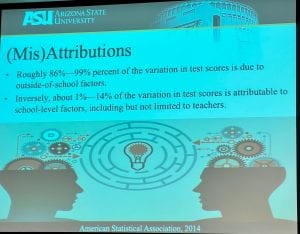
Worthy of review and discussion, especially 40 years past the “reform” movement …school factors. Out-of-school factors have had, continue to have, and will continue to have MASSIVE impacts on student performance. As one of our other experts shared, “roughly 86-99% percent of the variation in test scores is due to outside-of-school factors. Inversely, about 1-14 percent of the variation in test scores is attributable to school-level factors, including but not limited to teachers. Dr. Audrey Amrein-Beardsley is a professor at the Mary Lou Fulton Teachers College at Arizona State University and a renowned expert in assessment, educational reform history, and more!

As a quick aside, I have written about what success looks like on the blog,  see https://mikelubelfeld.edublogs.org/?s=measure+success for a list of earlier written blog posts on this topic. I am a strong advocate for using research-based and evidence-informed practices (like those from Marzano, et., al, Hattie, et., al, etc.) to impact and influence teacher work with students and school measures of success and district guideposts for success. We measure culture, engagement, and satisfaction as well as student growth, student learning/performance, etc.

Harvey went on to remind us that the US is a huge international outlier in terms of us having the highest rates of childhood poverty and the lowest support for poverty programs. All in all, school reform is not simple. It was not in 1983, nor was it in 1957 (Sputnik), 1979 (Florida test), 2001 (NCLB), 2011 (Race to the Top), 2016 (ESSA), or now, 2023! There are wickedly complex problems that Harvey identified – wicked not as in evil, but wicked as in highly complex.  Solutions needed in school “reform efforts” are those that require large groups of competing stakeholders to agree on what you “will” do. A Nation at Risk put education at the forefront of the nation’s attention, which is a good thing. But it created a 40-year obsession with standardized tests, which is not a good thing – in moderation, yes, the testing, in my professional opinion, is beneficial when it drives instructional decisions. I’m not sure that each child needs to take more than 100 standardized tests, though I think we may have gone overboard. The Commission put in place to assess the nation’s schools missed a great opportunity.

What they did is pre-determined that America’s economic woes at the time were due to the failings of its public schools. Today more than 50% of the nation’s public school children live in poverty – we have a poverty problem, I’ll posit, not an educational problem, per se.

In the next posts, I’ll share Christopher Cross’ reflections on the A Nation at Risk time period, report, and implications, share history of school reform notes from Dr. Amrein-Beardsley, and more! What I surmised from all of this, in brief, and as mentioned by Jim Harvey at the conference, the narrative of the failure of America’s public schools is false. The out-of-school challenges are really important, and they impact the nation’s public schools though the schools cannot be solely responsible for childhood poverty, for example. We must get a grip on the test-based obsession and moderate and regulate some of this over-reliance on standardization. Harvey closed his exceptional lecture with a quote from William Butler Yeats:

But I, being poor, have only my dreams; I have spread my dreams under your feet; Tread softly because you tread on my dreams.

William Butler Yeats


Part 1 of 4 – Forty Years Since “A Nation at Risk” – Education Reflections

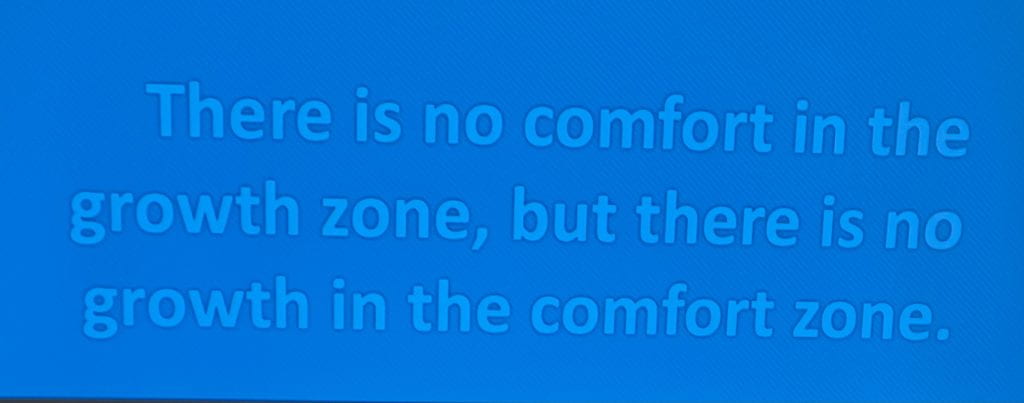
There is no comfort in the growth zone – but there is no growth in the comfort zone – this was a quote shared with us at the start of the National Superintendent Roundtable national convening in the summer 2023 conference in Los Angeles, California.

Nearly 40 of us convened to remember the education “reform” document and call to action called A Nation at Risk, and to contemplate the 40 years since – where we have been, where we are, and most important, where we are going!

With powerful presentations (some excerpted and summarized here in the blog and in subsequent posts) and with a visit to the President Ronald Reagan national presidential library & museum in Simi Valley (shared via images in the blog), the convening was awesome! Great dialogue, great, courageous conversations and questions and recollections, civil discourse with folks who have differing political views, and a whole lot more took place in our compact, concise, and short but powerful conference.

Often, people ask me, “What do I do as a superintendent” Part of the purpose of this blog is for me to illustrate just that. What “do” I do? 🙂 – A LOT … The role is diverse and rewarding, the opportunities to develop leaders are the most powerful and impacting legacy, and the power and honor to share and extend HOPE is a true gift.

In this blog post, I reflect on, share, and describe superintendent professional development. Leadership convening at a high level. History, politics, government, sociology, education, journalism, and more are covered in this experience and blog post.

40 years ago, A Nation at Risk was presented to the nation. It was a flawed report (as I will share), but it did raise PK-12 education to the forefront as a presidential issue – which can be a good thing. It started a four-decade pathway towards educational “reforms” and an obsession with standardized testing that we still grapple with today.

So …. What do I do?

I learn I gather with national and global experts, I engage in dialogue to make my thoughts known and clearer, and when challenged with new ideas, I may change my

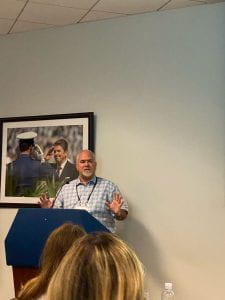
I am facilitating a discussion with one of our presenters

mind! I am a leader and a learner, and a lead learner. My attendance at and participation in professional development is part of what I do as a superintendent of schools. Each day I aim to be better, do better, and lead better for the thousands of students and staff, and community members I have the honor of serving.

40 Years Since a Nation at Risk … What have we learned … I will be sharing thoughts from the many pages of notes I took during our amazing and challenging presentations as well as during our incredible visit and guided tour at the President Ronald Reagan Presidential Library & Museum. As a former social studies and US

Me at the podium! The backdrop is the inauguration – pretty cool!!

History teacher, this was AMAZING. A whole bunch of peak moments were had during this short but powerful trip across the country!

The National Superintendent Roundtable (NSR) is a membership association of superintendents from around the USA. Currently, there are about 91 members nationwide. In partnership with its sister organization, the Schlecty Center, there are about 180 superintendents in total between the two organizations. Both are mission-driven to support leadership and growth.  We are all in favor of and stand by “Strong families, strong communities, with strong schools” as a mantra or “calling card.” We’re here to honor the 40th anniversary of A Nation at Risk and truly digest and dissect – what we have learned and where we are going.

James Jim Harvey – incredible speaker, scholar, writer, one of the authors of A Nation at Risk & Founder of the National Superintendent Roundtable

Our keynote presenter, Jim Harvey, founder of the NSR and one of the writers of A Nation at Risk was outstanding!! Jim reminded us all that public education is one of the major foundations of the United States society. Supporting American ideals and progress is our mission. Jim also reminded us of President Reagan’s inaugural address in 1980, where he stated that essentially, “…government is the problem.”. President Reagan ran on a platform that included eliminating the US Department of Education. His first Secretary was Terrell, Ted, and Bell.

Subsequent blog posts will detail more of the content and “What do we do now?”.

Audio Excerpts of National Presentation – Supt and Principals – Impact on learning in #112Leads

In this episode, learn how an initiative and partnership called DMBreakthrough Teams implemented last year at the District 112 Dual Language elementary schools positively impacted student growth & achievement!

Over spring break, I went to New York with Oak Terrace Principal Lilli Melamed and Wayne Thomas Associate Principal Colleen Goodrich. In addition to learning at the conference, we were invited to present the results from an initiative implemented last year at both dual language schools, DMGroup Breakthrough Teams.

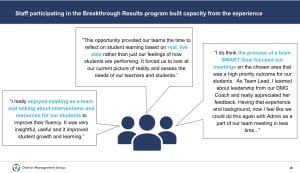
Having the opportunity to share, and specifically, hearing from Lilli and Colleen about the impact of last year’s DMBreakthrough teams 10-week program on multi-lingual learners in grades K-5 at their respective schools is incredible and made me very proud of our work, our students, and the District. Our session was titled “Learn how North Shore School District 112 (IL) supported their multilingual learners and achieved a higher percentage of students meeting their MAP growth goals after the Breakthrough Results experience.”

Our work with DMGroup to implement their Breakthrough Teams programs at our Dual Language schools last year was driven by that commitment to continuous improvement in learning. We are committed to creating conditions for equitable access to educational opportunities for each child every day. We are committed to creating conditions for teacher support and excellence every day. We are on a journey and proud to be focused on results.

En este episodio, aprenda cómo una iniciativa y asociación llamada DMBreakthrough Teams implementada el año pasado en las escuelas primarias de lenguaje dual del Distrito 112 impactó positivamente el crecimiento y el rendimiento de los estudiantes.

Durante las vacaciones de primavera, fui a Nueva York con la directora de Oak Terrace, Lilli Melamed, y la directora asociada de Wayne Thomas, Colleen Goodrich. Además de aprender en la conferencia, fuimos invitados a presentar los resultados de una iniciativa implementada el año pasado en ambas escuelas bilingües, DMGroup Breakthrough Teams.

Tener la oportunidad de compartir, y específicamente, escuchar a Lilli y Colleen sobre el impacto del programa de 10 semanas de los equipos DMBreakthrough del año pasado en estudiantes multilingües en los grados K-5 en sus respectivas escuelas es increíble y me hizo sentir muy orgulloso de nuestro trabajo, nuestros estudiantes y el Distrito. Nuestra sesión se tituló “Aprenda cómo el Distrito Escolar 112 (IL) de North Shore apoyó a sus estudiantes multilingües y logró un mayor porcentaje de estudiantes que cumplieron con sus objetivos de crecimiento MAP después de la experiencia de Breakthrough Results”.

Nuestro trabajo con DMGroup para implementar sus programas Breakthrough Teams en nuestras escuelas de lenguaje dual el año pasado fue impulsado por ese compromiso con la mejora continua en el aprendizaje. Estamos comprometidos a crear condiciones para el acceso equitativo a las oportunidades educativas para cada niño todos los días. Estamos comprometidos a crear condiciones para el apoyo y la excelencia de los maestros todos los días. Estamos en un viaje y orgullosos de estar enfocados en los resultados.

What are DMGroup Breakthrough Teams Results in D112? #112Leads

In the 2021-2022 school year, we chose to implement a robust planning and results-oriented project at both K-5 dual language (Spanish/English) schools in the District, Oak Terrace and Red Oak. Our main work has always been to create conditions that support student growth, learning, and teacher collective efficacy. In this post, I’m sharing some images that show graphically how incredible the student growth, learning, and performance was in this 10 week initiative last year.
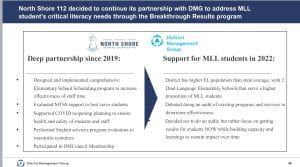
The results focused approach, led by a team from strategic partner DMGroup (from Boston, MA), helps teams of leaders, teachers, and educational support staff refine their sense of urgency and target professional efforts to impact student growth and learning. We worked with DM Group on a number of challenging projects over the past few years (reopening in COVID, Student Services/EL audit, MTSS planning and implementation).

Firstly, in District 112, our motto is Inspire, Innovate, Engage; and we firmly believe each child can learn and grow – every day. We stand firmly for equitable access to educational opportunities for each child every day. We take pride in the excellence of our teachers, administrators, support staff, parents, and Board.

 When we learn how to do better – we do better. When we make a mistake, we own it – explain it – and learn from it (and take efforts not to repeat it). After the devastating impacts of the COVID global pandemic (on society, learning, social connection, etc.) we reached out to experts in strategic leadership to see how we could improve and enhance our impact on learning to help our students emerge successfully.

Student success and district success are measured in multiple ways.  Pleasesee a previous blog post to get a sense of how I measure “success” (culture, engagement, service, assessment, etc.). Search Results for “Measure succes” – Mike Lubelfeld’s Blog

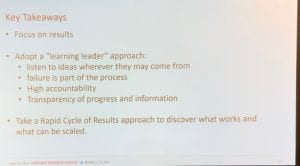
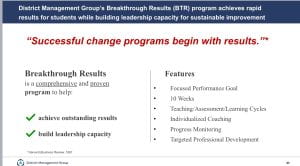
The point of working with the DMGroup on Breakthrough Teams comes from their motto: “Successful Change Programs Begin with Results”. The focus of the initiative is to focus on results – not barriers; not challenges; not the “why nots;” not the “yea buts;” but results.  Let’s make an impact.

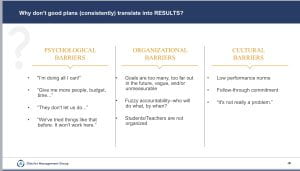
 They acknowledge psychological, organizational and cultural (org. Culture) barriers such as: “I’m doing all I can;” “It’s overwhelming;” “It’s not MY problem;” etc… .  And then share a team of strategic consultants to support the existing organizational structures and  help guide questions to and for student learning/growth and teacher learning/growth to work around, through and over those barriers to ultimately bring them down.

The cool part about working with the DMGroup on Breakthrough teams is that we had the opportunity to take existing structures (teacher team planning/group thinking time) student learning (using assessment tools), instructional coaching (District teacher leaders), administrative collaboration (co-designing and considering solutions) all to help us do our work better.
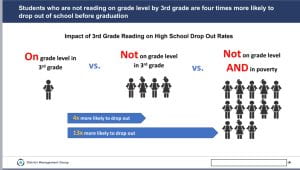
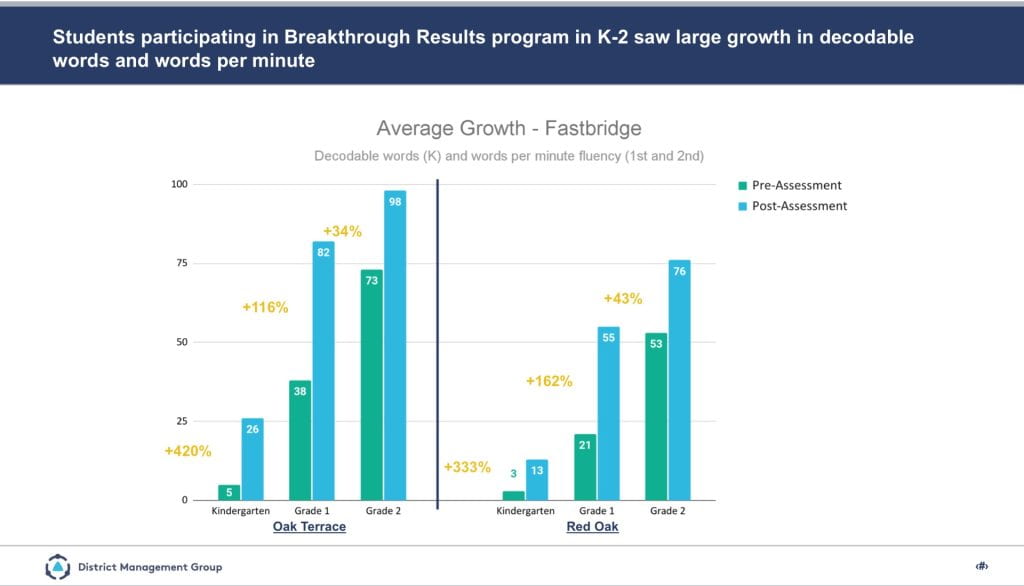
 

The DMGroup Breakthrough Teams program is focused on 10 weeks of intense, targeted, focused planning, ideation, succeeding, failing, learning, and re-ideating. The District, the School and the Teams work together to make the best decisions with the information at hand in real time on behalf of the learning. It’s an amazing professional experience – and, in D112, it yielded groundbreaking results for kids (and teachers) last year at Red Oak and Oak Terrace Schools.

We focused on our dual language schools with multi-lingual students in the District’s historic and long running magnet/choice instructional program. English Learners in the District have traditionally had challenging performance on standardized assessments, and the focus on their learning and needs, first, with this innovative program, proved that every child (regardless of “box to check”) can learn and grow in the proper conditions. We helped our teachers create the proper conditions and focus, and we co-created professional planning space to establish a results orientation.  And the results justify and support this effort.

As mentioned, in this post, I’m sharing some slides that show graphically how incredible the student growth, learning, and performance was in this 10 week initiative last year.

On April 11, at an upcoming school Board meeting, I will share a detailed presentation with two of my colleagues, Lilli Melamed (Principal at Oak Terrace School) and Colleen Goodrich (Associate Principal at Red Oak School last year and Wayne Thomas school this year).

 In June, we’ll share this year’s results from this year’s Breakthrough Teams experience at the five K-5 schools with traditional (English only) education, in grades kindergarten, first grade, and second grade.

Thanks for reading the blog! Check out the podcast, our upcoming board meetings, and general District communications as we share our journey of leadership, experiences, learning, growth, and results oriented focus.

Reflections from National Superintendent Summit – #112Leads

DMGroup Superintendent Strategy Summit

Reflections

March 29-31, 2023

New York City, New York

As a longtime member of a professional organization for superintendents, District Management Council (DMGroup), I am attending a conference—the DMGroup Superintendent Strategy Summit.

This conference focuses on how to leverage best practice strategies in educational leadership and management – we’re in it for students, staff and communities. It is a convening of leadership. I am one of 45 superintendents at this conference. In addition, there are 43 district and building leaders, 25 sector leaders (state chairs, etc.), representing 18 US states in 50 school districts. Conference sessions focus on sharing new insights into student supports, accelerating learning, strength leadership and strategic budgeting. This includes reviewing a Harvard Business School case study focused on the Chilean Mine Crisis to enhance our abilities to impact the communities and schools we serve.

Over the last few years, I have reached out to DMGroup for strategic consulting advice. For example, our ability to remain open during COVID was supported by very clear, direct, strategic, and thoughtful collaborative processes and planning based on DMGroup insights. As you will recall, in September 2020, NSSD112 was able to open with half-day in-person schooling, which proved to be a lifeline and far better for our students and community than being fully remote at that time.

NSSD112 is committed to continuous learning and improvement. This includes regularly reviewing our programs, services and processes to ensure that we are utilizing best practices in teaching and learning, as well as operating efficiently and cost-effectively. Over the past few years, we have conducted audits of our cybersecurity protections, technology service, equity, student services and internal financial controls. We proudly accept the findings from these thorough reviews, “warts and all”, as we lead with purpose, passion, and professionalism.

Our work with DMGroup to implement their Breakthrough Teams programs at our Dual Language schools was driven by that commitment to continuous improvement in learning. We are committed to creating conditions for equitable access to educational opportunity for each child, every day. We are committed so creating conditions for teacher support and excellence every day as well. We are on a journey and we’re proud to be focused on results.

This year, I am proud to have two members of the NSSD112 leadership team joining me to present about the results of our DMGroup Breakthrough Teams Results implementation last year at the District’s two K-5 Dual Language (Spanish/English) schools—Oak Terrace Principal Lilli Melamed and Wayne Thomas Associate Principal, Colleen Goodrich. As you will recall, Ms. Goodrich was the associate principal last year at Red Oak School and, this year, she was named Illinois Assistant Principal of the Year! As a superintendent, one of the greatest job roles is the development and support of other leaders.

Hearing from Lilli and Colleen about the impact of last year’s DMBreakthrough teams 10-week program on multi-lingual learners in grades K-5 at their respective schools is incredible and made me very proud of our work, our students and the District. Their session was titled “Learn how North Shore School District 112 (IL) supported their multilingual learners and achieved a higher percentage of students meeting their MAP growth goals after the Breakthrough Results experience.”

In an upcoming blog post, I’ll share more details about those student achievement results, including data and infographics from our presentation and process details, as well as updates on this year’s DMBreakthrough Team experience in grades K, 1, and 2 in five of our District’s elementary schools.